
A home for the holidays

_A930953
Above: One year after moving to his new home, Gerry Scholtz, Sr., enjoys greeting his neighbors.
From living in abandoned buildings or on the street, tenants of A Tiny Home for Good are grateful for a place to call home
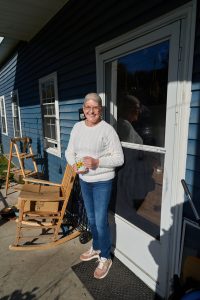
Once homeless, Jeanette Kilmartin stands on the front porch of her Syracuse home, where she has lived for eight years.
Surviving and thriving
“I went from having everything to having nothing.” Jeanette Kilmartin had a good job, owned a home, drove nice cars, and went on wonderful vacations. But two motorcycle accidents left her desperately in need of pain medication. When her prescription meds ran out, she turned to buying drugs on the street. “When that became too expensive, somebody turned me on to heroin,” she said. “I never thought I would stick a needle in my arm.” But within months, Kilmartin was manipulating her family members to get money for drugs. “It was really bad,” she said. “It was shameful for me and embarrassing for my family, for my daughter.”
Kilmartin spent a year and a half in and out of rehab. After getting clean, she lived in supportive housing through Helio Health. “But when the program ended, my counselor would take me to rooming houses that were unsafe and squalid. The places were so bad, I knew I wouldn’t survive in them.” Kilmartin spent time at the Rescue Mission Shelter, but she felt vulnerable. Since then, the shelter has become a more welcoming refuge, with two dormitories designated for women.
Kilmartin searched for an abandoned building that might be a safe place to call home. Then she met Andrew Lunetta, founder of A Tiny Home for Good. “I walked by the house he was building on Slocum Avenue and asked him if I could look inside. Andrew introduced himself and explained what his organization was about. He asked me about my situation, and I told him I was homeless. It was humbling and embarrassing,” she said, “but he looked at me like I was a regular person. I hadn’t been looked at like that in a long time.”
Thirty days later, Lunetta gave Jeanette the address to her new home. “When I walked in, Andrew said, ‘Welcome home.” At first, I didn’t believe it. I couldn’t imagine that I was really going to be able to live there. I dropped to my knees in gratitude.” Kilmartin knew this was her chance to get it right. She had a safe place to live, to take a shower, and make coffee each morning. A place where no one would bother her. Kilmartin got a job and planted her feet firmly in her new neighborhood.
“I can’t begin to tell you how humbling it was,” Kilmartin said. “When I had everything, I took it for granted. I had five winter coats, designer boots, and all this wonderful stuff. When you don’t even have one winter coat, and someone gives you one, when you don’t have anything, you truly appreciate it,” she said. “I still have that winter coat that I got from the Samaritan Center. I’ll never get rid of it because it reminds me of where I was and to be grateful for every blessing I’ve received.”
Settled and secure
It’s been a year since Gerry Scholtz, Sr., moved into his tiny home on Bellevue Avenue in Syracuse. He and the mother of one of his children were squatters in an abandoned building that A Tiny Home for Good had purchased. When his companion moved out, he had nowhere to go. “Mr. Lunetta told me he could help me out.” Scholtz spent several months in a shelter and wasn’t able to spend time with his children before he moved into his tiny home. “I’m doing good now,” he said. “Andrew’s organization helped me get myself together. I’m pretty settled now. I see my kids. I have an address so that I can get social services.”
“Andrew and the staff are good people,” Scholtz said. “I’ve never met anyone with so much kindness and good faith. They bring you along as good people so that you don’t focus on the negativity,” he said. Scholtz knows the factors that can impact the path his children take. “I’m trying to bring up my kids, to point out what’s out there — drugs and all that. They are learning slowly but surely. I’m trying to help them go in the right direction. I’m moving out (of homelessness) and they’re moving on. I’m not going to be here forever. They have to learn to come up without me.”
Scholz is grateful to have his children back in his life and proudly touts their achievements. ”My oldest daughter is going places,” he said. “She just graduated from high school and works at Wegmans. She just got a promotion. She’s super smart.”
How it all started
Prior to founding A Tiny Home for Good, Andrew Lunetta worked as a shelter aid at the now-defunct Oxford Street Inn men’s shelter. During that time, he learned that the only available permanent housing consisted of a small room with a shared bathroom, buildings rife with code violations, vermin infestations, and a concentration of individuals suffering from mental health and addiction issues.
Through extensive conversations with those facing homelessness and those in the homeless service field, Lunetta learned that an affordable and dignified home with a landlord invested in the tenants’ success was the best chance for those on the streets.
Since the organization was established in 2014, Lunetta and his organization have built 22 homes and renovated 15 additional units in Onondaga County.
“Homelessness is more widespread now,” explained Lunetta, who said that every county pulls the numbers for how many people are facing homelessness on any given night. “This year was the highest number in the past five years,” Lunetta said. “The cost of housing is prohibitive, and the places that are available have a lot of problems. No one would want to live in them long-term.”
A Tiny Home for Good serves as a developer and operates as the owner/landlord, providing properties that best suit the needs of its clientele. “We build on sites scattered throughout the city and don’t build more than a few properties on any given street,” explained Lunetta. “That allows those living in poverty to be integrated into a community that has access to public transportation and other resources that support independent living. Tenants sign a year-to-year lease. As long as the home continues to work for them and they meet our basic lease requirements, tenants are encouraged to stay.” Tenants are identified in partnership with emergency services and selected based on need.
One of the most important aspects of their mission is providing personalized long-term case management for their tenants. For many of them, that is the difference between remaining housed or returning to homelessness. “Our case managers lead with caring and respect for each individual and are motivated to help tenants succeed in their housing and beyond,” explained Lunetta. “Regular check-ins remind tenants that we are a resource and act as an informal way to gauge how they are doing.”
Lunetta said he wishes they were able to build and provide more housing faster because the problem is not going away. “Don’t get me wrong. Once someone gets a home, it’s not as if the problems of food insecurity and other issues go away. But it becomes more manageable when you have an address, so you can find a healthcare provider, put your address on a job application, or find the area food pantry,” he said. “It’s a huge hurdle that can be overcome by just having a set of keys to your own place.”
In gratitude
Jeanette Kilmartin has lived in a tiny home for eight years. She works as a security guard at St. Joseph’s Hospital and is on a month-long break while she waits for her security guard credentials to be renewed. She is grateful for her renewed relationship with her daughter. “When she stopped hiding her purse from me, I knew that she trusted me again,” Kilmartin said. “She knows now she doesn’t have to hide anything from me — her money or her possessions. While I felt such shame when I was stealing from her, I went to extreme lengths to support my addiction. My daughter is the reason I breathe. She is the reason I get up every day. The reason I go to work. I do it for her.”
Driven by kindness and compassion
Lunetta finds satisfaction and fulfillment in leading the organization that gives people in poverty and homelessness a fresh start. “We know we are doing good work. That’s what is important to us — treating our neighbors like family and making an impact on a daily basis, he said. “You have to have faith when you’re struggling to house as many people as possible as you can. And we can only do that thanks to the very generous support we receive from churches in the community, donors, vendors who have donated supplies, and the volunteers who spend their time with us,” said Lunetta. “It’s through that support that we are still able to exist. A lot of people don’t know about us yet, and in order to grow, it’s important for people to learn about our mission and how they can help. The more support we have, the better we can serve this community.”
Five more tiny homes will be ready for tenants to occupy before the end of the year. The new tenants will have more than a roof over their heads. They will have been given a fresh start, advocates to assist and support them, and most importantly, during this holiday season — a home.
For more information and to volunteer or donate to A Tiny Home for Good, visit atinyhomeforgood.org/.