Click to connect, gather to grow

Spirit of Hope Group photo digital evangelization
Fr. James Buttner, Mark Ranieri, and students get ready to board the bus for the July 2024 Steubenville Conference. Photo received 2 thousand interactions on Facebook.
Blending online evangelization with real-life encounters
There is no greater influencer among Catholics of all ages than the leader of the Church, Pope Leo XIV. Since being elected pope on May 8, 2025, he has used all forms of communication to reach the faithful around the world, including speeches, addresses, radio broadcasts, interviews with media, and papal letters. He also maintains official social media accounts on Instagram and X (formerly Twitter) under the handle @Pontifex.
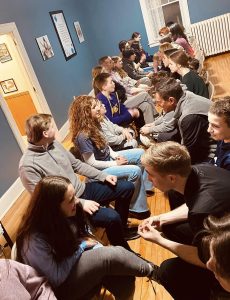
Icebreaker exercise during Spirit of Hope’s weekly Discipleship Group meetings for middle and high school students and adult volunteers. Photo received 2.4 thousand views on Facebook.
The Catholic News Agency reported in July that the Vatican welcomed “more than a thousand social media influencers to Rome on July 28-29, 2025, for an event intended to shape a new generation of Catholic missionaries — those who are sharing Christ on the internet. An active social media user, Pope Leo XIV is ready to help the Church navigate the fraught world of internet evangelization.”
Joelle Zarnowski, associate director of Communications for the Diocese, said that digital communication is an important tool to keep parishioners informed of diocesan news, celebrations, and other significant events. It is also a way to connect with and strengthen our Catholic community.
Zarnowski analyzes the data on how our audience is utilizing platforms to track how they are engaging with the diocese. She reported that currently, the Diocese has 11,698 Facebook and Instagram followers, 10,000 subscribers on YouTube, and 3,978 email newsletter subscribers. The Catholic Sun has 3,949 followers on Facebook and Instagram and close to 11,000 newspaper subscribers.
Based on the articles read each month, Zarnowski said that Catholic Sun readers are drawn to stories about hope and faith: “These types of stories resonate with people, especially during times of national and global crises and conflicts.” Zarnowski said that posting good news brings people of all ages closer to Christ.
A Pew Research report dated January 31, 2024, stated that Millennials, also known as Generation Y (born between 1981 and 1996), prefer social media platforms to include YouTube, Instagram, and Facebook. Millennials are the most active demographic on social media overall, with a high percentage using these platforms regularly.
The report includes analytics that show that Facebook remains a top platform for Gen X (those born between 1965 and 1980), with a significant majority having a profile and using it regularly to stay connected. YouTube is also popular among Gen X.
Baby boomers (born between 1946 and 1964) primarily use YouTube and Facebook when it comes to social media. According to data from the Pew Research report, around 60% of people aged 65+ use YouTube, and approximately 58% of people aged 65+ use Facebook.

Rev. Christopher Ballard, students Nolan Crumb and Charlie Martin at The Root Farm ropes course for the July 2024 Totus Tuus evening program outing. Photo received 1.7 thousand interactions on Facebook.
Zarnowski said that the communication platforms used by parishes and the Diocese as a whole must be all things to all people. “Social media is just one tool we use to reach people where they are at; a way to keep our communities engaged,” she said. Zarnowski suggests that for those using social media to evangelize and promote programs, services, and events, consistent posting is key.
Mark Ranieri, director of youth ministry at Spirit of Hope Parish, which encompasses eight churches in the western region of the Diocese, leads young adults in faith formation through weekly meetings, outdoor games, and preparation for the Sacrament of Confirmation. Rainieri said his primary communication tool is a platform called Flocknote, which allows him to communicate with parents and teens over 18 with mass text messages. He utilizes Facebook and Instagram for sharing photos and relevant information.
“I think social media is just one way among many to stay relevant in the lives of our families,” said Ranieri. “Nothing replaces the trust built over time through face-to-face and spoken interactions, but in our busy and fast-paced world, the reality is that social media has taken on a greater importance to connect people with one another.”
Nick Calaprico, director of youth ministry at St. Augustine, St. Elizabeth Ann Seton, and St. Mary of the Assumption in Baldwinsville, teaches Digital Literacy to the seventh graders in the Baldwinsville School District. He witnesses just how much time the students spend on electronic devices. Through conversations with teens, he has learned that they actually want to disconnect. “They want to be away from their phones. This past year, we have been actively doing more to provide opportunities for teens to disconnect and be present,” he said.
Calaprico said that while social media and digital communication does play a role and it has its place in evangelizing different generations, he agreed with Ranieri’s assessment of the importance of face-to-face interaction. “Social media shouldn’t be the sole form of their growth in faith. It needs to direct students into entering the physical community that will walk with them and strengthen their relationship with Jesus.
To connect with parishioners of the three parishes, a newsletter is sent via email to those who subscribe. Calaprico also utilizes Instagram to inform teens and parishioners about what the youth program is doing. For communicating with teens, Calaprico said they use the app “Called,” an all-in-one community platform for church and ministry leaders to forge connections with their members. It allows teens to be in a group chat and stay connected with a faithful community that meets them where they are in today’s world.
The Jubilee of Youth Conference, held July 28 to August 3 in Rome, was the most-attended event of the Catholic Church’s 2025 Jubilee Year. An estimated 1 million young adults, teens, and chaperones flocked to Rome from 146 countries.
A Vatican News Agency article posted on July 28, “Catholic Digital Missionaries and Influencers,” reported that the Jubilee event saw hundreds of digital missionaries and Catholic influencers from around the world who gathered in Rome for the first-ever Jubilee for Digital Missionaries and Influencers. The two-day celebration focused on fostering communion, deepening mission, and sharing hope through digital platforms.
In his opening remarks to digital missionaries and Catholic influencers, Paolo Ruffini, Prefect of the Dicastery for Communication, emphasized the importance of in-person connection and the unifying power of God.
“It is beautiful to be together in person,” he said, noting that while digital platforms unite us, “what truly binds us is not the web, but something that transcends us: God Himself.”
“We are not alone,” said Ruffini. “We are a single people. And together, we are called to make the digital world not just connected, but truly human, truly Christian.”