DPC speakers focus on parish renewal, synodality
IMG_9677
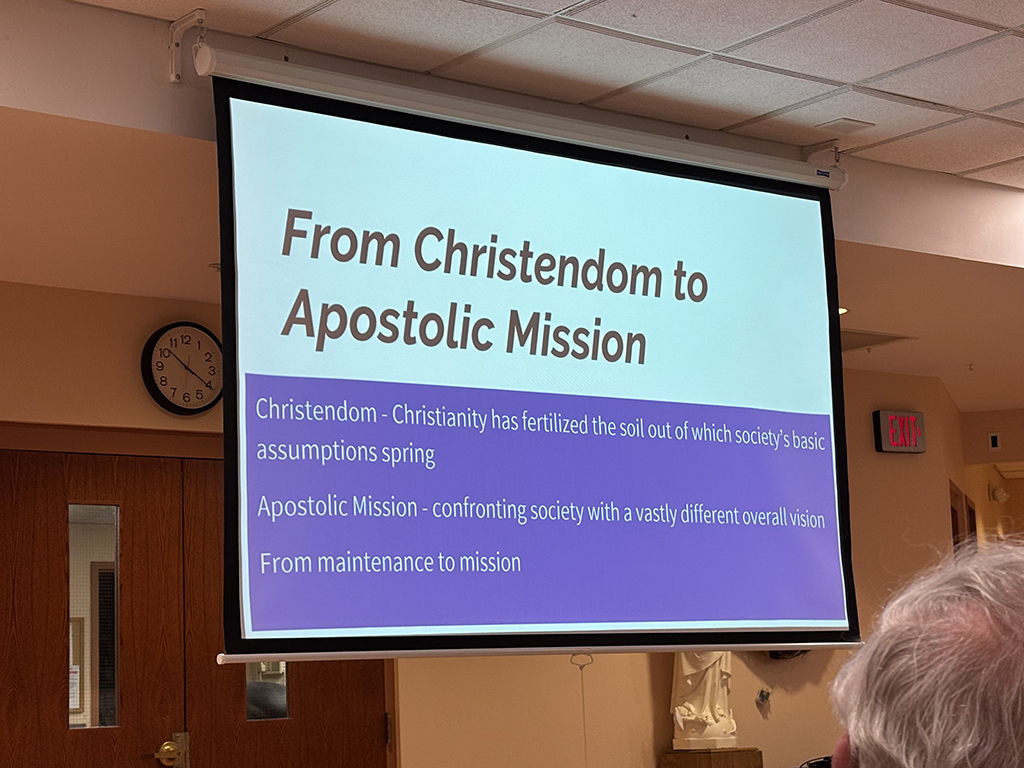
One of many slides shown during Fr. Seibt’s presentation. Sun photo | Tami S. Scott
The latest meeting of the Diocesan Pastoral Council (DPC) took place on the morning of March 7 in Yeazel Hall at Holy Cross Church in DeWitt. During this session, Father Christopher Seibt, vice chancellor for the diocese, presented to attendees on how his two parishes, Sacred Heart in Cicero and Divine Mercy in Central Square, journeyed to become “Parishes on Mission” beginning in 2023. Sister Katie Eiffe, CSJ, the diocesan vicar for religious and director of synodal planning, gave an update on the Synod. Bishop Douglas J. Lucia also held his regular Q&A session.
The following are highlights from the quarterly event.
Strategies for missionary renewal in parishes
At the beginning of his presentation, Fr. Seibt asked attendees to think more basically about a term Catholics use all the time — “parish.” After small-group discussions, a definition was provided: a stable community of disciples gathered around the Eucharist, shepherded by a pastor and in communion with the bishop. Next, Fr. Seibt asked attendees to identify the Church’s mission and some challenges in carrying it out. Together, they pointed out several difficulties facing the Church in carrying out its mission of worship, evangelization, and service, including a loss of the sense of the sacred in people’s lives; unrealistic expectations in which people come into a parish wanting their needs to be met without any demands from their own time, talent or treasure; a lack of a sense of belonging; and individualized Christianity, in which people don’t come to Mass consistently and receive the Sacraments without a sense of discipleship.
Confronting these challenges, Fr. Seibt continued, involves recognizing that we are no longer living in a time of Christendom, in which the wider culture largely aligns with Christianity, but rather a time of Apostolic Mission, requiring the Church to go out and challenge society with a very different vision of life. Another way to describe this transition is “moving from maintenance to mission,” Father said.
Fr. Seibt pointed to his parishes of Sacred Heart and Divine Mercy as examples of parishes that have set out to move from maintenance mode to being on mission, and he also highlighted several other parishes that have put forth similar efforts: St. Rose of Lima in North Syracuse, Spirit of Hope in Oneida, Mary, Mother of Our Savior in Utica, and Our Lady of Sorrows in Vestal. Father stated that the process of focusing on apostolic mission looks different in each unique parish and that there are often bumps in the road.
“No one does it perfectly. We did our best. We learned some things along the way. Don’t get the idea that all of this just happened so beautifully one day, and it all just took place. Some of the things were planned — we actually kind of got ahead of some things — and a lot of things were not planned. We just had to pivot or sort of deal with those things. A lot of things were changed, not because they were necessarily bad … but because the world has changed and the Church has changed,” he said, adding that many people were involved and all of it was made possible by God’s grace.
The process started in July 2023 when St. Bernadette’s in Constantia closed. Fr. Seibt said it was one of the hardest things he had ever had to do, and although it was sad, the parishioners knew it was time to move on and make the best of the situation. The following step was officially joining Divine Mercy with Sacred Heart. In a letter that went in the parish bulletin, Fr. Seibt asked parishioners to do four things: keep our eyes fixed on the Lord, remember we’re one body in Christ, act in a Christian manner, and not let any spiritual discouragement from the evil one cause us to fall away. Along with the parishes coming together, a new Mass schedule was rolled out. Many more changes followed, affecting different areas of parish life, such as youth ministry, timing of funeral Masses, combined staff meetings from both parishes, and combined OCIA programs. Many of these changes went smoothly, Father explained, but others were more difficult.
What was key through it all, Fr. Seibt emphasized, was communication. “You cannot over-communicate,” he said. In terms of communication with parishioners, the parishes utilized mailings, automated phone calls, and town hall meetings to ensure people were aware of the changes and what was to come.
Fr. Seibt detailed changes and events that occurred in late 2023 to present day, including a new parish logo, parish audits, which events remained separate and which were combined at Divine Mercy and Sacred Heart, stewardship and HOPE Appeal efforts, volunteer training, and much more.
Before answering questions, Father ended with inspiring guidance: “Receive the graces and spiritual consolations that come and the promptings of the Holy Spirit which lead us to new places. Share the gift of faith, share the joy that’s part of it, and share the peace that also comes when we focus on mission and become parishes on mission.”
Synod implementation phase has begun
In her update on the Synod, Sister Katie Eiffe summarized the phases and form the Synod has taken so far — the many listening sessions at various levels all the way up to the General Assembly of Bishops — that have led to the current consideration of how we will continue to grow into becoming a Synodal Church. The next step will be getting the concept and practice of synodality down to the parish level, Sister explained.
“We’re asking parishes to use the listening process that we’ve used here [at the DPC] called ‘The Conversations in the Spirit.’ A listening session is different from a town hall, because it uses that process of listening deeply,” Sister said. “Hopefully that’s happening in parishes, and we’ll get some information, and we’ll determine where to go from there.”
The DPC will next meet on Saturday, May 2.
Editor Tami S. Scott contributed to this story.