‘Every life is a gift’
MAIN
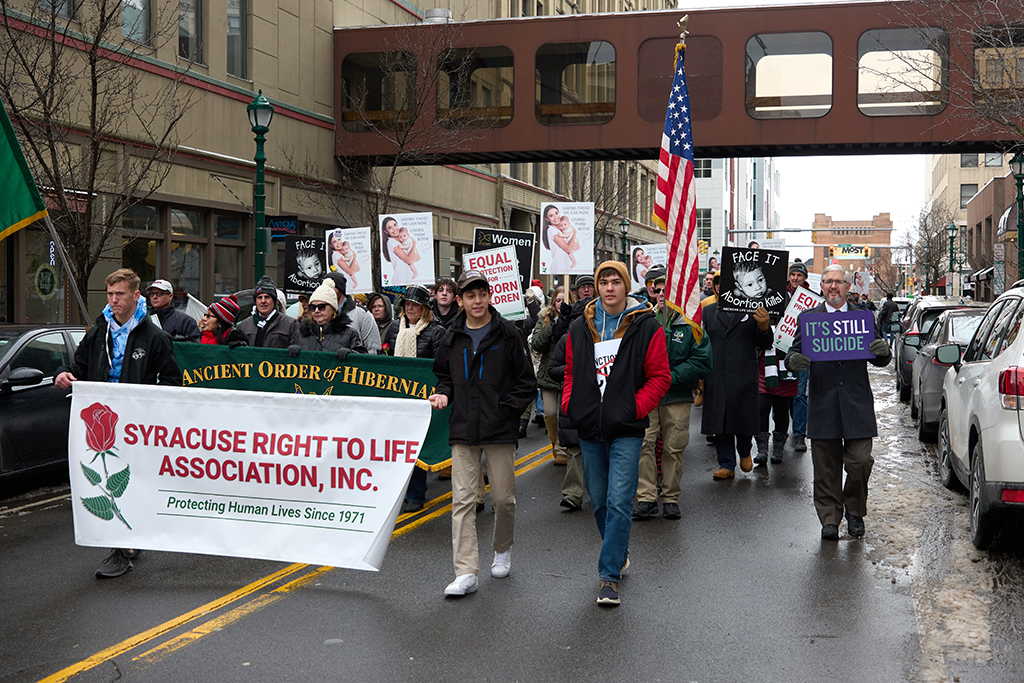
Over 200 people march in downtown Syracuse on Jan. 17 for the 53rd annual Syracuse March for Life. Sun photo | Chuck Wainwright
Witnesses for life gather, walk side by side at annual Syracuse Mass, March for Life
By Elizabeth Landry
Staff writer
One can imagine the variety of cold, wet, wintry weather those attending the annual Syracuse March for Life have experienced over the years, since the march always takes place on the Saturday before Jan. 22 – the date when the landmark Supreme Court decision in Roe v. Wade was established in 1973. This year, during the 53rd annual Syracuse March for Life held on Jan. 17, the weather was cold, yet dry, and the sun even came out — a fitting analogy for the hope felt by those who stand up for life amid the wider culture that often, unfortunately, abandons those most in need of life-giving protection.
Before the marchers assembled in front of the MOST Museum and took their walk down East Jefferson Street to the courthouse, many faithful gathered that morning at the Cathedral of the Immaculate Conception for a Holy Hour followed by the annual Mass for Life. In his homily during Mass, Father John Kurgan emphasized the importance of standing up for life not only in opposition to abortion and assisted suicide, but also to support those who are vulnerable in different ways: the oppressed, those whose lives are in danger and are seeking asylum, and those who are nearing death.
“Certainly, if we don’t have the courage to stand up for the unborn, then we can never stand up for them at any other point in their life, because they may not be here with us,” Father said. “We have to march with our eyes open, because it would be uncommon in our city not to encounter people who are in need. … We shouldn’t just be in a shelter. We have to be outward with those people. We have to be His feet, His voice, His hands.”
Lisa Hall, director of the Family/Respect Life office for the Diocese of Syracuse, expressed similar sentiments when she spoke with The Catholic Sun ahead of the day’s events. She emphasized the need for relationship and the need to love one another and to love God through difficult situations.
“It’s about being with one another in the mess — not abandoning one another in the mess,” said Hall. “Life is messy, but it still needs to be celebrated. Every life is a gift. Every baby is a blessing. Every human being was created with a plan and a purpose. We sometimes don’t all live up to that potential we’re created for, but it doesn’t make you less valuable. It doesn’t make you have less worth. And that’s how we need to regard one another — as worthy and valuable.”
“It can feel very isolating, being an advocate for life in [New York] state,” said Charles O’Malley, Respect Life program coordinator, referencing the recent decision of Governor Kathy Hochul to advance the assisted suicide bill that passed in the New York State Legislature. “We need to come together and see that there are like-minded people. … It’s good to be together with people and have that joyful aspect of [this work], because we are sharing a positive message.”
Many voices speaking up for life
Just as the Holy Hour, Mass, and March for Life are important public events that show support for life from conception to natural death, they are also significant in that they bring the members of the local pro-life community together in fellowship. Many pro-life supporters from different walks of life were in attendance, all advocating for the vulnerable.
Nicholas Mion, a seminarian from Binghamton who is in his Propaedeutic Year at the Stanley Rother House of Formation at Mount St. Mary’s Seminary in Emmitsburg, Md, was an altar server during the Mass for Life. Speaking with The Sun after Mass, he echoed Father Kurgan’s message about our collective responsibility to be supporters of life.
“We need to keep that light shining within us, and then shining it out to everybody else, knowing how precious and important [life] is. [We need] to show our solidarity, knowing the great gift of God is worth fighting for and is worth enjoying and living to the fullest,” Mion said.
Also speaking with The Sun after Mass was Laura Kavanaugh, a parishioner at St. Francis of Assisi in Bridgeport and a mother to eight children. Alongside expressing her dismay with today’s culture, which often shows a lack of basic regard for human life, Kavanaugh also shared personal stories from her own life.
“I’m the only survivor of my mother’s 13 pregnancies,” she said, adding that some ended in miscarriage, while some of her siblings were born prematurely and weren’t able to survive due to the medical limitations of the time. She shared that she does have one adopted brother, and that she, herself, also experienced two miscarriages.
“The gift of life is not a given,” said Kavanaugh. She also shared that she grew up learning about how precious the gift of life is. “The priest I grew up with preached respect for life regularly in his homilies. He used to send an entire bus from our parish to the National March for Life from the mid-1970s. I did that as a teenager.”
One teenager among many who participated in this year’s March was Sophia, a ninth-grader who was attending as part of a group from Bishop Ludden-Grimes Jr./Sr. High School.
“I’m here with my school to explain why we should have equal protection for the born and the unborn,” Sophia said. “I think that’s very important because I think that every child of God deserves to be on the Earth. … I think every child should be able to be born and to have a loving, happy family.”
Hope amidst discouragement
Once the March reached the steps of the city courthouse, Christine Fadden, president
of the Syracuse Right to Life Association — the organization that sponsors the Syracuse March for Life each year — welcomed all who came out to witness for life. Shortly after Heritage Baptist Church pastor Jonathan Burns led the assembly in prayer, the Syracuse Right to Life area director, Rhett Cox, introduced the day’s main speaker: Jessica Rodgers, coalition director for the Patients Rights Action Fund.
In her speech, Rodgers didn’t shy away from sharing stories exposing the danger and horror of assisted suicide that have come out of places like Canada and Oregon, where assisted suicide has been practiced for several years. But she also shared many glimpses of hope and encouragement. Although Governor Hochul has committed to sign the physician-assisted suicide bill, Rodgers pointed to three facts that have given her hope in the face of such a blow to the cause of witnesses for life in New York state. First, the legislation was held back for 10 years before the bill was passed. Second, when it did pass, it was by the slimmest majority of any bill sent to the governor this year.
“Third, when the governor did decide to sign the bill, she made significant changes to the legislation,” Rodgers said. “There are provisions she’s added that we haven’t seen in other bills, and that tells me that she knows what was sent to her was unsignable. She knew she could not put her signature to that page. Unfortunately, she believes that the changes she has requested will make this bill safe. The truth is that the very core of assisted suicide is dangerous and discriminatory and will cause harm.”
Rodgers went on to say that there are two things everyone can do in the wake of the unfortunate news regarding the physician-assisted suicide bill in New York. She suggested we call our doctors, insurance companies, and any other medical systems we operate within and inform them we will not see or participate with any doctor or institution that participates in assisted suicide. Second, “and perhaps the most important of all,” she said, “it is incumbent upon us to not abandon vulnerable patients.
“Each of us holds innate worth and dignity that cannot be stripped away by illness. Let us come alongside each other in the hardest moments, carrying true compassion and support. Let us love so well that assisted suicide is never an option. I am inspired by your advocacy and continued dedication to honoring the dignity of all our neighbors, no matter the circumstances. The law may have abandoned our most vulnerable neighbors, but we must not do the same.”