From Rite to Order; the initiation process has a new name, renewed energy
CFW04227
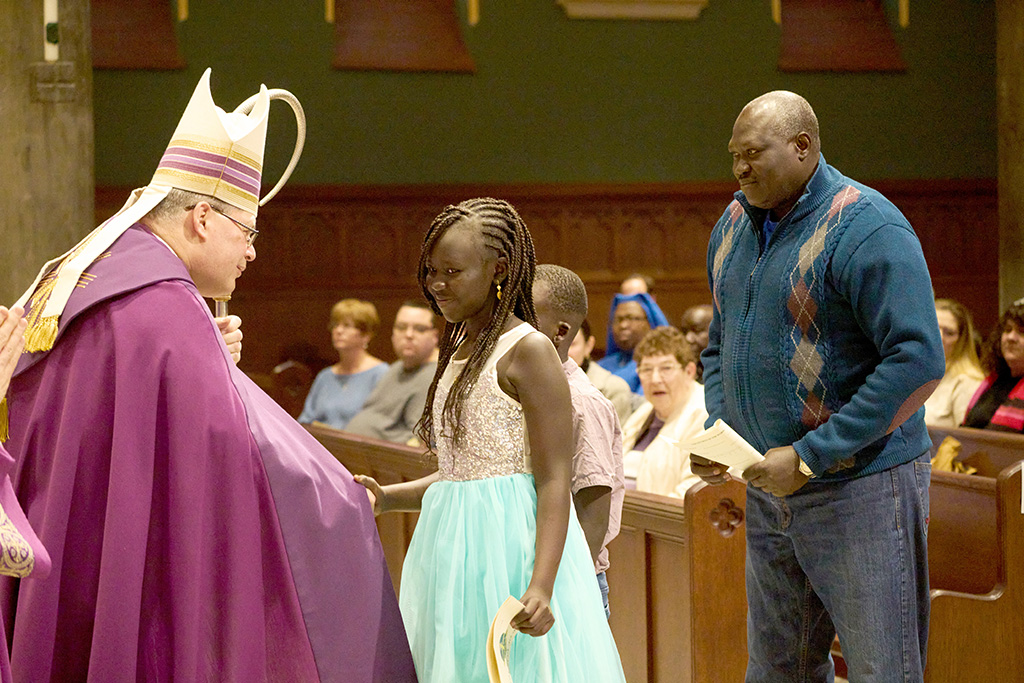
Bishop Douglas J. Lucia greets a young catechumen during the 2023 Rite of Election at the Cathedral of the Immaculate Conception. This rite is part of the revised OCIA process.
As the new liturgical year gets underway there is a subtle but meaningful change in the process by which non-Catholics and baptized Catholics seeking additional Sacraments of Initiation are prepared to be fully welcomed into the Church.
What has been referred to as the Rite of Christian Initiation, or RCIA, is now the Order of Christian Initiation, or OCIA. The name is changing to better reflect the origins of the process and to shine a brighter light on the individual rites that make up the process.
Confused? Don’t be. We have diocesan experts to simplify and explain.
It’s been in the making
The new order was approved by the United States Conference of Catholic Bishops (USCCB) in November 2021.
Parishes may begin introducing the new order with the beginning of the new liturgical year on December 1, the First Sunday of Advent. All parishes must implement it by Ash Wednesday, March 5, 2025.
The flexibility is necessary, in part, as the texts used by parish teams to accompany the change are in short supply, given that dioceses across the U.S. are in need of the new books.
The change from ‘rite’ to ‘order’ reflects a much deeper revision than one might recognize on the surface.
“There’s not a lot of substantial changes to this,” explained Father Christopher Seibt, vice-chancellor of the Diocese of Syracuse and pastor of Sacred Heart (Cicero) and Divine Mercy (Central Square) parishes. “It’s an updated, better translation and I think they’ve done a better job of trying to organize the material.”
Father Seibt is also a Canon lawyer who holds a Licentiate in Sacred Theology (S.T.L) and a Licentiate in Philosophy (Ph.L). He oversaw the diocesan R.C.I.A. process when the change was first announced and has followed it since. He acknowledges that the new order is a lot of material for parish teams to absorb.
“It’s all great, but it really takes volunteers in parish ministries,” he said. “It requires them to read through it and to really learn this process.”
“Process” is a key word to describe one of the fundamental reasons behind the change in name. The new order more readily implies that learning about and practicing the faith is ongoing, and there are several liturgical rites that accompany that process. Those rites and the accompanying studies together make up the new Order of Christian Initiation.Ready to help make the change happen
Josh Corcoran is the current director of the Office of Liturgy and RCIA. He told us that the most recent revision in the Roman Missal is the change that most people in the pews would recognize as part of what he described as the “ongoing process of retranslating all of the rites of the Church.” He adds that the “Christian Orders of Funerals, of Penance, Matrimony and Baptism” have also undergone retranslation revisions.
“We are trying to bring people into a closer relationship with Jesus,” Corcoran added, focusing on OCIA. This is part of the process of evangelization for those who may be cradle Catholics or who have already been welcomed into the church, he said, in reaching out to those who want to know more.
“Most parishes tend to start their classes, the catechesis, in the fall when the academic year begins. But they [catechumens and candidates] can start anytime of the year,” he said.
Corcoran says that people can reach out to their pastor or parish staff to connect inquirers with the process, or they can contact his office.
Who is a catechumen?
These are unbaptized individuals seeking to learn about the faith.
Who is a candidate?
These are baptized Christians seeking to enter into full communion with the Church.
Need help?
Contact the Office of Liturgy and O.C.I.A., 240 East Onondaga Street, Syracuse, NY 13202-2608. Call (315) 470-1420 or visit syracusediocese.org/office-of-liturgy-and-rcia