ABOVE: Farmers in Chauffard work together to fill bags with soil for planting the seedlings.
Submitted by Kate McMahon
The women and men walk slowly and purposefully up the path from the river. They carry buckets and cans of water as if they weigh little, not spilling a drop. The group passes a dozen farmers working in a bean field, discussing adjustments to wooden frames they’ve built to help crops and soil hold onto the steep hillside. The water carriers round a bend, reaching their destination. They set their burdens down and cluster in the shade of a protective canopy. Sunlight dapples through onto rows of tree seedlings growing in black bags.
The men and women begin emptying their buckets and cans into watering cans, tending to baby mango, lemon, coconut, breadfruit and mahogany trees. They gaze out at the deforested hillsides of their community, then back at the tree nursery, finding hope.
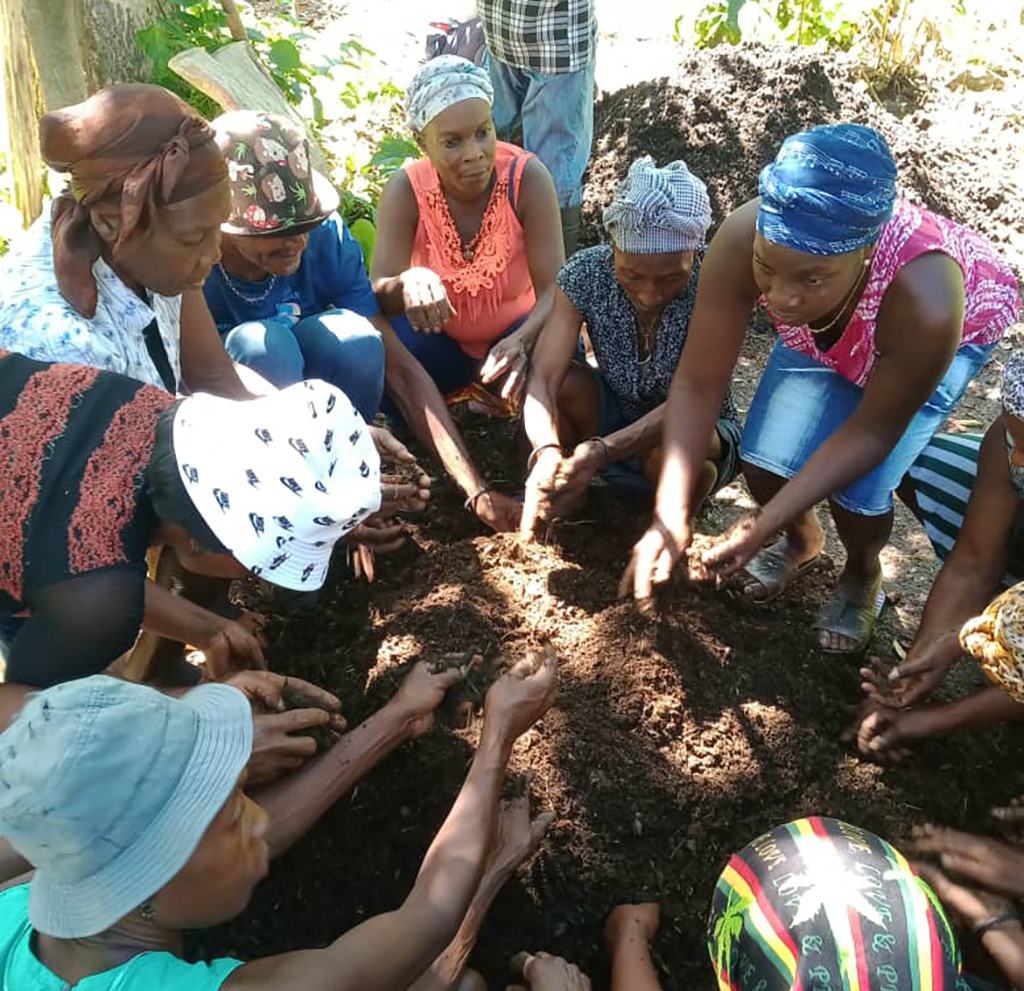 Four hundred farmers in Chauffard, Haiti, care for these tree seedlings. In exchange, they receive improved black bean and pigeon pea seeds, along with high-quality farming tools. An agronomist from the Haitian organization Smallholder Farmers Alliance leads a series of training sessions to help farmers improve their methods. This effort is part of the Tree Currency Program.
The Church of St. Michael and St. Peter on Onondaga Hill funds the Tree Currency Program in Chauffard with a matching grant from the Raising Haiti Foundation. During this five-year program, Haitian agronomists from the Smallholder Farmers Alliance lead training sessions, distribute seeds and tools, and supervise the tree nursery work. Once the seedlings reach a certain size, they are distributed among participants.
The program addresses multiple concerns in Chauffard. Future trees will help prevent soil erosion, create shade in the hot climate, and produce fruit to combat hunger. Improved seeds are expected to increase crop yields, providing farmers with more beans to feed their families and sell. These changes will reduce food insecurity in the community.
For over two decades, the Church of St. Michael and St. Peter has had a twinning relationship with the Church of the Immaculate Conception in Chauffard. During that time, the community has endured the 2010 earthquake and devastating hurricanes that washed away houses, crops, and livestock. Parishioners in Syracuse funded the rebuilding of the church, medical clinic, and rectory.
Education has been a primary focus. The Church of St. Michael and St. Peter supplements teachers’ salaries and funds the school lunch program, sending $5,000 a month to provide a hot lunch of rice and beans or dried fish for more than 1,000 students. For many, it is their best—and sometimes only—meal of the day.
At the end of the school day, students clad in blue and white uniforms file out of classrooms into the blazing sun. In clusters, they joke and tease one another as they walk home. They pass their parents’ fields, which will soon yield more and better crops, and approach their small cinder block homes, which will eventually be surrounded by fruit trees—all thanks to the Tree Currency Program. These children glimpse a better future.
More information about the Tree Currency Program and other projects involving the Church of St. Michael and St. Peter and the Church of the Immaculate Conception in Chauffard can be found at Haiti In Our Hands.
To donate, send a check to the Church of St. Michael and St. Peter with “Haiti” in the memo line at 4782 W. Seneca Turnpike, Syracuse, NY 13215, or visit www.stmichael-stpeter.org to donate electronically.
Editor’s note: Kate McMahon works in the Haiti Twinning Program – Haiti Medical Mission programs at St. Michael’s-St Peter’s Parish in Syracuse.