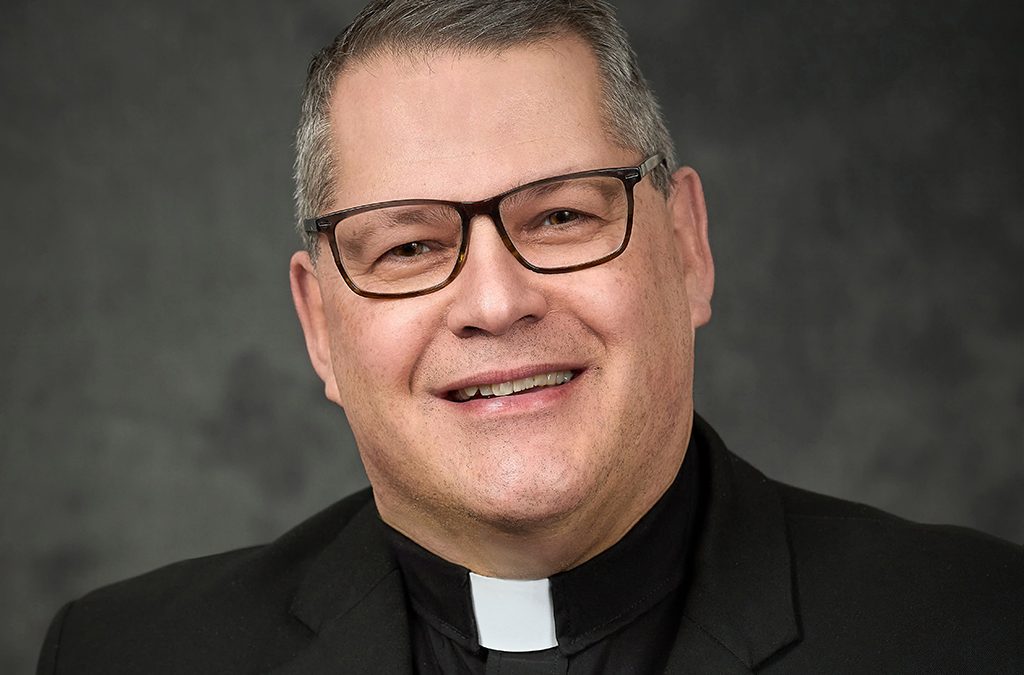
(Editor’s note: The following is Bishop’s homily from the Women’s Conference Mass held on Oct. 25 at the OnCenter in Syracuse)
Today, dear sisters and brothers, we have gathered in this place united in our desire to grow closer to God and to one another as bearers of hope in a present-day world desperately in need of this virtue. The Catechism of the Catholic Church defines virtue as a “habitual and firm disposition to do good.”
In this sacred time together, we turn our gaze to our Blessed Mother Mary, who is the Mother of Divine Hope. The Second Vatican Council in the eighth chapter of its “Dogmatic Constitution on the Church” (Lumen gentium) says of the Blessed Virgin that she “shines upon our world, until the day of the Lord shall come, as a sign of our sure hope and comfort for your people on their pilgrim way” (#68).
This morning, I would like to take us to two places connected with the Blessed Mother — Palestine and Lourdes. Both places I have visited — one, 11 years ago this December, and the other, just last week. Though separated by geography and time, both lands speak to the heart of our Christian vocation — its power to heal, to intercede, and to bring peace where there is pain.
As you and I reflect on the Marian titles of “Our Lady of Palestine,” the patroness of peace in the Holy Land, and “Our Lady of Lourdes,” the mother of healing and humility, they illustrate for you and me our own calling to magnify the Lord. Especially to the poorest and lowliest among us in our world today — to be women and men of grace, bearers of hope, and vessels of divine love.
In her, who is known as Our Lady of Palestine, one finds a mother amidst conflict. Our Lady of Palestine, patroness of the Holy Land, was formally recognized in 1927 by Pope Pius XI, and her feast is celebrated on this day. She stands as a beacon of peace in a region torn by division. Her image — Mary with arms outstretched over Jerusalem — reminds us that even in the most fractured places, a mother’s love can mend what politics and power cannot.
In our own human condition, sisters and brothers, we know the ache of brokenness — whether in families, communities, or our own hearts. Our Lady of Palestine calls us to be peacemakers. She invites us to prayer as she does so in the Upper Room — prayer for reconciliation, not just in the Holy Land, but in every land where hearts are hardened and hope is scarce — even in this land who declares itself to be one nation under God, but struggles to live out God’s great commandments of loving God and loving neighbor, documented or undocumented.
In 1858, Mary appeared to a humble girl, Bernadette Soubirous, in Lourdes, France. She did not choose a queen or a scholar, but a poor, sickly teenager who lived in difficult and struggling circumstances, both economically and in the wear-and-tear of everyday life. Through Bernadette, Mary revealed a spring of healing — both physical and spiritual. Millions have since journeyed to Lourdes, seeking miracles and renewal, and last week I was one of those who heard the Lord’s invitation and that of his mother to “come to the water.”
What I found there is something I am still processing, but I can say that when I came out of the water at Lourdes, I felt a deep connection with the presence of God! What does this say to one seeking to be a man or woman of faith, of hope, and of love? That God sees us in our lowliness. That our wounds — visible or hidden — are not signs of weakness but places where grace can flow. Our Lady of Lourdes reminds us that healing begins with humility and that miracles often come through the least expected.
Sisters and brothers, all three titles of Mary that we have mentioned this morning show us that our lives are not to be passive but prophetic. To be bearers of light in a world that is darkened by sin and death. That is what our Holy Father, Pope Leo XIV, was writing about to the Christian faithful in his recent Apostolic Exhortation, Dilexit te (I have loved you). You and I, sisters and brothers, are called to be intercessors like Mary, standing in the gap between suffering and salvation as bearers of light and of the Divine Hope that became flesh among us in Jesus Christ, Son of God and Son of Mary.
Whether we are mothers or fathers, daughters or sons, sisters or brothers, or friends, but above all, citizens of this world, and more importantly, of the Kingdom of God, we carry within us the call and the capacity to nurture peace and birth healing. Let us be daughters and sons who, like Mary, say “yes” to God even when the world says “no.” Mary’s “yes” to God changed history. Her courage, faith, and obedience made her the first disciple and the mother of the Church. Today, we are invited to echo her “yes”— to be light in darkness, hope in despair, and love in action.
Let us be women and men who pray with boldness, love without condition, and serve with joy. Holy Mary, Our Lady of Palestine, teach us to be peacemakers. Our Lady of Lourdes, teach us to be healers. May we, like you, carry Christ, our Hope, into every corner of our diocese, our nation, and our world. Amen.