‘Please give to those who have given a lifetime’
IMG_2415
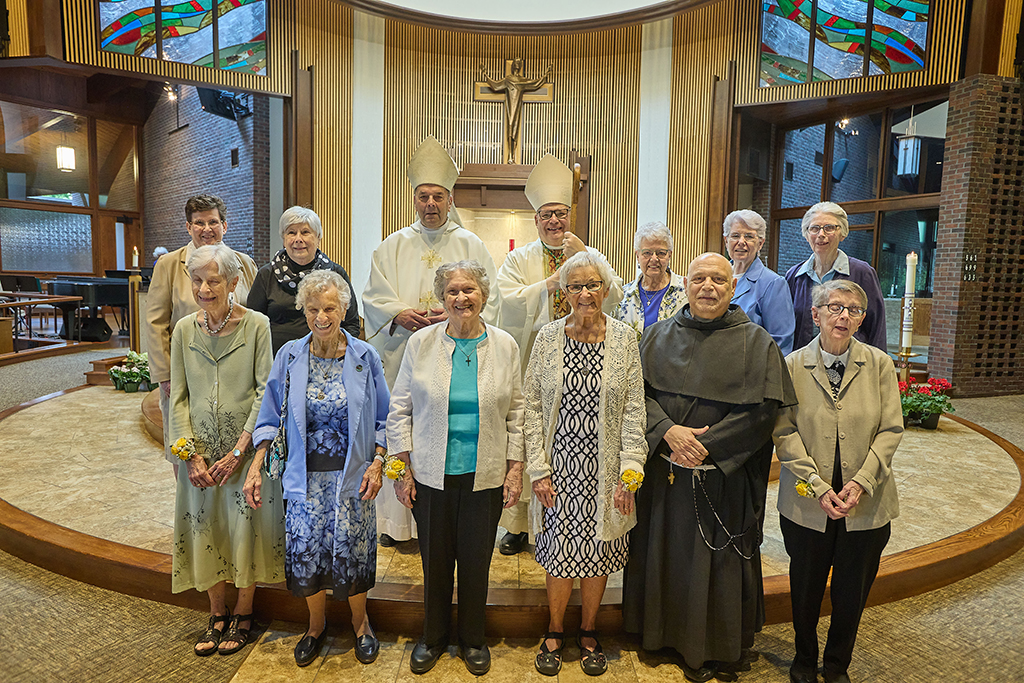
A photo of the 2024 diocesan religious jubilarians with Bishop Emeritus Robert J. Cunningham and Bishop Douglas J. Lucia in May. (Sun photo l Chuck Wainwright)
ABOVE: A photo of the 2024 diocesan religious jubilarians with Bishop Emeritus Robert J. Cunningham and Bishop Douglas J. Lucia in May. (Sun photo l Chuck Wainwright)
National Religious Retirement Fund collection is Aug. 17-18
By Dc. Tom Cuskey, editor
The annual Retirement Fund for Religious collection will be held across the diocese the weekend of August 17-18. The collection is managed by the National Religious Retirement Office (NRRO).
If you receive your weekly envelopes by mail through your parish, you may not find the religious collection envelope among them, though.
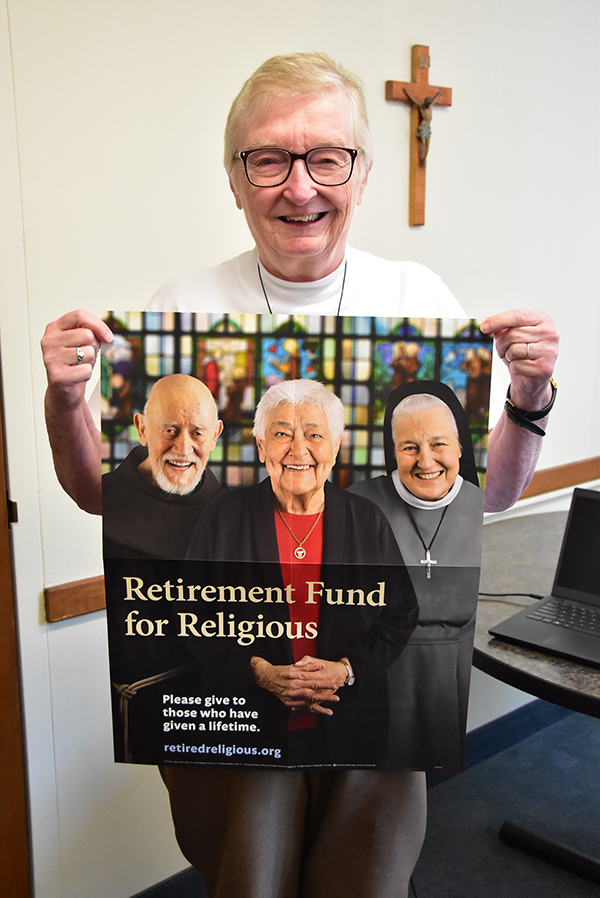
Sr. Katie Eiffe displays a poster that reminds all of the upcoming religious collection campaign.
“We just started engaging in the national collection three years ago,” Sister Katie Eiffe says, “because we had our own diocesan fund.” Sister is the diocesan Vicar for Religious, among other duties. “Since the late 70s, Bishop Frank Harrison established a diocesan fund. So, because we could receive funding from that we didn’t ask for funding from the National Office.”
The diocesan fund was originally expected to last ten years, but through good management it provided for the local religious community for more than 40 years. For the last three years, the diocese has participated in the national campaign.
Many of us have been blessed to have know some of these faithful servants. Through the years, the active presence of religious priests, sisters and brothers in the lives of the faithful have had tremendous impact. That alone has motivated some donors to be generous to the fund.
“I get these notes, or sometimes people call, and they just talk, you know, in glowing terms about a particular brother or particular priest, or how a particular sister so changed their lives,” Sister says. “Sometimes the donation is very small, might be $25, but like any other fundraiser, every penny helps.”
Sister Kaite explained that the fund provides access to monies through grants to religious communities serving in the diocese.
“For specific needs,” Sister explained, “and it’s for the care of the elderly … health care, because that’s probably the largest percentage of costs for religious communities nowadays.”
The ever changing demographics underscore the need. “The vast majority of our Sisters are retired and elderly, so there’s fewer of us in ministry,” she says. In her order, for example, The Sisters of Saint Joseph of Carondelet take a vow of poverty. The pay received for their work in ministry goes to the order. From there, Sisters receive a stipend for living expenses; the remainder goes to fund order expenses including the care of their elderly. It is next to impossible for those sisters still in active ministry to be able to directly support the aging members. That’s what makes the National Collection so important to these congregations.
“The congregations apply for a grant and it can be for the actual health care costs, or it can be for other things that are needed for those sisters beyond health care. For example, if someone needs a hospital bed, that type of thing.”
The grant application process is rather complex, Sister said, and it takes into account what is needed now and what might be projected for future need, much like an insurance actuarial table would. In Sister’s order, where there are fewer than 200 sisters, there has been a longevity trend that speaks well of the community and demonstrates their need.
“We just lost a Sister in the last couple of weeks, she had just turned 100.” She told the Sun. “And, in the last two or three years, we’ve had four or five sisters reached the age of 100. So, when you have four or five out of approximately 200, that’s pretty good.”
So many of the religious sisters, brothers and priests that have served through the years have done so for minimal compensation, giving generously of themselves to those in need through their work in healthcare, education and other fields. Many of us who attended Catholic schools or had religious education in our parishes have fond memories of these religious servants. Unfortunately, many younger Catholics today have not had that personal experience. That can affect overall awareness and understanding of the need to help.
How to contribute
Participating parishes will have designated envelopes available the weekend of August 17 and 18. If your parish runs out of envelopes, one can still donate by mailing a donation directly to the NRRO. A form to accompany your donation is available at https://retiredreligious.org/ways-to-give/donate/. You may also place your own envelope in the collection. Label it to the National Religious Retirement Office; please include your name, address and that you are member of the Diocese of Syracuse.