
Stations of the Cross: Retracing the route of Jesus
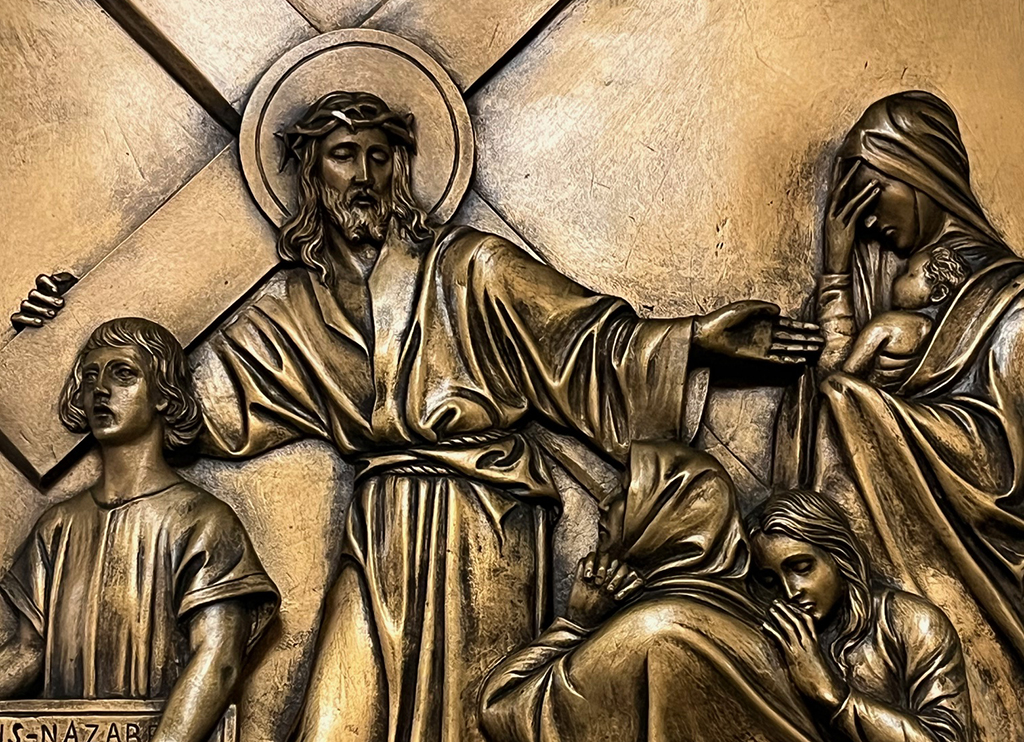
IMG_3346 stations of the cross Holy Family
Praying the Way of the Cross is a familiar Lenten practice for many Catholics. It’s a time when we meditate upon 14 scenes in Jesus’ route to Calvary. Long ago, in the early centuries of Christianity, faithful Christians would make pilgrimages to the Holy Land to retrace the steps that Jesus took from the Garden of Gethsemane to His crucifixion, and then to the Church of the Holy Sepulcher, which marks the place where Jesus was laid in the tomb before His Resurrection. This path is known as the Via Dolorosa, the “Sorrowful Way.”
Father Michael Galuppi, pastor of Our Lady of Hope and St. Michael – St. Peter in Syracuse, has visited the Holy Land many times and has taken groups to Jerusalem as well. He is very familiar with the Way of the Cross that winds through the old city of Jerusalem. He recalled the strong emotional impact of his first journey. Each year, on Good Friday, thousands of pilgrims retrace the route Jesus took from his sentencing in front of Pontius Pilot to Golgotha where He was crucified. Christ carried his heavy cross along this route, known as the Via Dolorosa (Way of Suffering or Way of Sorrows) and paused at 14 points along the way. The places where Jesus stopped along the Via Dolorosa are called the Stations of the Cross.
Fr. Galuppi said it has long been cited that the Franciscans can be credited with popularizing the Stations of the Cross. It is his understanding that St. Francis of Assisi, whose spirituality intently focused upon the incarnational aspect of Jesus, desired to make the things we read about in Scripture experiential for people.
“That is why St. Francis, at the Grecco in Italy, gathered townspeople and animals and assembled a ‘live nativity’ at Christmas,” explained Fr. Galuppi. “And from that time on, he is credited with founding the tradition of people putting up a creche or nativity scene in their homes so they could touch, feel and see the Christ child at His birth.” Fr. Galuppi said that St. Francis made his way as a pilgrim to the Holy Land in 1219 and wishing that every Christian might want to follow in the footsteps of Jesus on the Way of the Cross, he decided to bring the Holy Land and the Way of the Cross to them.
In 1731, Pope Clement XII gave all churches the right to have the stations, provided that a Franciscan father erected them with the consent of the local bishop. At that time, the number of stations, which had fluctuated throughout history, was fixed at 14, explained Fr. Dan Muscalino, pastor at St. Francis Xavier Parish in Marcellus. “As Father Galuppi explained, it allowed people who could not travel to the Holy Land to be able to pray the Stations of the Cross in their churches.”
In the traditional 14 Stations of the Cross, only eight are directly based on Scripture.
The third, sixth, seventh, and ninth stations were passed on in early Christian tradition but not found in the biblical gospels. In 1991, Pope John Paul II created a new version of the Stations of the Cross by altering the 14 traditional stations and added a 15th station – The Resurrection of Jesus.
“The Stations of the Cross remind us of the great compassion and mercy God has for His people,” said Fr. Muscalino. “The addition of the 15th station reminds and helps us reflect on the great victory of Jesus Christ over sin and death by His passion, death and glorious resurrection.”
The Stations Of The Cross
1. Jesus is condemned to death (Matthew 27:22-26, Mark 15:1-15, Luke 23:13-15, John 19:1-16)
2. Jesus takes up His Cross (Matthew 27:26, Mark 15:15, Luke 23:25, John 19:15-16)
3. Jesus falls for the first time
4. Jesus meets His Mother, Mary (Luke 2:34-35, 51; John 19:26-27)
5. Simon of Cyrene helps Jesus carry the Cross (Matthew 27:32, Mark 15:21, Luke 23:26)
6. Veronica wipes the Face of Jesus
7. Jesus falls for the second time
8. Jesus meets the women of Jerusalem (Luke 23:27-31)
9. Jesus falls for the third time
10. Jesus is stripped of His garments (Matthew 27:35, Mark 15:24, Luke 23:34, John 19:23-24)
11. Jesus is nailed to the Cross (Mark 15:25, Luke 23:33)
12. Jesus dies on the Cross (Matthew 27:50, Mark 15:37, Luke 23:46, John 19:30)
13. Jesus is taken down from the Cross (Matthew 27:57-58, Mark 15:42-46, Luke 23:50-53,
John (19:38)
14. Jesus is laid in the tomb (Matthew 27:59-60, Mark 15:46, Luke 23:53, John 19:40-42)
15. The Resurrection of Jesus
Good Friday Stations of the Cross
Join Bishop Lucia in praying the Stations of the Cross at a 6 p.m. service at the Cathedral of the Immaculate Conception in Syracuse.
Check your church bulletins for dates and times of Stations of the Cross being held at your parish.