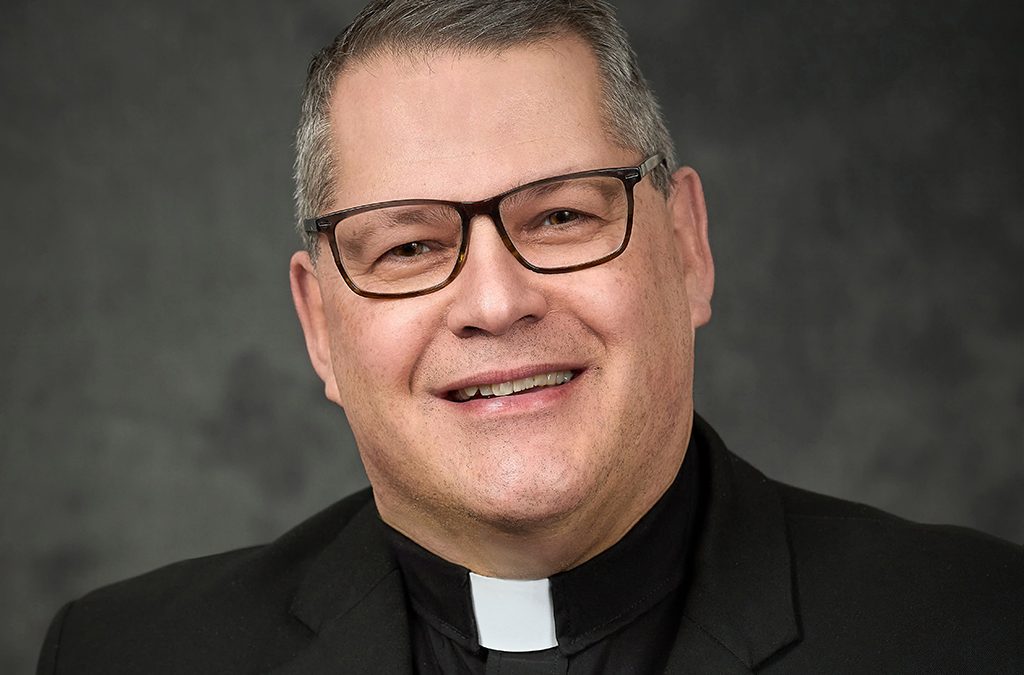
Editor’s note: The following is Bishop Douglas J. Lucia homily for Christmas 2024. The Christmas season continues until the Feast of the Baptism of Christ, typically celebrated on the Sunday after Epiphany.
Away in a Manger
Away in a manger, no crib for a bed,
The little Lord Jesus laid down his sweet head.
The stars in the sky looked down where he lay,
The little Lord Jesus asleep in the hay.
The cattle are lowing, the baby awakes,
But little Lord Jesus no crying he makes.
I love Thee, Lord Jesus, look down from the sky
And stay by my cradle til morning is nigh.
Be near me, Lord Jesus, I ask Thee to stay
Close by me forever, and love me, I pray.
Bless all the dear children in thy tender care,
And take us to heaven, to live with Thee there.
One of my favorite things to do at Christmas time is to spend time sitting before the Nativity scene. Some are set up in stables, while I have seen others set up in front of altars or just as figurines on a table or a mantelpiece. No matter what the setting, I have enjoyed such “stargazing” (if you can call it that) since I was a little boy. In these moments, I let the figures in front of me tell me the Christmas story all over again; and I am amazed at what I learn from them each time I do so. This leads me to a story I recently encountered through the internet.
In 1994, two Christian missionaries answered an invitation from the Russian Department of Education to teach morals and ethics in a large orphanage. About 100 boys and girls who had been abandoned, abused and left in the care of a government-run program were in the orphanage.
It was nearing Christmas and they decided to tell them the story of the first Christmas. Interestingly, it would be the first time these children had heard the story of the birth of Christ. They told them about Mary and Joseph arriving in Bethlehem. Finding no room in the inn, the couple went to a stable, where the baby Jesus was born and placed in a manger. Throughout the story, the children and orphanage staff sat in amazement as they listened. Some sat on the edges of their stools, trying to grasp every word.
When the story was finished, they gave the children three small pieces of cardboard to make a crude manger. Each child was given a small paper square, cut from yellow napkins that they had brought with them since no colored paper was available in the city. Following instructions, the children tore the paper and carefully laid strips in the manger for straw. Small squares of flannel cut from a worn-out nightgown were used for the baby’s blanket. A doll-like baby was cut from tan felt which the missionaries had also brought with them.
It was all going smoothly until one of the missionaries sat down at a table to help a 6-year-old boy named Misha. He had finished his manger. When the missionary looked at the little boy’s manger, she was startled to see not one, but two babies in the manger. Quickly, she called for the translator to ask Misha why there were two babies in the manger. Crossing his arms in front of him and looking at his completed manger scene, Misha began to repeat the story very seriously. For such a young boy, who had only heard the Christmas story once, he related the happenings accurately until he came to the part where Mary put the baby Jesus in the manger.
Then Misha continued, “And when Mary laid the baby in the manger, Jesus looked at me and asked me if I had a place to stay. I told him I have no mamma and I have no papa, so I don’t have any place to stay. Then Jesus told me I could stay with him. But I told him I couldn’t because I didn’t have a gift to give him like everybody else did.
“But I wanted to stay with Jesus so much, so I thought about what I had that maybe I could use for a gift. I thought maybe if I kept him warm, that would be a good gift. So I asked Jesus, ‘If I keep you warm, will that be a good enough gift?’ And Jesus told me, ‘If you keep me warm, that will be the
best gift anybody ever gave me.’ So I got into the manger, and then Jesus looked at me and he told me I could stay with him — for always.” The little orphan had found someone who would never abandon nor abuse him, someone who would stay with him — FOR ALWAYS.
Isaiah 11:6 announces, “And a little child shall lead them.” This Christmas 2024, little Misha beckons you and me to return to the manger so that we can come to know “the kindness and generous love of God our Savior.” In the words of another Christmas song originating from the Benedictine Priory at Weston, VT: “Deep, deep into the stillness of night, when the earth slept, intense with calm and expectation, the Dawn rose and with the light of day, Word of our God leapt from heaven, bringing new wholeness and peace: Emmanuel.”
Yes, brothers and sisters, as Jesus would many years later instruct his disciples to, “put out into the deep” (Lk 5:4) — you and I are being invited to plunge into the depths of the Christmas event to encounter the true significance of what it means that, “the Lord is born for us” (Psalm response — Mass at Dawn). This invitation is accompanied this day by the Church’s own summons to enter into a year of Jubilee.
This observance has occurred in the life of the Church since 1300 with varying intervals. First, every 100 years, then every 50 years, and since 1470, every 25 years. At its heart, is the call to make a journey both as individuals and as Church that heightens our awareness that our God has not forsaken us and that we are redeemed by our God and are His holy people. Therefore, the practice of pilgrimage … of a journey that takes us closer to the Incarnate One, the God-Man, accompanied by a renewed call for prayer and penance, are hallmarks of a Jubilee year.
Pope Francis in speaking of this occasion has stated, “May the Jubilee be a moment of genuine, personal encounter with the Lord Jesus, the ‘door’ (cf. Jn 10:7,9) of our salvation, whom the Church is charged to proclaim always, everywhere, and to all as ‘our hope’ (1 Tim 1:1).” And the theme the Holy Father has given to the year ahead is, “Pilgrims of Hope.”
Again, our little evangelist Misha helps you and I to better understand what it means to be a pilgrim of hope. How can you and I share wherever we are on life’s journey that God is with us forever and one’s hope in such a promise will not lead to disappointment? How can we help people know that we are a land and people not forsaken by God? Could it be our own call to keep others “warm” by returning to our environs and “glorifying and praising God for all they had heard and seen, just as it had been told them?” (Lk 2:20).
Let me conclude with these words that I have made my Christmas Greeting this year: “From a humble stable began the world’s greatest pilgrimage of HOPE — a HOPE that continues to seek a place in our hearts and homes today. May HOPE light the way for you and your loved ones this Christmas and into the New Year! Christmas Blessings!”