
A reflection: Epiphany
PARISH PARTICIPATION GIFT OF SELF
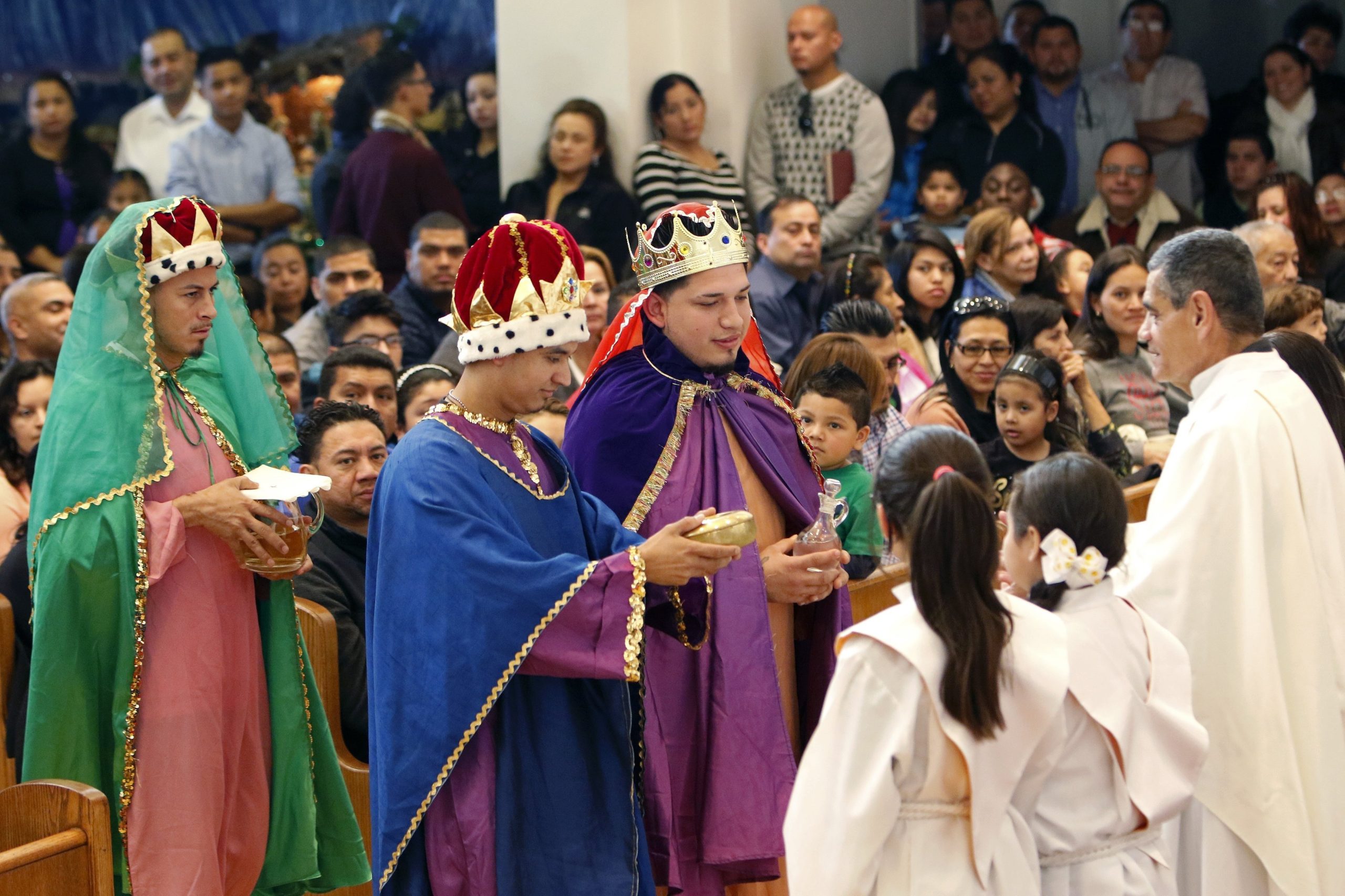
Young people dressed as the Three Wise Men are seen in this file photo presenting gifts during a Spanish Mass on the feast of the Epiphany at St. John of God Church in Central Islip, New York. Participation in parish ministries and liturgies is one way to make a gift of self and service, throughout the year. (OSV News Photo/Gregory A. Shemitz)
By Deacon Tom Cuskey, editor
All together now: “We three kings of Orient are…” and now, sing that line with a question mark at the end. “We three kings of Orient are?” As in “who are these guys?” Mystic visitors from the East! Are they kings? We hear them described as Wise Men. Are they men of science … astronomers who follow stars? Astrologers who look for messages in the heavens? Holy men? All of the above? The feast of the Epiphany has a very important history in our faith and universal culture, one that has a very important message or two for us today.
And more singing! “On the twelfth day of Christmas, my true love gave to me…” In the old tradition calendar, 12 days after Christmas took us up to January 5th or Epiphany Eve. The celebration of the birth of Our Lord ended and the Epiphany – traditionally January 6 — celebrated the arrival of the Magi as well as the Baptism of Our Lord and the beginning of Jesus’ public ministry. This was the major feast of the season for many years in the early church. There are traces in the Eastern Church that show Epiphany being celebrated as early as the late first century. The celebration of Christmas, designated in the year 336, obviously came later. Epiphany was first.
In the East today, many celebrate “Three Kings Day” where the priest blesses chalk which the faithful bring home and use to write on their homes: “C-M-B” and the year. C-M-B…Caspar, Malchior, and Balthazar, the names of the Magi. The initials also abbreviate the Latin phrase, Christus mansionem benedicat: “May Christ bless the house.” That provides a definite parallel to the Jewish feast of Passover where marking the door prevents evil and death from entering the home of the faithful who live there. Instead, the Epiphany blessing is more proactive, though – it brings life as opposed to preventing death. There’s always a lot of history behind our faith practices that should invite us to focus on what Epiphany means to us today.
Only the Gospel of Matthew includes the story of the Magi – and he invites us to ponder about Christ and worship:
- God commands all the power in the universe to make his Son known and to be worshipped. Think about it … a census is called to bring Joseph and Mary to Bethlehem, fulfilling the prophecy of Micah that the ruler of Israel will be born there. Mysterious celestial events and hosts of angels bring shepherds and wise men to the stable where Christ can be worshipped. Jesus reaches out to the fringes from the beginning of his time on earth.
- Jesus is a troubling to presence to those who choose not to worship Him. Just ask Herod. This infant, the “King of the Jews” that has been born, is very troubling to the sitting Jewish monarch … being king is his job at the moment and he wants to hold on to it. The Gospel says he “was greatly troubled and all Jerusalem with Him” (Mt 2:3). As a child, the evil and dark forces against Christ are already forming. This marks the first light on the passion and death of Our Lord, when the King of the Jews will be sacrificed for the sins of the world.
- Worshiping Jesus means joyfully recognizing all authority and dignity to Christ with sacrificial gifts. The Magi model the perfect manner of worship for the Messiah. They announce and address him as a King. When they find him “they prostrated themselves and did him homage. Then they opened their treasures and offered him gifts of gold, frankincense, and myrrh” (Mt 2:11). The gifts bring joy to all – those who give and those who receive.
- Jesus is to be worshiped not just by Jews, but by all the nations of the world, as represented by the wise men from the East. And he is to be worshipped because of the great love he has for us, the great love the Father has for us to send his only son to save us from sin. His coming has been foretold and anticipated for centuries.
Jesus, the Messiah, is God showing love for everyone, and he calls us to do the same. In the 8th Century, Saint Bede described Balthasar, one of the wise men, as a person of color. Most Nativity scenes depict him as such, and rightly so. In this sense, he represents in this story the total universality of God’s love. We live in such a fractured society today. There are so many marginalized people, and so much anger that creates unrest and violence in our culture. War rages in the Holy Land, Ukraine, Africa. Experts can easily point to other times in our history when we have engaged in such hate, only to survive to engage it in again, and again, and again. If there is only one takeaway from the Epiphany, make it yours and make it one of love and joy. Follow the example of the Magi – listen, watch for the signs, be open to God’s direction — and come together as a diverse group of loving people who have one common King, the Messiah, the Savior of the world.
Merry Christmas!