Canon law: Rights, responsibilities, and pastoral accompaniment
CFW06858 (1)
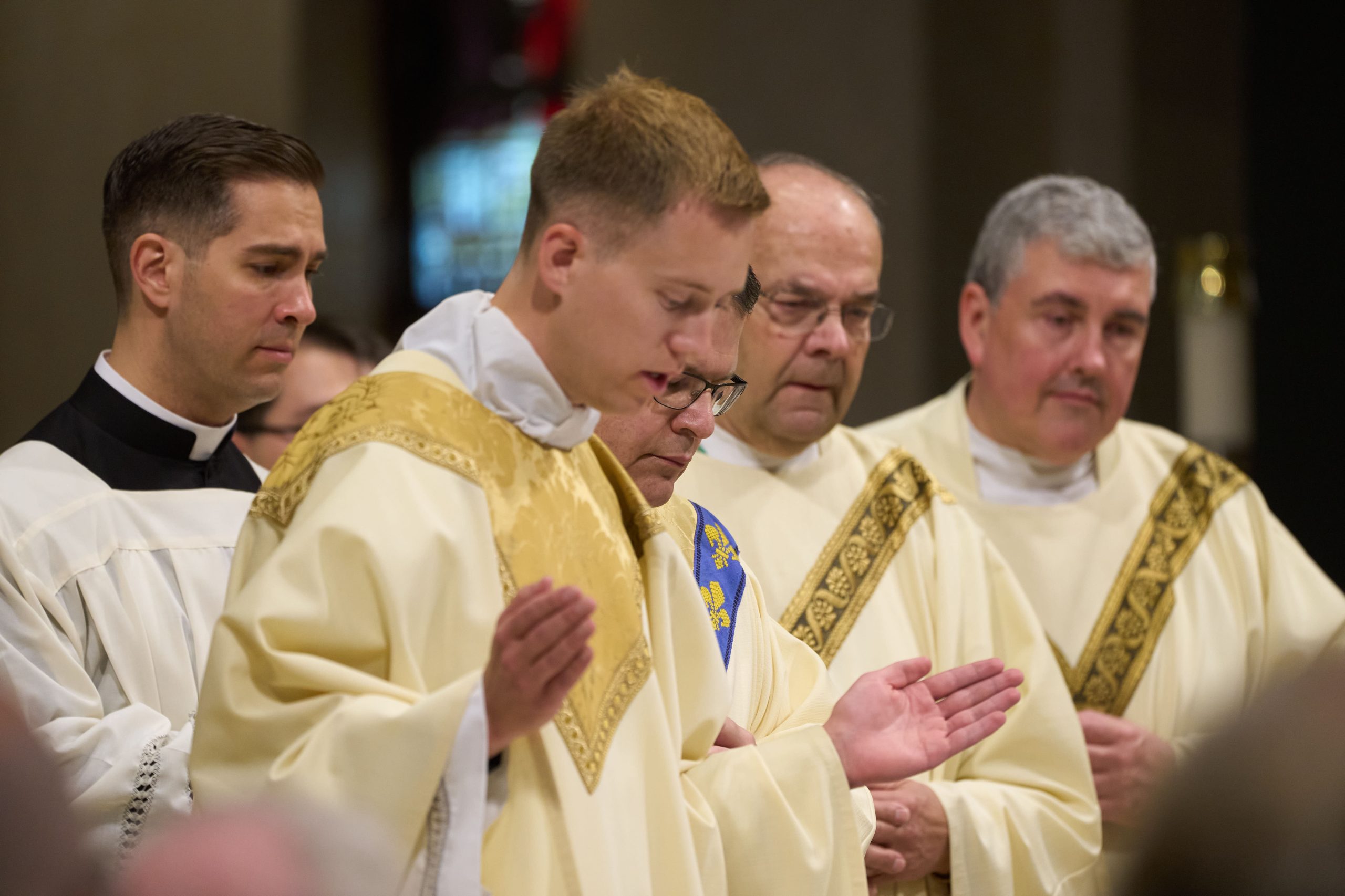
Father Buttner concelebrates the Eucharistic Prayer at his ordination Mass. Sun Photos l Chuck Wainwright
A Q&A with Father James Buttner, soon-to-be canon lawyer
Many Catholics may think of canon law as a vague manual of complicated rules and regulations within the Church. To help explain the basics of canon law, Bishop Douglas J. Lucia explained that the structure is somewhat similar to the way the court system is organized in New York state and the United States — with a hierarchy that extends from the diocesan tribunal to the Roman Rota.
“Once you have your canon law degree, there are different functions you might have,” said Bishop. He gave examples of the various roles in canon law at the diocesan level: a judicial vicar is like the chief judge; an adjutant judicial vicar is essentially an associate justice; the defender of the bond is one who defends the Sacrament of Marriage; and the promoter of justice helps ensure justice is being done.
Bishop also described canon law as a balance of rights and responsibilities: “This is a place where rights are meant to be respected, but also where responsibility is upheld,” he said.
Canon lawyers currently in our diocese include Bishop Lucia, Bishop Emeritus Robert J. Cunningham, Father Rob Hyde, Father Cliff Auth, Monsignor Timothy Elmer, Father Christopher Seibt, Father John Donovan, and James Salamy, director of the Diocesan Tribunal and Office of Public Policy.
Father James Buttner is now studying to become a canon lawyer for the Diocese of Syracuse, as well. The bishop explained that Fr. Buttner is being trained to serve as a judge in the Church’s tribunal, hearing cases involving marriage and other canonical matters, including the application of penal law in cases concerning priests.
Bishop shared what he looks for when selecting diocesan priests, such as Father Buttner, to study canon law. “I’m choosing somebody, first of all, who I consider is academically able to study law. … I also look for somebody who’s pastoral, because the whole principle of a law in the Church, even of penalties in the Church, is that it’s meant to be medicinal. [Laws] aren’t meant to be permanent; they’re meant to be medicinal. … We speak of the divine physician; I’m looking for somebody who can be a physician, somebody who can really care for those who come to them,” he said, adding that, as Pope Francis would say, someone who can truly accompany people.
When asked about what guidance or advice Bishop would offer Father Buttner as he continues on his journey studying canon law, he emphasized pastoral accompaniment. “I would remind him how much this can be of pastoral assistance for people … especially [when] going through the annulment process. People will say to me, ‘I never realized that this could bring such closure or bring such healing.’ I think sometimes we have to really remember the pastoral nature of all this.”
Just before officially transitioning from his assignment as parochial vicar at Sacred Heart Church in Cicero and Divine Mercy Parish in Central Square to studying canon law at St. Paul’s University in Ottawa, Canada, on July 1, The Catholic Sun reached out to Father Buttner for his unique perspective on his journey so far and into the future. Below are his responses.
CS: When did you initially feel called to study canon law?
JB: My call to study canon law was precisely that: a call! Namely, I was ‘called upon’ by our Bishop to study canon law in order to serve the diocese in this capacity. Canon law governs how the Church functions at every level: liturgically, administratively, juridically, etc. Therefore, it’s really important to always have a few people with expertise in this area serving the diocese. That being said, I certainly found my canon law courses at seminary interesting and engaging. But I did not think I would ever study it further until I was asked about it.
CS: What interests you most about canon law?
JB: While the name might sound esoteric, canon law is actually quite familiar to most people, at least in part. For example, the rules about fasting in Lent, the requirement to attend Mass on Sunday, and the fact that only priests are able to hear confessions are all examples of canon law. We often take these for granted as just ‘what Catholics do,’ but their foundation is in canon law.
At the same time, there are other rules or important Catholic things that we might not have learned about: What is a ‘dispensation’ or a ‘domicile,’ or a ‘delict’? There are important rules about who can validly serve as a godparent, or how Mass intentions are offered, or the fact that Catholics are obliged to be married according to canonical form … There’s a lot to learn!
I’m definitely looking forward to learning more about what the law says about the different aspects of our lives as Catholics, both to better follow it myself as well as teach it to others. Doing so will help both me and others grow closer to Christ.
CS: What is the process like for studying canon law?
JB: I am studying for my “Licentiate” in canon law, known as a “JCL” (Juris Canonici Licentiatus). As the name suggests, this is a license or professional degree that allows me to serve in an official capacity, such as a judge in the marriage tribunal. My degree program at St. Paul’s in Ottawa is three years, and I just completed the first [year] online. The process for studying is very similar to any college degree program: Classes follow a typical university schedule, although St. Paul’s follows a three-semester schedule: fall, winter, and spring. My classmates are a mixture of lay students and other priests who have been sent by their dioceses, and we are from all over the world, in addition to native Canadians. I had classmates this past year from Australia, many parts of Africa, Europe, as well as a number of other priests from the United States.
CS: What does the future hold in terms of returning to the diocese to serve as a parish priest?
JB: Bishop Lucia asked me to study canon law precisely for the sake of serving the Diocese of Syracuse as a canon lawyer in addition to continuing to do so as a parish priest. On a practical level, this will involve me serving full-time at one or more parishes while also working part-time for the diocese on canon law-related matters. This will likely include work with the marriage tribunal, which handles petitions for declarations of nullity (“annulments”), but may also involve other tasks such as helping draft decrees and other administrative documents for the bishop, or consultation for other canonical matters.
We already have a handful of priests who do exactly this: Fr. John Donovan, Fr. Christopher Seibt, and Fr. Rob Hyde are all full-time pastors while also working on canon law for the diocese in various capacities. Msgr. Timothy Elmer is our judicial vicar, while also being active in parish ministry, too. So there is quite a precedent for this path, and my own trajectory will be similar to theirs.
CS: Is there any concern about you leaving the diocese temporarily to study canon law, considering the shortage of priests in our area?
JB: Our diocese needs to always have at least a handful of priests with this licentiate, for the good of everyone in the diocese. At the same time, Bishop Lucia was very mindful of the shortage of clergy in our diocese, which is why I enrolled in a program that included some online portions so I could continue to serve in the parish. In the end, my own studies of canon law are really aimed to help the diocese in light of our clergy shortage, rather than being a hindrance. When canon law is not understood or followed, the Church suffers, and things can be damaged: the proper celebration of the sacraments, parish communities, and even priestly vocations. Hopefully, the long-term effect of my studies will be to help cultivate a healthy practice of the faith in our diocese in a way that fosters an increase in vocations, especially to the priesthood.
CS: Why is canon law important? How will studying canon law enhance your vocation as a priest, as well as help and/or guide Catholics?
JB: A rather common narrative these days is that law is opposed to mercy. This sometimes feeds an attitude of suspicion and resistance to norms and rules like those in canon law, which are seen as restrictive and getting in the way of being pastoral.
Pope Francis actually gave one of the most helpful responses to this idea, though. Addressing the Roman Rota (a high ecclesiastical court in Rome) in 2014, Pope Francis stated that: “The juridical dimension and the pastoral dimension of the Church’s ministry do not stand in opposition.” In other words, canon law is not the enemy to being ‘pastoral’, but rather the very path to it.
I remember learning how, in the Old Testament, the law was viewed as a profound gift rather than a burden, since it established and defined a relationship between the People and God. For Moses and the people of Israel, the law was the very basis for their relationship with God. For us Christians, that relationship with God is now mediated by Christ, but He himself said that He “did not come to abolish the law.” The Gospels repeatedly show us how Jesus is the fulfillment of the law, rather than its negation. This is shown in the Sermon on the Mount, at the Transfiguration, etc. All of this suggests that the law really is an essential basis for our relationship with God, and that Christ and the law actually go together and are harmonious rather than opposed. If the Church is the Body of Christ, then Her laws are deeply significant for the well-being and health of that Body.
In short, we ought to view the law primarily as the very way to true pastoral ministry, rather than its enemy. It is my hope that taking the time for these studies will allow me to be a better pastor and priest so that I can more effectively and faithfully lead people closer to Jesus Christ in His Church. That — after all — is the entire purpose of my life and vocation as a priest!