Liverpool deacon offers an ‘iconic’ presentation
IMG_0938
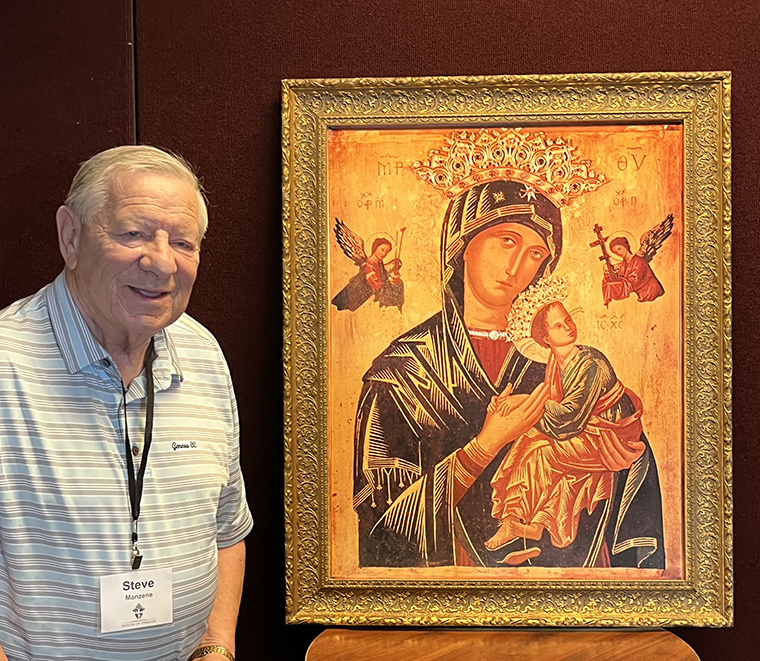
Deacon Steve Manzene with the icon Our Lady of Perpetual Help.
By Dc. Tom Cuskey
Editor
This month, Steve Manzene marks 32 years of ordained service as a permanent deacon. He serves the people of Epiphany Parish in Liverpool, proclaims and preaches the Gospel and gives countless hours of service at local nursing homes, ministering to all. He also has a fervent desire to share what he has learned about a very famous image that was introduced to him early on in his diaconal service.
“Many years ago Father Quinn came up to me, he saw me looking at it,” Deacon Steve shared, recounting his initial meeting with the late Father John Quinn of Utica at an early clergy convocation he attended. Father had given a talk about the icon of Our Lady of Perpetual Help to priests and deacons at the diocesan gathering. “He said to me, ‘Would you like to learn about it?’ I said, ‘Sure, I’d love to!’”
 The icon is one of the most well-known images in the Western and Eastern Christian faith cultures and beyond. The backstory and the meaning of the various elements of the image provide a fascinating tale that is lesser known.
Citing the Vatican Library, MonasteryIcons.com offers that historians first documented its appearance when it arrived at the Church of Saint Matthew in Rome in 1499 from the island of Crete. Stories of miracles and intrigue surrounded it. A Cretan thief supposedly brought it to Rome and mysteriously died shortly thereafter. It became lost, only to be rediscovered through the efforts of Redemptorist Fathers in 1866. Since then the beautiful image has been duplicated by artists and iconographers. It graces the walls of countless churches and holy places around the world.
“There is one hanging in the chapel area at Christ the King Retreat House,” Deacon Steve reported. He recently shared his knowledge of the icon with fellow deacons attending this year’s convocation in September where a copy was displayed. Some of Deacon Steve’s notes on the image — and the questions it raises to the beholder — included:
- The Greek letters on the top left, MP, translate to “Jesus Christ.”.
- The Greek letters on the top right, OV, translate to “Son of Mary.”
- The gold coloring of the background represents eternal life, a theme of this icon.
- The angel at the upper right is holding a cross. It questions the viewer as to how the cross relates to eternal life.
- The angel on the left, upon careful observation, is holding a sword. In the theme of eternal life, it represents the sword that pierced Christ’s side. The blood and water that flowed indicate the waters of Baptism and the blood of the Eucharist. For Mary, it recalls the prediction of Simeon who told her that the “child is destined to cause the falling and rising of many in Israel,” and that a sword would pierce her own soul (Luke 2:34).
- Mary is wearing a double crown, representing that she is queen of heaven and earth.
- Her head covering is a symbol of virginity. The garment extends down with gold beads dangling above her right arm. These are signs of her perpetual virginity.
- Mary is looking at each one of us, inviting us to in turn look at Jesus who wears the crown of King of Kings. His eyes look to heaven; he directs our attention to the Father.
- The gold in the garment that Jesus is wearing represents his divine kingship. Hints of blue also speak to divinity. The gold is shaded in red representing his humanity in the blood he shed on the cross for us.
- Jesus is wearing only one sandal; the other dangles from his foot. This is Jesus inviting us to walk with Him to Eternal Life.
The study of and faithful fascination with icons and their interpretations is well documented through the centuries. At times, it even became troublesome to Church leaders.
“Between 750 and 850 the Church outlawed prayer to the icon because it was taking more and more prayer than the actual speaking to God,” Deacon Steve added. ”When you look and see the depth in that picture, you can see how much spirituality comes from it.”
Deacon Steve also shared “a special thanks to Father John Quinn who gave me these reflections on the icon at one of the first convocations that I attended. May he rest in peace.”