Msgr. Charles Brady: ‘An irresistible force in the struggle for civil rights’
Screenshot
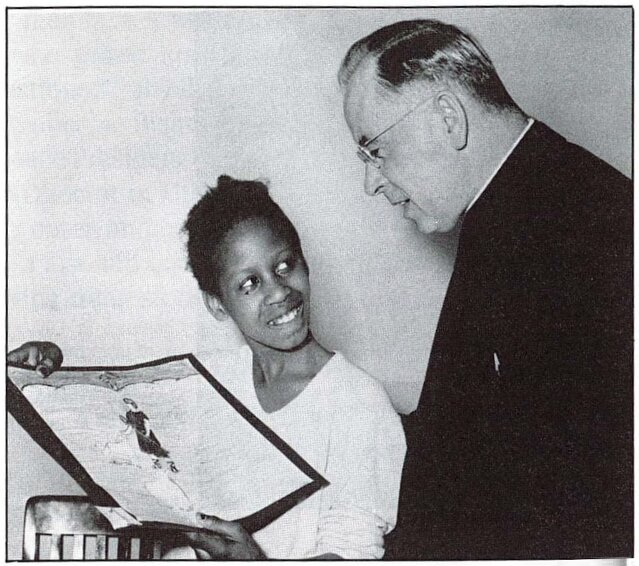
Lillie Belle Boyd shows Father Brady her winning entry in the annual Brotherhood Week poster contest. Photo | Chancery Archives
Remembering the legacy of Father Brady during Black History Month
By many accounts, the late Monsignor Charles J. Brady was an amazing man of many qualities: a leader, a stalwart for justice, a tireless servant, but also an unassuming, humble man who blazed trails with love and kindness.
In a March 1978 editorial in the Syracuse Herald-American, published shortly after his death, Mario Rossi described Father Brady as “Syracuse’s quiet storm of social justice.” In the same article, Rossi recalls Bishop Walter Foery saying, “Father Brady is a saint.” In the introduction to Sr. Alethea Connolly, CSJ’s 1989 biography of Father Brady, God Love Ya, Bishop Thomas J. Costello wrote, “For me, Father Brady was the quintessential ‘be-attitude’ person. Poor, both in spirit and in fact, he gave away all he had, both things and self. Lowly, meek. Merciful and forgiving. Insulted and even persecuted. Single-hearted, he thirsted for what is right and hungered for justice. ‘Be-attitudinal’ indeed!”
Ordained a priest in 1930, Father Brady served for several years as associate pastor at Most Holy Rosary Church and briefly as chaplain at St. Mary’s Hospital before entering the Army just ahead of World War II, serving as a chaplain in the 21st Infantry Regiment Medical Corps. The work that formed his gargantuan legacy, however, began when he returned after the war, when he founded the Bishop Foery Foundation. His mission was to minister to the black community in Syracuse’s inner city neighborhoods, working against the forces of racism and discrimination.
An undated newspaper clipping from the Diocese of Syracuse archives, “Rev. Brady, friend of blacks passes away,” by Kofi Quaye, recounts Fr. Brady’s tremendous impact on the underserved African American population in the inner city, including an improvement in living conditions as well as the elimination of many forms of injustices operating against the interests of black people.
“For almost forty years, Rev. Brady was the pillar on which the community was propped,” wrote Quaye. “Not only did he provide moral direction to us, as an individual living a life of conscience, he provided a leadership that was rooted in idealism. Exhibiting undaunted courage in the face of adversity, Rev. Brady defied all odds to become an irresistible force in the struggle for civil rights in this community. He shattered precedence by being one of the few members of the clergy and of his race that identified with Blacks at a time when any such stance meant courting peril for oneself.”
Today, Fr. Brady’s mission and legacy are carried on through the Brady Faith Center, which was started in 1980 by Father John Schopfer, who continues as the organization’s pastoral director even in his retirement. The Brady Faith Center encompasses a long list of programs, including the Brady Farm, Brady Market, Pedal 2 Possibilities, Vacation Bible School, and more. Father Schopfer explained what the Brady Faith Center is all about, and how its efforts continue the important work that Fr. Brady started.
“About a year after Fr. Brady’s death, I realized how important it was to carry on the work that he started, and we needed a stable home to do that,” Fr. Schopfer said. “The Brady Center is a refuge from street life. This is not the street — it’s a home. It’s multicultural. Everybody — no matter who you are and what you’re coming from — is most welcome, and we don’t judge you. We support you. This is the Brady family.”
Fr. Schopfer said that when he was growing up, everybody knew Fr. Brady, and that he inspired a lot of people to help in his ministry. “If you met Father Brady and had any extra time at all, you wound up doing something with Father Brady,” Father said jokingly.
When ministering to the community, Fr. Schopfer emphasized Fr. Brady’s way of just getting to know the people on a personal level, building relationships with them to learn what their pastoral needs were, and that he, himself, has carried on that way of “connecting beyond the walls,” as he calls it. “You go out and meet the people, and respond to their pastoral needs in any way that’s necessary and feasible. Meet as many [people] as you can. … Walking by, [if] you see someone on the porch, or getting out of the car, coming home, you can say, ‘How are you doing? Is everything going along OK for you?’”
Father Brady is no longer physically with us, but his spirit and ministry live on through the work of Fr. Schopfer and the Brady Faith Center. As Rossi wrote back in 1978, “Father Brady would never completely leave this community; something of him would always be about us, his achievements, his example, his inspiration, his love.”