NYS Historic Register adds St. Peter’s Church in Rome
IMG_7858
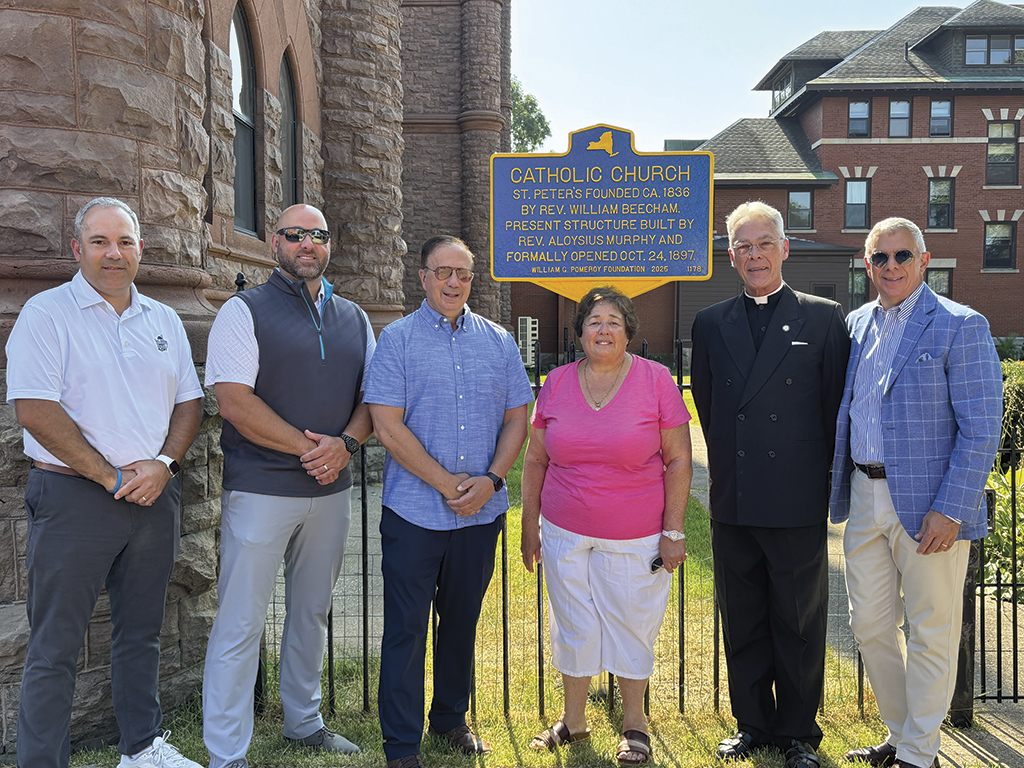
Pictured from left to right: Sen. Griffo’s Chief of Staff Brian Adey, Mayor Jeffrey Lanigan, Sen. Joe Griffo, former commissioner of the NYS Office of General Services and former assemblywoman Ro Ann Destito, and County Executive Anthony Picente. Photos | Tami Scott
On a beautiful, warm, and sunny Tuesday morning in August, Father Sean O’Brien, local officials, and a handful of parishioners gathered outside to celebrate the recognition of St. Peter’s Church on the New York State Historic Register. Present for the unveiling of the long-awaited commemorative plaque were NYS Sen. Joseph Griffo, Oneida County Executive Anthony Picente, and Rome Mayor Jeffrey Lanigan.
“St. Peter’s was the beginning of Catholicism in 1835 here in Rome, and now, as part of Sacred Heart, St. Peter’s is part of a larger community,” said pastor Father Sean O’Brien. “It’s a new beginning for the Catholic community and how we’re going to move forward in 2025, and I love new beginnings.”
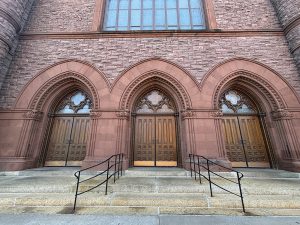
St. Peter’s Church, designed by architect
Archimedes Russell, was constructed with Medina sandstone, earning it a place on the Medina Sandstone Hall of Fame in 2019. Photos | Tami Scott
Effective July 1, Rome’s St. John the Baptist Church, St. Peter’s Church, St. Paul’s Church, and Lee Center’s St. Joseph’s Church became one parish community called Sacred Heart. St. Peter’s, however, is the principal church “given its historical, architectural, and liturgical significance, as well as its central location and ministerial import,” stated the June 5, 2025 decree from the Diocese of Syracuse.
Located at 200 North James Street in Rome, today’s St. Peter’s was constructed in 1897 by world-renowned architect Archimedes Russell, founder of King & King Architects in Syracuse, who also designed St. Matthew’s Church in East Syracuse. The building materials — including Medina sandstone for the facade — were transported by horse and cart along the Erie Canal, Father said. That distinctive feature earned the Victorian Gothic structure a place in the Medina Sandstone Hall of Fame in 2019.
Former commissioner of the New York State Office of General Services, former assemblywoman, and parishioner, Ro Ann Destito; Sen. Griffo’s chief of staff, Brian Adey, also a parishioner; and The William G. Pomeroy Foundation in Syracuse each assisted in the process that led to the esteemed designation.

The morning light shines on
St. Peter’s as people gather for the unveiling ceremony. Photos | Tami Scott
When asked what advantages come with being placed on the state historic register, Destito said that down the road, should the church need improvements, sometimes funds are available to assist in upgrades. She emphasized, however, that the church is currently in “very good shape.”
Primarily, the benefit lies in “the distinction and the recognition of our forefathers that this church has been here,” she said. “It’s historical not only here in the city of Rome — [but] in the state of New York. It is one of the top 10 original churches.”
The first St. Peter’s Church was established in 1836 and was located on the corner of Floyd Avenue and Spring Street. Since then, that location has had a rich history as St. Peter’s School, later renamed St. Aloysius Academy. It then became Rome Catholic School, which shuttered in 2024.
Sen. Griffo remarked on the church’s historical significance — not only from an architectural standpoint but also from the perspective of its parish community — and what it has meant for the city of Rome and its parishioners. He added with a smile that even though it now serves as the principal church of the Sacred Heart parish, we still need to refer to it as St. Peter’s, “because it’s not often you can say you went to St. Peter’s in Rome.”