Project COMPASSION: Pastoral care training for lay ministers
IMG_1697
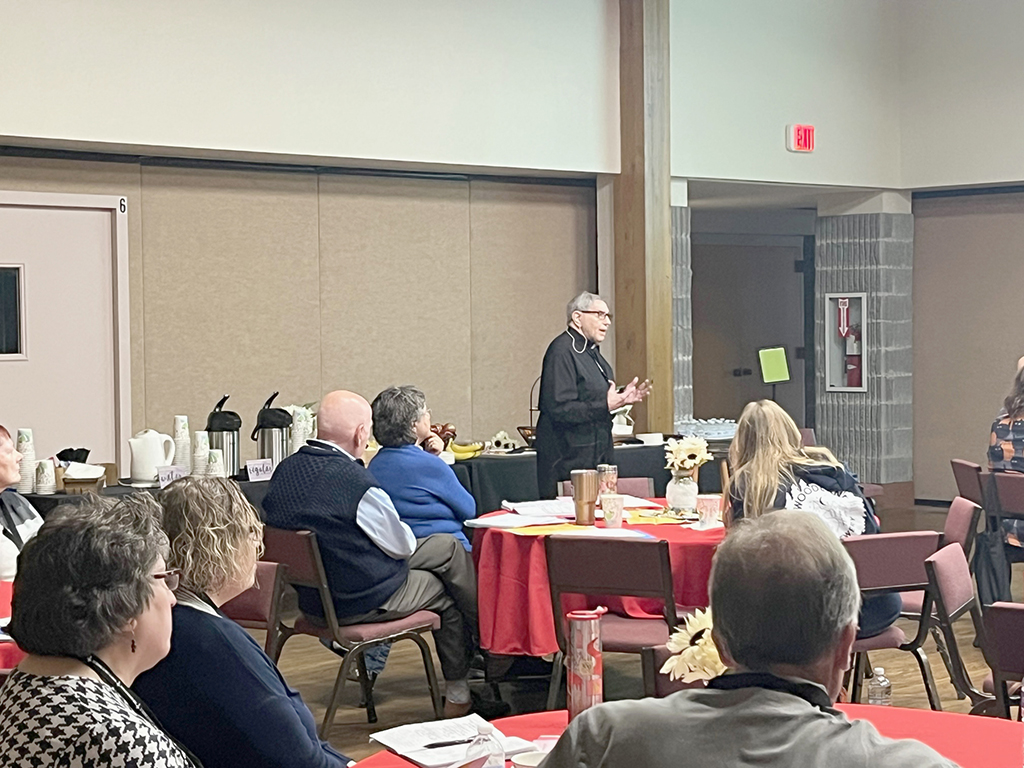
Father Charles Vavonese presents to pastoral care volunteers and staff.
By Eileen Jevis
Staff writer
Vincent D’Angelo is a parishioner at Holy Family Church in Syracuse. He is also the middle school youth minister and assists with faith formation, sacramental preparation and the high school programs. D’Angelo was one of approximately 45 people who attended the Project COMPASSION workshop — a program developed by Father Charles Vavonese and Dr. Paul Fiacco.
The program provides a series of videos from experts that train participants on how to deliver spiritual and emotional guidance to individuals and families coping with serious illness, palliative care, end-of-life moral and medical issues, and grieving and loss.
In an interview with former news anchor Dan Cummings located on the website, Dr. Fiacco shared his perspective on the importance of palliative care and the challenges primary care physicians face due to time constraints because of their busy schedules. “When you give a patient a diagnosis of a serious illness, your treatment plan has to change from a curative therapy to a palliative therapy which is trying to alleviate the patient’s suffering,” said Dr. Fiacco. “You have to educate them about their disease and about end-of-life issues. Because we don’t really have the time to do this, it leaves patients and families trying to navigate on their own.”
Fiacco explained that as a primary care doctor, he has a unique connection with his patients due to long-term relationships with them. He explained that if physicians can have end-of-life conversations early in the diagnosis, they can make a difference as far as quality of life. “Because of the trust our patients have in us, we become a trusted adviser and an advocate for all aspects of their healthcare,” he said.
Fiacco said that he and Father Vavonese developed Project COMPASSION to not only help patients and families with end-of-life issues, but also to help primary care physicians have conversations that are timely, efficient and result in the patient being more educated. “For the Project, we developed a series of videos to also help spiritual care ministers become trained like foot soldiers and go out and help patients both emotionally and spiritually. Because at this stage of life, spiritual care allows the patient to feel at peace and to be accepting of their chronic illness,” explained Fiacco.
During the pastoral care workshop Father Vavonese and Dr. Fiacco taught participants about practical and spiritual preparation for visiting patients and families. They shared tips on how to offer support when visiting those who are in crisis. They suggested that spiritual care ministers should make an appointment to visit the patient or family, introduce themselves to those in the room, acknowledge their suffering, and show care and concern. “As a pastoral minister when you enter the life of another, you are walking on holy ground. Ask the Divine Physician for guidance as you listen to and speak with the person and their family,” said Father Vavonese.
“Father’s description of ‘walking on holy ground’ in this approach to ministry will stay with me through my training in the Formation for Ministry Program,” said D’Angelo. “One of the highlights was simply a very relatable derivation of the word ‘compassion.’ The word originated from the Latin word compati which literally translates to ‘suffering with,’” he said. “That really resonated with me because it is so closely related to our call to accompany each other on our journey of faith.”
“Pastoral Care ministry is about caring for those in need,“ added Eileen Ziobrowski, director of the Office of Adult & Ministerial Formation. “What Father covers in the workshops would apply to the many encounters we have with others as they struggle in life.”
Ziobrowski said there is a great need for pastoral care ministers in the diocese. “If you feel called to serve in this way, if you have a compassionate heart and the ability to listen, you may want to speak with your pastor about the needs in your parish.”
This Pastoral Care Training Program assists volunteers to build on their present knowledge and experience and expand their ministry skills so that they may offer care and concern to their parish family. The program is a hands-on and practical approach to pastoral care delivered in video format. The first three required videos are on Pastoral Care I, II, III. Students will also select two elective videos of the seven available. Those topics include End-of-Life Medial Moral Issues, Spirituality for the End-of-Life, Grieving and Introduction to Palliative Care.
“I was surprised how interested I was in learning more about this ministry opportunity,” said D’Angelo. “I had preconceived ideas about this ministry but having learned more about it and listening to the testimonies of the participants, I’m inspired to learn more. I highly recommend everyone visit the Project COMPASSION website when it becomes available. I feel that this workshop has better prepared me to answer God’s call to minister to those in need.”
For more information on Formation for Ministry, contact Eileen Ziobrowski at 315- 470-1491 or [email protected]. Information on Project COMPASSION will be available in November when the website is live. Project Compassion was funded by the Mother Cabrini Health Foundation.