
Seeking hospitality for the homeless
IMG_8803
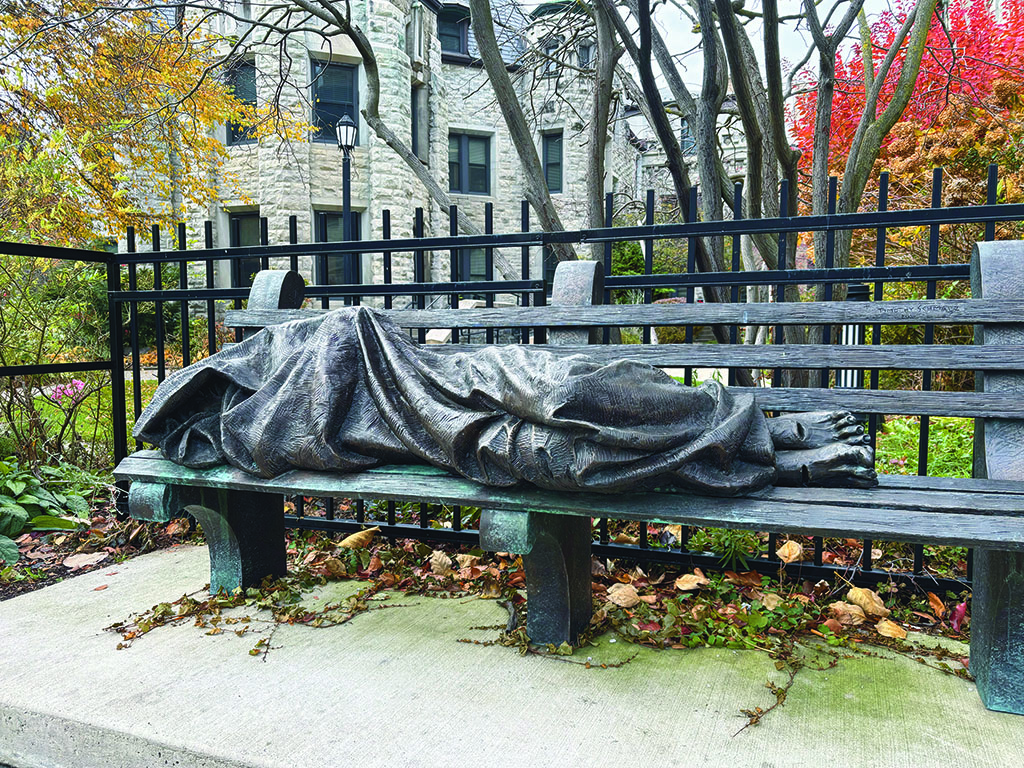
Installed directly outside the Cathedral of the Immaculate Conception in Syracuse is the “Homeless Jesus” statue. The sign next to the statue reads, “This poignant sculpture places Christ with the most marginalized in our society.” Sun photo
Data indicates — and our own eyes register the truth if we step outside in local urban areas — that homelessness is on the rise.
According to the U.S. Department of Housing and Urban Development’s (HUD) 2024 Annual Homelessness Assessment Report (AHAR) to Congress, a total of 771,480 people in the United States experienced homelessness in 2024, and the number of people experiencing homelessness on a single night in 2024 was the highest ever recorded.
The AHAR also showed that New York State has one of the highest rates of homelessness in the country, second only to California. Narrowing down further, in Onondaga, Oswego, and Cayuga counties, there were 1,192 homeless individuals in 2024, a 67% increase from 2022 (Jan. 2025 “New Yorkers in Need: Homelessness in New York State” report from the New York State Comptroller’s Office).
HUD and the United States Interagency Council on Homelessness point out several causes of homelessness in our country: affordable housing shortages; high inflation; wages that do not keep up with rising rents and housing costs; lack of access to quality health care, including mental health care; and the end of homelessness prevention programs put in place during the COVID-19 pandemic are all contributing factors.
So, what is being done to help the housing-vulnerable and unhoused population who live right here in our own community?
Recognizing the humanity of this population and helping to meet their most basic needs has long been the work of Catholic Charities of Onondaga County (CCOC). CCOC has operated an emergency men’s shelter for decades. It’s an 80-bed shelter relocated in early 2023 to 1801 Erie Boulevard East in Syracuse. CCOC also operates an overnight Hospitality Center, Cathedral Emergency Services (CES), located at 262 E. Onondaga St., which is open nightly from 4 p.m. to 8 a.m. These two sites offer many essential services to our housing-vulnerable neighbors. Yet CCOC leadership recognizes the need for a hospitality center during daytime. Individuals need a welcoming place at all hours, both night and day.
“We, firsthand, have seen upwards of 40 individuals who spend the night” at the overnight Hospitality Center, said CCOC Executive Director Mike Melara. “And one of the challenges,” he continued, “is at 8 o’clock in the morning, you know, they need to leave. And so that has kind of been a pressure point for us.”
At the beginning of 2025, Onondaga County contacted CCOC, expressing interest in collaborating to create an expanded version of the overnight Hospitality Center. This triggered the search for a new location with increased space, ideally equipped with several bathrooms and showers.
“That was exciting for us,” Melara said, “to think that we could expand what we currently do. And what was even better was the County was going to deliver services in this same [future] building. So, there’d be a hospitality component, and then there’d be health, mental health, and peer recovery services all in the same building, [being] offered to these unhoused individuals.”
Melara explained that many city and county officials came together as a planning team, identified a location that seemed suitable, and were pursuing further exploration of the site. However, even though the location had not yet been made public, efforts to pursue further planning of the site were paused due to a petition demanding the location be disqualified. It was a disappointing development.
“I think what the Catholic Charities team found most disappointing is that on any given day, there’re 40 to 60 unhoused individuals who spend the majority of their day on the streets, who cannot get their most basic needs met, including having a restroom, having a place to get a drink of water,” said Melara. “Our plan, no matter what the location, is to talk to the neighbors. We want to make sure that we hear the voices of community members. The trick is you have to have enough of a plan to be able to share with the community, so that you’re anticipating some of their questions, and also hearing what their concerns are, still modifying your program based on those concerns.”
The team hasn’t given up on securing a site for a 24/7 hospitality center, according to Melara.
“We’re just going to keep working away until the right spot makes itself available. It’s just taken us a little longer than we thought. So, for us, it’s about persevering. And it’s not just for us. We’re persevering on behalf of folks that just really have no place to go,” he said.
Every effort counts
By Tami S. Scott
Editor
When the doors open at 4 p.m. at Catholic Charities of Onondaga County’s (CCOC) current overnight Hospitality Center, guests walk through a narrow hallway to a small, rectangular-shaped room furnished with chairs backed up against the long wall. A few new plastic rocking chairs form a separate row in the vicinity of an average-sized television. There’s a table, a microwave, books, and magazines. Light snacks are available. Women and men sit on opposite sides, and sometimes a caseworker joins them to offer support.
One late afternoon just last month, the room wasn’t yet as full as usual. It was a mild and sunny fall day; no urgent need to seek protection from extreme temperatures or inclement weather. The Hospitality Center comfortably accommodates 40 people. Anyone in excess of 40 individuals must be turned away. There is a single half-bath, and no place to rinse off or clean up, because the building’s plumbing can’t handle the demand. “It’s meant to be an office building,” said Jessie Butts, CCOC Program Officer for shelter & emergency services. “It’s not meant to be what it is. We need somewhere where the plumbing can handle it.”
Despite the lack of basic amenities and restricted hours, individuals experiencing homelessness are familiar with CCOC’s Hospitality Center and trust they will be welcomed and safe. Ideally, CCOC will find a location in or near downtown Syracuse and can expand hours of operation to 24/7. “If [the Center] is too far out of downtown, they’re not gonna go,” said Butts. CCOC is seeking, for those in need, not just a place to go, but also access to nearby services.
“We already are doing this,” said Lindsay Cronkright, CCOC’s Chief Financial Officer. “We actually provide the service whereby we will shuttle anyone to any of the shelters in our county, not just ours — Rescue Mission, Salvation Army, Vera House — it’s a true community service for men, women, and children. We have already proven it’s a success, and there is a need. We just want to expand our hours to 24/7.”
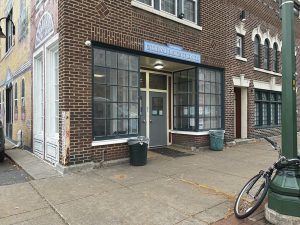
The front entrance to Cathedral Emergency Services, the overnight Hospitality Center operated by CCOC and located at 262 East Onondaga Street. Sun photo
The goal is to welcome as many people as possible at CCOC’s Hospitality Center in hopes that CCOC can then assist with securing temporary or permanent shelter. In general, once an individual is sheltered, he or she is more receptive to receiving other life-altering services.
Melara recognizes the concerns of business owners, residents, and the general public who witness inconsistent or difficult behaviors from potential patrons that are directly related to untreated mental health needs and or substance abuse. “I’m of the belief that if we can create a space where people belong and can get their basic needs met, then we will likely see a decrease in troubling behaviors. [A 24/7 hospitality center] could be a very productive response to a community problem. Things could get better.”
Cronkright, too, offered perspective on the ongoing issues affecting the unhoused population. Although she and her team are vigorous advocates for marginalized individuals, they cannot develop viable solutions on their own — nor should they. “This is not a Catholic Charities of Onondaga County problem,” she said. “This is a city of Syracuse, County of Onondaga problem. We cannot be expected to solve this. It really takes the system. It’s bigger than us. If someone wants to pose ideas or offer locations, we’re more than willing to consider them, but we can’t do this on our own.”
Melara again emphasized the importance of opening doors to a place where CCOC personnel can build relationships with individuals. “They’re just on a tough path right now. They are not invisible. They are real people with their own unique stories,” he said. When CCOC’s men’s shelter on Erie Boulevard East first opened, Butts recalled a couple of men in tears, overwhelmed by the efforts made to create a better environment for them. “When you’re able to meet with these people and build that rapport, it affects everybody — us and them,” she said. “We have guys that will still come back just to say, ‘Hey, look what I’m doing. Look how good I’m doing.”