‘The deep breath of prayer’
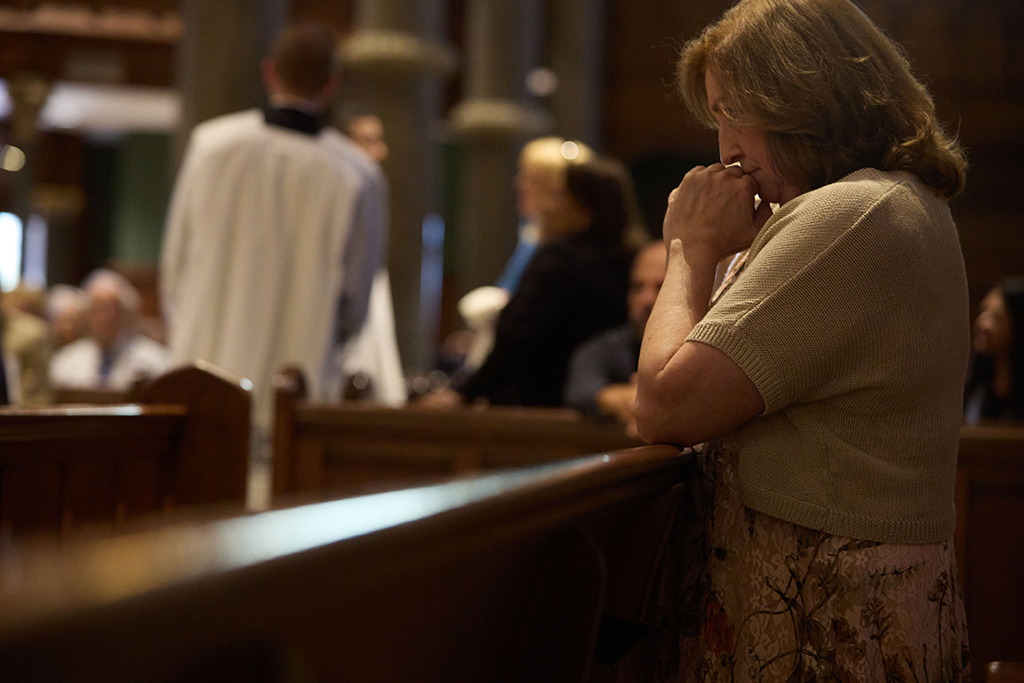
1Y4A3291
Preparing for Jubilee 2025, ‘Pilgrims of Hope’
By Tami S. Scott, associate editor
In January, Pope Francis designated 2024 as a Year of Prayer, calling Catholics worldwide to intensify their prayer lives leading up to Jubilee 2025, themed “Pilgrims of Hope.” It is now seven months into the Year of Prayer — so we at the Sun decided to tackle the Pontiff’s request with an article that may help us all get on board with prayer no matter where we are on our journey.
As pilgrims of the Christian faith, prayer is the air we breathe to sustain and strengthen our spiritual life and relationship with God. Without it, our foundation crumbles.
 In a 2013 Apostolic Exhortation, Pope Francis wrote: “Without prolonged moments of adoration, of prayerful encounter with the Word, of sincere conversation with the Lord, our work easily becomes meaningless; we lose energy as a result of weariness and difficulties, and our fervor dies out. The Church urgently needs the deep breath of prayer …”
Gratefully, there are multiple ways to converse and connect with God through liturgical, communal or personal prayer (note that eloquence is not required).
Deacon Michael Ruf, of the linked communities of Christ the King and Pope John XXIII in Liverpool, is currently leading a prayer study group at Pope John XXIII. About 40 people attend each week to learn and hold discussions based on a book by Father Ronald Rolheiser, “Prayer: Our Deepest Longing.”
“It’s about how do we pray? What are the challenges to prayer? You know, our busyness in our lives, our distractions, all the voices we have coming in and how do we discern God’s voice? So [the author] helps,” Dc. Michael said. “He gives you a lot of food for thought.”
For this article, the Sun sought insight on prayer with Dc. Michael, who is also a spiritual director through the Spiritual Renewal Center. We spoke with Sister Laura Bufano, vicar for Pastoral Leadership and associate director of Pastoral Planning in the Office of Pastoral Leadership and a spiritual advisor. Additionally, we met with St. Mary’s Church, Baldwinsville parishioners Cindy Horton and Renée Romance (the Eucharistic Adoration coordinator) about their prayer lives and any advice for people struggling with time, words or ways to pray.
So, what’s it all about?
“For me, prayer is about awareness,” Sister Laura said. “It’s about being aware of God’s unconditional love and that it’s not relegated to only one part of the day or one part of my life.”
Sister spoke about being attentive to what surrounds you — to the beauty of creation, to the person sitting in front of you — because everything is connected and “because God is not going to miss an opportunity to get our attention.” She said a central theme to Benedictine spirituality (based on the Rule of St. Benedict) is to “listen with the ear of the heart.” If something stirs your soul — a Scripture verse, a song lyric or simply wanting to sit in silence, reflect on the message you’re receiving from God.
 “During quiet time, and with the attentiveness, it moves us, moves me, to action,” she said. “It’s not just about Jesus and me. It’s bigger than that because that’s where we’re the most one with God, so when those nudges come, I will pray for the person (who comes to mind) and sometimes I will be led to action” — through a phone call, a visit or another means.
Reading the Psalms is another way to direct your thoughts toward prayer. “Every emotion is expressed in the Psalms,” Sister said. “Psalm 139 is an awesome place to start.” She said even repeating just one line for a week can be used as a base to start a conversation with God. “[Don’t] be afraid to simply sit and listen,” she said. “With a repeated phrase, you get to a point where you don’t need to repeat it anymore. It can lead you to that place – that peaceful place, that stillness.”
Dc. Michael spoke of an ancient way of looking at prayer, by lifting our hearts and minds to God. “That’s prayer,” he said. “And then we don’t always lift up what we think God wants to hear. We lift up what we need to lift up – if we’re angry and we’re in pain, if we’re joyful, if we’re happy — all the emotions. We lift those up in our hearts and our minds to God. That is of itself a prayer.”
Sister Laura also emphasized that you don’t have to be specific when you go to God with prayer because God already knows you. “He already knows all your wants and your needs and your fears and your desires,” she said. “Sometimes, I literally say that to God, ‘I know you already know.’”
Above all, Sister Laura and Dc. Michael equate a grateful heart as central to prayer.
“Every time it comes down to gratitude,” Sister Laura said. “I meet monthly with my spiritual director. We have conversations about where I am with God, where I am with my prayer, and almost always I end up saying, ‘Well, it’s gratitude again,’ even when things are challenging or difficult, it comes down to gratitude. That’s the distillation.”
Dc. Michael quoted a 13th-century German theologian and mystic Meister Eckhart as saying, “In the end, the only prayer we need is thank you.”
Schedules, struggles and perseverance
 St. Mary’s of Baldwinsville parishioner Cindy Horton carries with her a little book that has the names of all the people she’s praying for in it. It’s divided into sections based on needs or requests. She also says a special prayer for priests, bishops and the pope.
“My morning prayers are an hour and a half long,” she said. “I pray for many, many people.” Cindy has a dedicated space in her home, away from distractions, so she can focus on her time with God. She also attends Adoration on Tuesdays at St. Mary’s.
“It’s a renewal every day, my prayers,” she said. “And that’s important to me to be on the right path for the day. I want God to know that I’m ready for whatever he has, whatever he wants of me that day. I try to be prepared for it and let him know that I am ready.”
Horton’s prayer life wasn’t always this devout, however. “I had been away from the Church for a while. Quite a while. My mother was [the] Catholic in the family and my dad wasn’t. I didn’t get instruction at home. We didn’t say grace, we didn’t do that,” she said. “When I came back, I wanted it so much for myself and my family that I came back much stronger.”
She began to say the Hail Mary and the Our Father again. At Mass, she’d pick up certain prayers she liked and collected pamphlets and books until she came to a point where she found what resonated with her. “And now a good share of my praying is my own,” she said. Horton also noted that her prayer time isn’t limited to mornings – she prays throughout the day, too. “It’s not formal prayer, just talking to God,” she said.
Fellow parishioner Renée Romance is currently struggling with a set prayer schedule. “I used to have a routine and I fell out [of practice],” she said. But she finds the centering prayer — when you take certain phrases and say them over and over again — to be extremely beneficial. For her, it’s a line from the Surrender Novena: “O Jesus, I surrender myself to you, take care of everything!” “As I go throughout the day, when I feel anxious or when something’s unfolding that, you know, I’m like ‘whoa, what’s happening?’ Then it’s kind of like an anchor.”
Romance also journals her thoughts and tries to pen daily gratitudes but admits she wrestles with routine. However, she leads a weekly Bible study and enjoys group rosary recitation. “There’s really a lot of power in community prayer, all the voices come together and it’s just a really beautiful way – it’s personal yet it’s community,” she said.
Romance, like Horton, also fell away from the church. When she returned, she admits she “wasn’t really sure how to pray.” “Even though [my prayer life] is not where I want it to be, I feel like it’s [grown] leaps and bounds from when I first came back to church 10 years ago. Everything’s baby steps and sometimes you take a few steps backwards and then go forwards.”
When asked for advice on how to pray or what to say, Romance echoed Sister Laura’s sentiments. “God knows our hearts,” she said. “He knows us, he created us and so he knows however we talk — I think that’s a stumbling block for people, you know, that it should be a certain way — but you can’t be intimidated by it because you’re trying to get closer to Jesus and he knows who you are and he knows where you are in your faith.”
And if you still don’t know where to start, a simple thank you is enough.