The joy of Christmas through the octave and beyond
NATIVITY SCENE CHRISTMAS
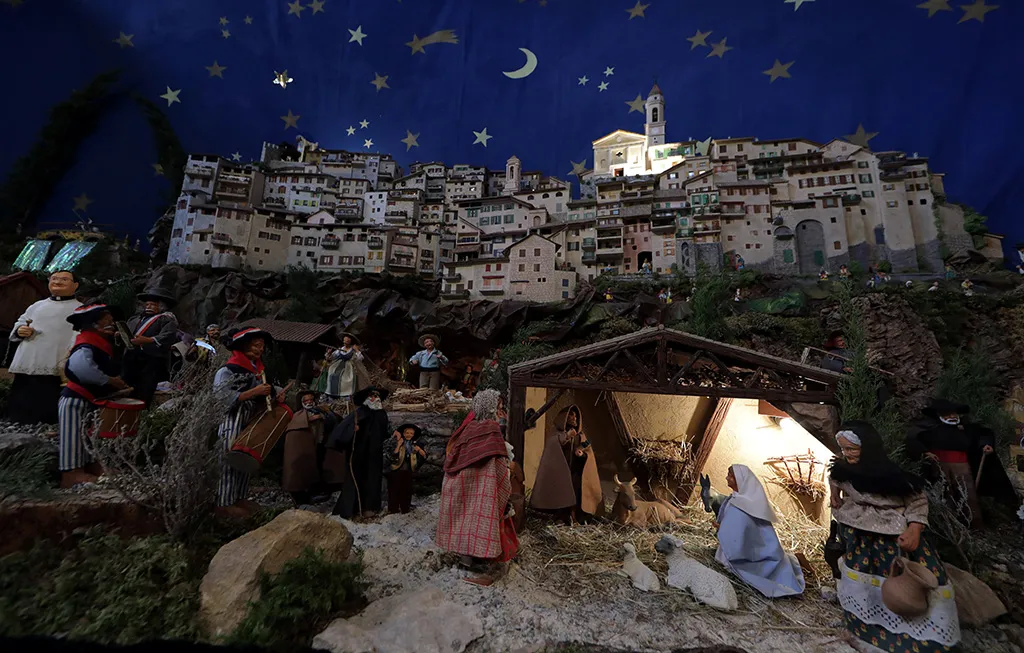
A Nativity scene is seen in Saint Pierre chapel in the medieval mountain village of Luceram as part of Christmas holiday season, France, Dec. 15, 2016. Luceram presents more than 450 creches (Nativity scenes) from the tiny to the huge yearly in December as part of the Circuit des Creches. (OSV News photo/Eric Gaillard, Reuters)
By Leonard J. DeLorenzo , OSV News
(OSV News) — The Lord of all comes to us wrapped in swaddling cloths and lying in a manger. This is God’s great proposal — his knock upon our door.
He would not force his way into our world or into our lives. He has come meekly. And to our credit, some of our number received him with great care. This is part of our reason for joy at Christmas, and during the Christmas Octave, the Church schools us in the memory of this joy.
— The Nativity of the Lord (Lk 2:8-11)
According to St. Luke, the Good News comes first to shepherds. The angelic announcement imitates an imperial proclamation, so that during the time of the emperor’s census, the far greater savior and benefactor is hereby made known. But the shepherds hear that this great glory of God is given in meagerness and humility contrary to the great images of power.
From this dizzying light, upon these confounding words, and after the suddenness of this event, what do the shepherds do? “(They) said to one another, ‘Let us go, then, to Bethlehem to see this thing that has taken place, which the Lord has made known to us'” (Lk 2:15).
The shepherds act upon what they have heard but do not yet understand. Their initial response to the Good News is to draw nearer (cf. Lk 2:16). The next response is to proclaim what was made known to them about the child (cf. Lk 2:17). And their final response is to return from whence they came, but now “glorifying and praising God for all they had heard and seen” (Lk 2:20).
They hear, they seek after, they bear fruit. They rejoice at the coming of Christ.
— The feast of the Holy Family (Mt 1:24-25; Lk 2:51)
God found a friend in his servant Joseph. Here was a man who would wait upon the word of the Lord, following neither his own impulses nor the conventions of his day, but instead would obey the command of the Lord first of all. Because of Joseph’s obedience, the Son of the Most High humbled himself to take cover under the name of Joseph, while the mystery of Mary’s motherhood was protected under the spousal care of her most chaste spouse.
Mary opened her heart to the mystery of this child, whose origin she both knew and did not know. From the time the angel came to her, she pondered the word of the Lord (cf. Lk 1:29, 2:19, 2:35, 2:51). Upon first receiving the word of God, she “set out and traveled to the hill country in haste” (Lk 1:39) and there proclaimed the glory of the Lord (cf. Lk 1:46-55). She is the best of soil to whom the word of God comes: ready, attentive, responsive, fruit-bearing.
It was in the household of Joseph and Mary that “Jesus advanced (in) wisdom and age and favor” (Lk 2:52). He grew from Joseph’s obedience, from Mary’s pondering and sacrifice. Their regard for one another and for their son, in fidelity to the Lord, created the culture in which the Son of the Most High was first received into this world. This was a family cultivated by two people who were — as St. Paul later hymned — patient and kind, not jealous or boastful, not arrogant or rude; they “(bore) all things, (believed) all things, (hoped in) all things, (endured) all things” (cf. 1 Cor 13:4, 5; 1 Cor 13: 7).
— The feast of the holy innocents (Mt 2:18; cf. Jer 31:15)
The winds of malice came swiftly for Jesus, who was sheltered from this harm by the obedience of Joseph. Herod’s rage at the newborn king did not reach its target. Nevertheless, there were victims: “He ordered the massacre of all the boys in Bethlehem and its vicinity two years old and under” (Mt 2:16). These holy innocents were the first to be confused and punished for Christ, as every martyr thereafter would seek to be.
These infants were the most vulnerable: All they could do was receive. They would receive from others either care or cruelty, kindness or callousness, nurturing or neglect, what was good or what was evil. From Herod, their ruler, they received the sentence of death because of his hardness of heart and irascible pride.
But the Lord hears the blood of victims crying out to him from the ground (cf. Gn 4:10). They are gathered up in Christ’s sinless sacrifice when the time comes. In him, their memory through the memory of the Church by the witness of the Gospel and the work of the liturgy. They received the Lord by their blood.
Along with these holy innocents, Christ claims all the poor, the lowly, the victimized and the exploited as his own.
As St. Oscar Romero preached, they are the ones who truly rejoice at the coming of Christ: “No one can celebrate a genuine Christmas without being truly poor. The self-sufficient, the proud, those who, because they have everything, look down on others, those who have no need even of God — for them there will be no Christmas. Only the poor, the hungry, those who need someone to come on their behalf, will have that someone. That someone is God, Emmanuel, God-with-us. Without poverty of spirit there can be no abundance of God.”
— Epiphany (Mt 2:9-11)
Who are these Magi? As Pope Benedict XVI attests in his study of the Infancy narratives, the meaning is not clear. They were perhaps “members of the Persian priestly caste” or “rulers of a distinctive religion … (whose) religious ideas were thought to be strongly influenced by philosophy.” Otherwise, they may have been “possessors and users of supernatural knowledge and ability, magicians, and finally deceivers and seducers.”
What is more important than ascertaining precisely who they are is noticing what they do. They fall down and worship. With whatever wisdom they possessed — whether natural or unnatural, trustworthy or illusory — they come seeking “the newborn king of the Jews” (Mt 2:2). Their reading of the stars has led them to seek after understanding, and they have come to find him who is the reason for the appearance of the star that has disrupted their study. Their own ways have been disturbed, and they take notice.
As Benedict XVI concludes: “The key point is this: the wise men from the east are a new beginning. They represent the journeying of humanity toward Christ. They initiate a procession that continues throughout history. Not only do they represent the people who have found the way to Christ: they represent the inner aspiration of the human spirit, the dynamism of religions and human reason toward him.”
The star in the East appeared in the sky for all to see, but it is these Magi who, following it, “have come to do … homage” to the one to whom the star leads (Mt 2:2). Like the disciples who asked Jesus what the Parable of the Sower meant, the Magi have stepped out of the crowd in their desire to let the meaning of this sign change them. They pass right by the arrogant ruler puffed up on his own understanding — Herod — as they persist in seeking the one worthy of their worship.
— Baptism of the Lord (Lk 3:16)
The first time John the Baptist was in the presence of Jesus, he “leaped for joy” in his mother’s womb (Lk 1:44). From the start, the coming of Christ has been the source of John’s joy. John is most assuredly unlike those who when they first hear the word of God “receive the word with joy” but, because they do not allow the word to sink down deep within them, eventually fall away (Lk 8:13).
John proves that he is not rocky soil. What he rejoiced at in infancy, he rejoices at in adulthood: the coming of Christ is his joy.
Welcoming the Lord is a costly sacrifice for John as an adult. When he was a child in his mother’s womb, he had nothing of his own. But as a grown man, he has a following; he has realized success in his ministry. He is a man of influence. There are many thorns that could prevent John from welcoming the Lord. Indeed, welcoming the Lord now means prioritizing the one truly necessary thing, and relativizing everything else. He receives the Lord under his hands, he does his part, then he gives Jesus priority. He chooses joy in choosing Christ.
— Presentation of the Lord, or Candlemas (Lk 2:34-35)
The final feast of the Christmas season (by its full 40-day observance, running to Feb. 2), brings us to the Temple, where Mary and Joseph present their son as an offering to the Lord. (There are three Jewish rites combined into one event here in Luke’s Gospel, but tending to that will take us away from our main point.) Jesus is received by the righteous and devout man, Simeon, who proclaims the coming of this child as the salvation of all: a light to the Gentiles, the glory of Israel.
The joy of receiving him, though, is again tied with the danger of his arrival. Now is the time when the true character of each heart is laid bare, because the presence of Jesus forces a decision.
In the book of the Prophet Isaiah, the Lord speaks confounding words through the prophet to his people. At one point, the Lord instructs Isaiah to prophesy that: “(The Lord) shall be a snare, a stone for injury, a rock for stumbling to both the houses of Israel, a trap and a snare to those who dwell in Jerusalem; and many among them shall stumble; fallen and broken; snared and captured” (Is 8:14).
God himself is here the rock upon which men stumble and fall. By the words of Simeon, Jesus, who is God’s living word and the presence of God’s saving action, is the one upon whom rising and falling will be determined. Against him, illusions will disperse and the truth will remain. He is the one who draws out the secrets hidden in the hearts of many. Why? Because everything depends on whether people will welcome him or reject him. In Jesus, God has made himself the guest and put us in the position of host.
At the close of the 40 days of Christmas, the Church echoes Simeon’s unambiguous announcement that the savior has come. This good news is inseparable from the imminent fulfillment of Simeon’s prophecy: The thoughts of many hearts shall be revealed.
It is both consoling and challenging, then, that Mary’s own heart — her soul — is presented to us right in the middle of this proclamation. She is the one who never fails to bring the word of the God into her heart, to give him priority, to offer her entire life to him, and to sacrifice for him.
She welcomes him even though welcoming him fully means sharing in his passion, accepting sorrow after sorrow for love of him. She will weep when he weeps and rejoice when he rejoices.
She is the good soil. She nurtures us, whom she claims as her children, to become good soil, too.
Leonard J. DeLorenzo is a professor of the practice in the McGrath Institute for Church Life and concurrent professor in the department of theology at the University of Notre Dame.