
Happy New (Liturgical) Year!
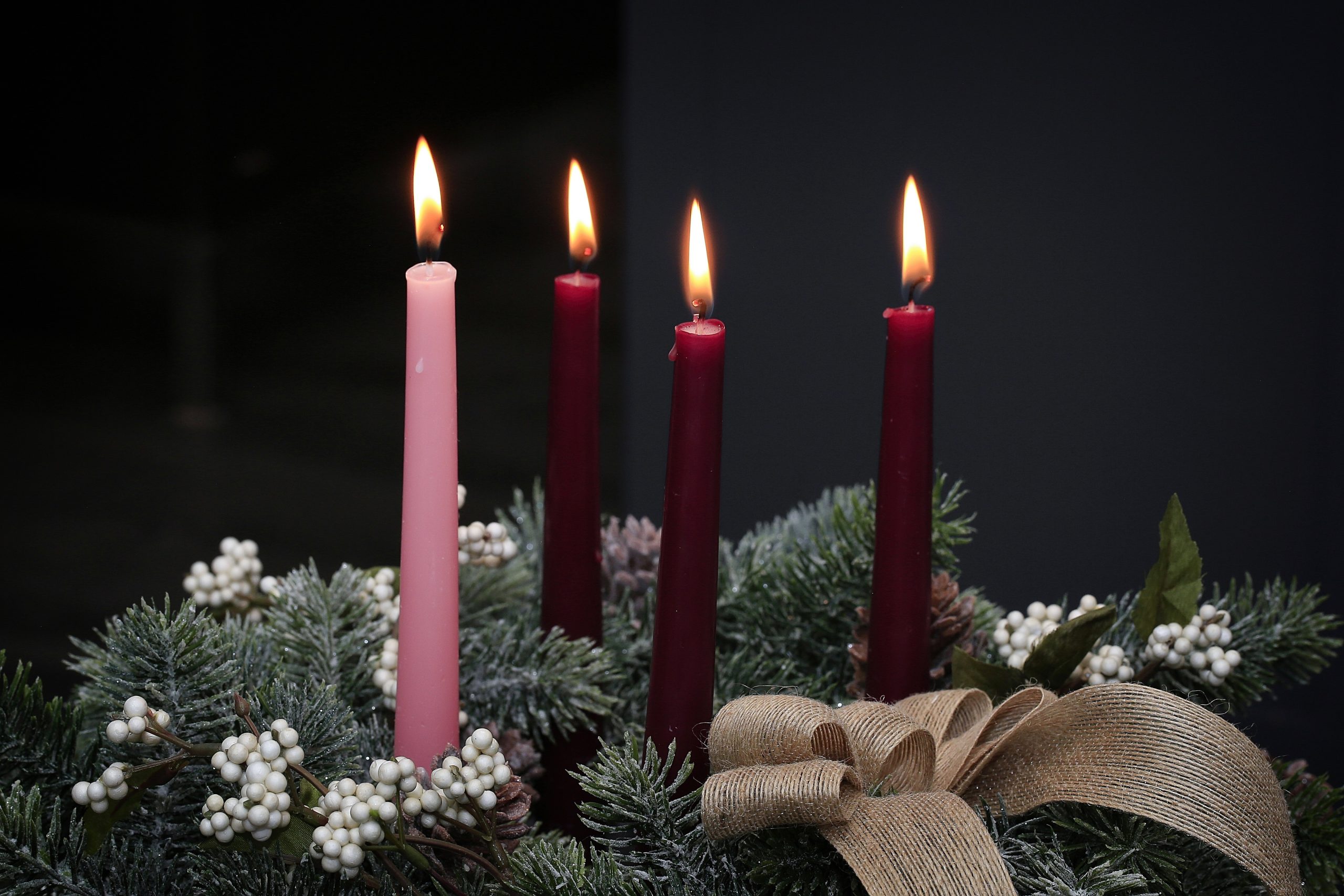
ADVENT CANDLES
Advent candles and a wreath help bring focus to the time before the coming of our Lord. Each candle represents a week of Advent. (OSV News photo/Nancy Wiechec)
(OSV News photo/Nancy Wiechec)
The Advent season is upon us.
The season of Advent can be . . . well, confusing to those who do not pay close attention to what’s coming.
It’s purple in church-color, like Lent, but pre-Easter fasting doesn’t seem to fit in here. After all, Andy Williams is singing “It’s the most wonderful time of the year,” isn’t he? We must remind ourselves, though, that he’s talking about Christmas and it’s not that time yet, at least not in practicing our faith. Yes, everyone seems to be partying, and that’s okay. Our true Christmas celebration begins on December 25th. Yes, Advent may be confusing to those who don’t know Jesus, but very spiritually rewarding to all who welcome him.
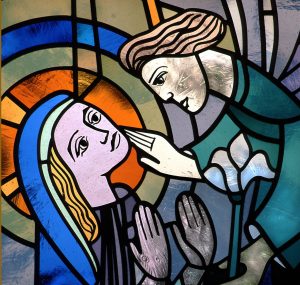
In this church window depicting the Annunciation, the angel Gabriel appears before Mary to proclaim that she is to be the mother of Jesus. The window is from St. Mary’s Church in Willmar, Minn. The hymn, “The Angel Gabriel From Heaven Came,” focuses on the Annunciation. (CNS photo/Crosiers)
Like Gabriel says to Mary in the Gospel for the 4th Sunday of Advent in this liturgical year, “Do not be afraid.” What follows is a random collection of things to know about Advent to get you into the true spirit and prepare you for the celebration of Christmas.
Short wait
Unlike Lent which is always a 40-day observance, Advent can vary depending on what day of the week Christmas falls on. This year it’s a Monday so – voila – we have the briefest observance of Advent possible coming up, 22 days. December 24 is the 4th Sunday of Advent as well as the sole day in this year’s fourth week. The longest Advent possible lasts 28 days, four full weeks, occurring when Christmas falls on a Sunday.
Hoping an Advent calendar might make it easier to keep track? Make sure you find one that fits the faith. If it’s been a while, the calendar is a daily countdown to Christmas that often offers a daily treat. Some are just 12 days long (think “On the first day of…”) while others might span the month of December. CNN.com recently shared their 57 best Advent calendars (some of them are for pets!). The prices range from $8 to – gulp — $1933 for a calendar that gives one a different gift of fine jewelry for 12 consecutive days. Editor’s note: even Gabriel would be afraid after reading that.
A little history
According to the U.S. Conference of Catholic Bishops website (usccb.org), Advent wreathes are traditionally made of evergreen branches woven into a circle. It supports four candles, one for each week of the season. A new one is lit each Sunday. White candles may be used but they are most always purple, except for one pink or rose candle lit on the Third Sunday, Gaudete Sunday. This is the Latin word for ‘rejoice’ and it marks a time of joy that we have reached the midpoint of our waiting for Christmas. More importantly, lighting one more candle each week symbolizes the approaching Light of Christ. The world grows ever brighter as the celebration of his birth draws near and as we wait in hope of his Second Coming.
—————————————————————————————————
Watch Bishop Lucia’s Message for the 1st Sunday of Advent HERE
—————————————————————————————————
The origins of Advent itself are not perfectly documented. Catholic News Agency reports that in 480, St. Perpetuus decreed a fast for the monks, three times a week lasting from the Feast of St. Martin of Tours (November 11) until Christmas. The Council of Tours made that a law for monks in 567 and was expressed in specific detail by the Council of Macon in 582. Through the centuries the season evolved and a focus on fasting was part of the observance, much like Lent. The practice was losing momentum, though, leading Pope Urban V to take some of the official fasting requirements off of the laity in 1362. Liturgically, St. Gregory was the first to organize the observances of the season in the 8th Century. The evolution to the Advent we know today can be found here: https://www.catholicnewsagency.com/resource/55951/the-history-of-advent
Why purple?
A file photo shows an Advent wreath at the Vatican. The third Sunday of Advent is known as Gaudete Sunday. (CNS photo/Paul Haring)
As we know, purple is the vestment color of Advent and Lent, and is commonly the color of the stole a priest will wear when hearing confessions. Our friends at the Arlington (VA) Catholic Herald report that the colors violet and purple signify penance, preparation and sacrifice. Historically, purple was also a color of royalty. Various shades of the color may be used. The Herald suggests that violet, a shade of purple might be used in Advent; it has hints of blue, the color associated with the Blessed Virgin. A more reddish shade of purple could be used in Lent, signifying the sacrifice of the Cross.
O Antiphon!
This makes a great Catholic trivia question: what are the O Antiphons? These verses date back to the 8th Century and are part of the Daily Office Evening Prayer for December 17 through the 23rd. Each of the seven antiphons begins with “O,” hence the name. The keyword that ties them together, however, is “come.” They are prayers of longing and expectation of the Messiah. Read them here: https://www.usccb.org/prayers/o-antiphons-advent
It’s all about…
Liturgical themes for Advent focus on our expectation today of Christ’s Second Coming. Just as we celebrate the birth of Christ at Christmas, Advent is a time to remember — through Scripture, prayer and meditation – of how our faith prepared us for his birth and how God fulfilled his promise of the Messiah. Themes relate, of course, to the Scripture readings of the season and cycle. We are entering Cycle B in our annual liturgical rotation, a time that focuses primarily on the Gospel of Mark. During Advent, we will hear from Mark on the first two Sundays, followed by John and Luke. Hallow.com shares that the weekly themes this year are, in order, hope, peace, joy and love. Readings will also set a mood of watching and waiting during Advent.
Wrapping it up
The best place to learn about Advent and the rest of the new liturgical year is in church, of course. There is no greater classroom than the sanctuary where the priest offers the Mass. So, go to Mass, as often as you can during Advent. Check to see if your parish offers a livestream recording. If not, you can be part of Mass any day, at any time by visiting the diocesan Catholic TV YouTube channel (https://www.youtube.com/@syrdio). Weekday noon Masses are livestreamed; might make a great evening watch if you flip channels and find nothing else that can make your day and change your life.
Some additional links to content mentioned here are below.
https://www.catholicherald.com/article/columns/what-do-liturgical-colors-mean/
https://www.catholicnewsagency.com/resource/55951/the-history-of-advent