Imitators of God
lucia-house cassock (1)
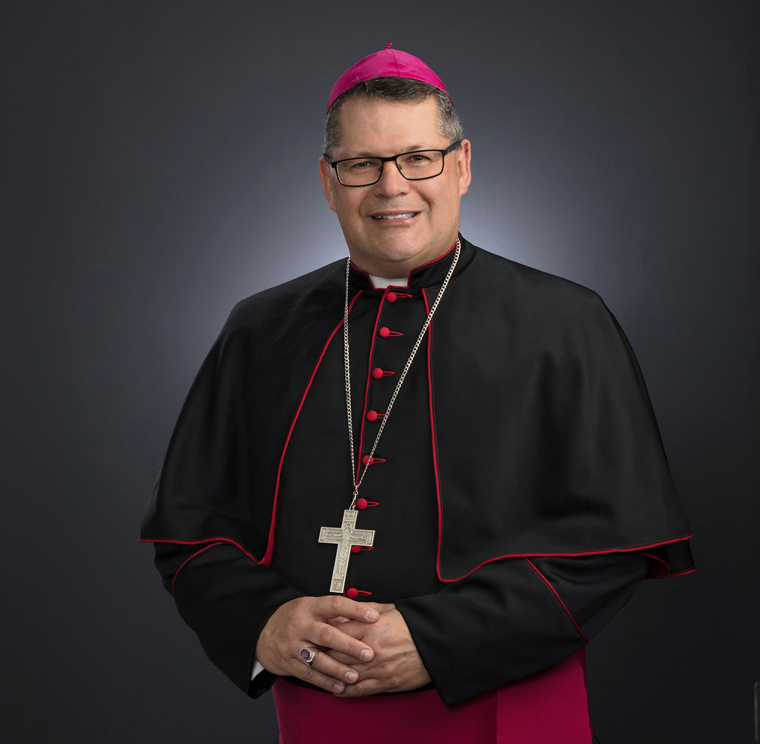
Editor’s note: This was Bishop Lucia’s homily delivered during the World Marriage Day Mass at the Cathedral of the Immaculate Conception on Sunday, February 11.
I think many in this congregation, if not most, would agree that every marriage has its moments of joy and moments of anguish. These moments are found readily in the Book of Tobit in the stories of Tobit and Anna and that of Sarah and Tobiah. Closer in history to the present day, the marriage between Winston Churchill and his beloved Clementine was very difficult – especially just before World War II, when Churchill’s warning about Germany isolated him from his fellow members of the British Parliament and government; and the Stock Market crash nearly ruined him financially.
As recounted in the 2002 film, The Gathering Storm, Churchill’s predictions about the inevitability of war finally proved true and he is called back to power as First Lord of the Admiralty in England’s war cabinet.
Shortly, within a few months, he will be prime minister. As he returns to London to take up his post, Churchill turns to his long-suffering Clementine and says, “Thank you. Thank you for being rash enough to marry me, foolish enough to stay with me, and loving me in a way I thought I never be loved.”
These words echo, Tobiah’s invitation to Sarah to pray at the beginning of their married life: “Sister, get up. Let us pray and beg our Lord to have mercy on us and to grant us deliverance” (Tobit 8:4). He then acknowledges, “Now, Lord, you know that I take this wife of mine not because of lust but for a noble purpose. Call down your mercy on me and on her, and allow us to live together to a happy old age” (Tobit 8:7). They said together, “Amen, amen” (Tobit 8:8).
In essence, what this couple is asking at the very beginning of their life together is repeated by St. Paul in his words to the Church of Corinth, “do everything for the glory of God” (1 Cor. 10:31). What I would like to suggest this afternoon as you and I reflect on the Sacrament of Marriage and hear Jesus’ call in the gospel to be the salt of the earth and to be the light of the world, is that the heart of marriage is to be a living presence – an outward sign – of God’s presence, of God’s love coloring the world in which we live.
For many years, sisters and brothers, acceptance of the Church’s teaching on marriage and family has eroded among Catholics. Many either do not know or else do not perceive as true what the Church steadfastly maintains regarding the enduring nature of the marriage commitment, fidelity within marriage, the need for married couples to remain open to life and the duties of parents as the first educators of their children in the ways of faith.
As we see in today’s first reading from the Old Testament, the institution of marriage existed long before Christ lived on this earth, long before the Roman Catholic Church was founded. Nonetheless, the Sacrament of Matrimony takes a natural institution and elevates it to a living and life-giving sign of Christ’s love for His Church and makes clear the nature of the relationship between husband and wife.
As Catholics, we are conscience-bound to accept the wisdom our faith sheds on the institution of marriage. The fundamental truth concerning marriage and family can be known and defended by human reason and relates to basic human values that run deep in history and in a vast array of cultures and religions. Clearly, the declining number of solid marriages is the most fundamental vocations shortage facing both Church and society!
That is why this afternoon, as we celebrate these jubilees of marriage, we focus on the sign and love, Christ calls you as couples and indeed all of us by baptism, to be for one another. Our prayer is:
That you may be rash enough to give one another everything you possess, everything you love, everything you are to the other, without limit or condition, without doubt or fear;
That you may be foolish enough to always forgive one another and never to quit on one another; foolish enough not to look for quick fixes or the easy way out; foolish enough to realize that even the darkest Good Fridays will be transformed by an Easter morning;
That you may love one another in a way you cannot even begin to imagine, loving one another in good times and bad times, loving one another unconditionally and selflessly, loving one another even when you don’t deserve to be loved.
Ultimately, as Paul writes, brothers and sisters, we are invited in our lives to become imitations of Christ for others, for the world around us. In the Vatican’s recent declaration, “On the Pastoral Meaning of Blessings,” the final section is titled, “The Church is the Sacrament of God’s Infinite Love.” And who is this Church…we are the Church! Sisters and brothers, we are called in our vocational states: marriage, ordained ministry, the consecrated life, the single life to be the Sacrament of God’s Infinite Love.
Paragraph 44 of the document states:
“Any blessing will be an opportunity for a renewed proclamation of the Kerygma (of the Gospel), an invitation to draw ever closer to the love of Christ. As Pope Benedict XVI taught, ‘Like Mary, the Church is the mediator of God’s blessing for the world: she receives it in receiving Jesus and she transmits it in bearing Jesus. He is the mercy and the peace that the world, of itself, cannot give, and which it needs always, at least as much as bread.’”
Turning again to the words of Winston Churchill to his beloved Clementine: “Thank you. Thank you for being rash enough to marry me, foolish enough to stay with me, and loving me in a way I thought I never be loved.” Are these sacramental words not only for the married couples gathered here today, but for the Church as well? As the Church prays in the second preface of the Nuptial Mass: “In the union of husband and wife you give a sign of Christ’s loving gift of grace, so that the Sacrament we celebrate might draw us back more deeply into the wondrous design of your love.”
Brothers and sisters, the challenge for every Christian is to know what to do when they find themselves in situations without love. The great Spanish mystic and doctor of the Church, St. John of the Cross, offers some sage advice, “Where there is no love, put love – and you will find love.”
Today, on World Marriage Sunday, we joyfully celebrate a love beyond words shared between a husband and wife in the marital covenant. We pray for all married couples called to be imitators of Christ’s sacrificial love in the world. May their marriages be bright beacons of hope…living reminders of Jesus’ love as they create nurturing homes for Church vocations! Amen.