National congress sends forth Catholics to ignite new Pentecost as Eucharistic missionaries
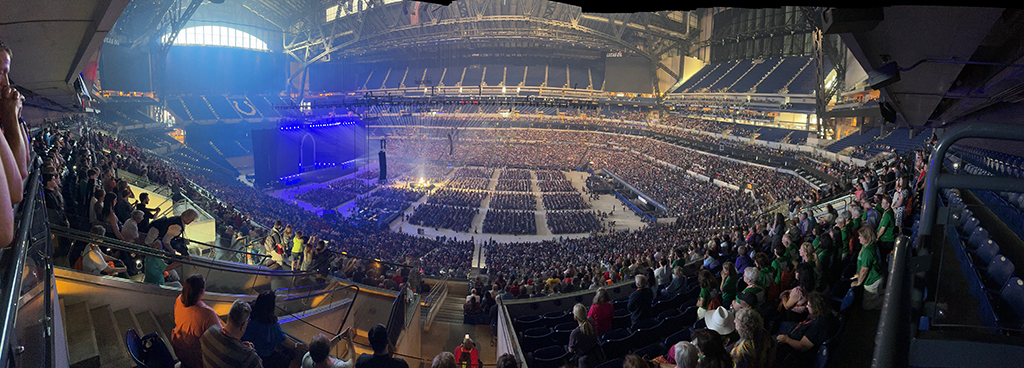
image0 (7)
Above: A panoramic look at 60,000 pilgrims in Lucas Oil Stadium, Indianapolis. Photo courtesy of Eric Rose (St. Mary of the Assumption, Baldwinsville).
[box] Be sure to read the accompanying story with impressions of some of the Diocese of Syracuse attendees.See the August 1 edition of The Catholic Sun for Bishop Douglas J. Lucia’s column and thoughts on the Congress.[/box]
By Peter Jesserer Smith , OSV News
INDIANAPOLIS (OSV News) — As five days of the National Eucharistic Congress concluded with one final revival and a beautiful solemn Mass in Lucas Oil Stadium — Bishop Andrew H. Cozzens of Crookston, Minnesota, board chairman of the National Eucharistic Congress Inc., stood in Lucas Oil Stadium.
“I have a question for you,” he told the crowd. “This is the 10th National Eucharistic Congress — do you think we should do an 11th one?”
Some 60,000 congress participants — representing 50 U.S. states, 17 countries, and various Eastern and Western churches, and speaking over 40 languages — cheered wildly in the stadium.
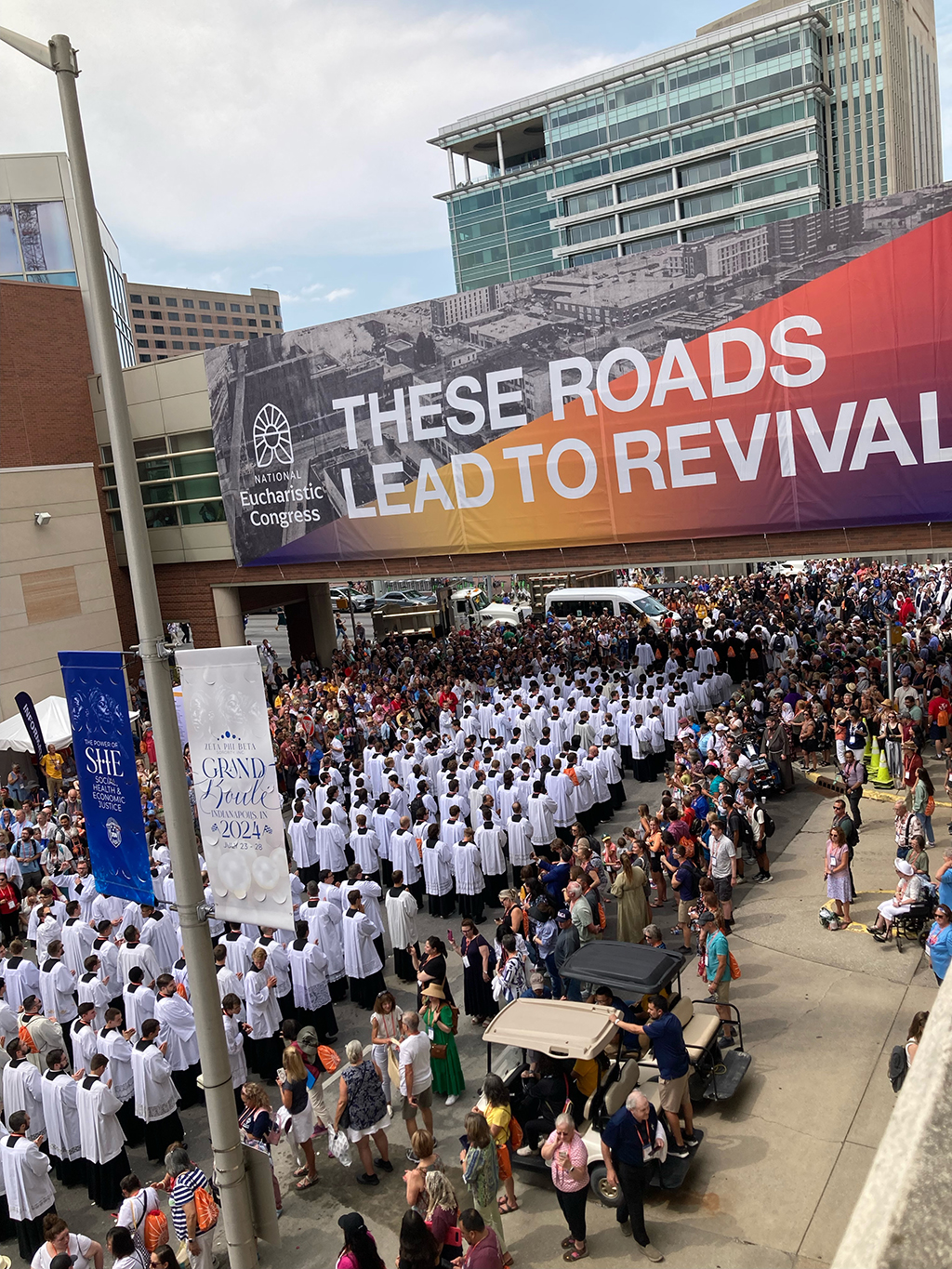
A river of the faithful — priests, deacons, religious and laity – parade through the streets of Indianapolis, escorting the Blessed Sacrament. Photo courtesy of Amy Sullivan (Our Lady of Sorrows, Vestal).
They also again rose to their feet to give the U.S. Catholic bishops an enthusiastic standing ovation for making possible the five-day congress with its impact sessions, breakout sessions, special events, revival nights with Eucharistic adoration and Benediction and beautifully celebrated reverent Masses.
The event reflected the diversity of a church all united in the same Eucharistic Lord and eager to use their gifts for a new Pentecost in the church.
The first day of the July 17-21 congress began with an evening revival as the 30 perpetual pilgrims, who had walked the four National Eucharistic Pilgrimage routes, took their final official steps of their eight-week journey into the stadium carrying icons of each route’s respective patron saints — St. Juan Diego Cuauhtlatoatzin, St. Junipero Serra, St. Elizabeth Ann Seton and the Blessed Virgin Mary — that were put around the altar where the Blessed Sacrament was placed.
“How will we know that we are experiencing Eucharistic revival?” Cardinal Christophe Pierre, the papal nuncio to the U.S., asked in his keynote speech July 17, encouraging everyone to surrender their hearts to the Lord over the next few days. “When we are truly revived by the Eucharist,” he said, “then our encounter with Christ’s real presence in the sacrament opens us to an encounter with him in the rest of our life” and then “spills over in our daily life, a life of relating to others, our way of seeing others.”
Every day of the congress began with most congress-goers joining in beautifully and reverently celebrated Eucharistic liturgies in the stadium — including a July 20 Holy Qurbana, the Syro-Malabar form of the Eucharistic liturgy, prayed in English. Additional morning and evening Masses at nearby sites in different languages, such as Spanish or Vietnamese, or in different forms, such as the Byzantine rite or the older usage of the Roman rite.
Three days of the congress, July 18-20, were split between seven morning impact sessions and nearly 20 afternoon breakout sessions on a variety of topics meant to form, equip and inspire people, including clergy, to live more deeply their faith in light of Jesus making himself truly present in the Eucharist — and how to practically bring what they have learned into their parishes, ministries, groups and families.
The exhibit halls in the Indiana Convention Center were packed throughout the congress, as long lines formed for exhibits such as the Shroud of Turin or Eucharistic miracles. Religious sisters provided a kind of spiritual air traffic control that guided people to the lengthy confession lines.
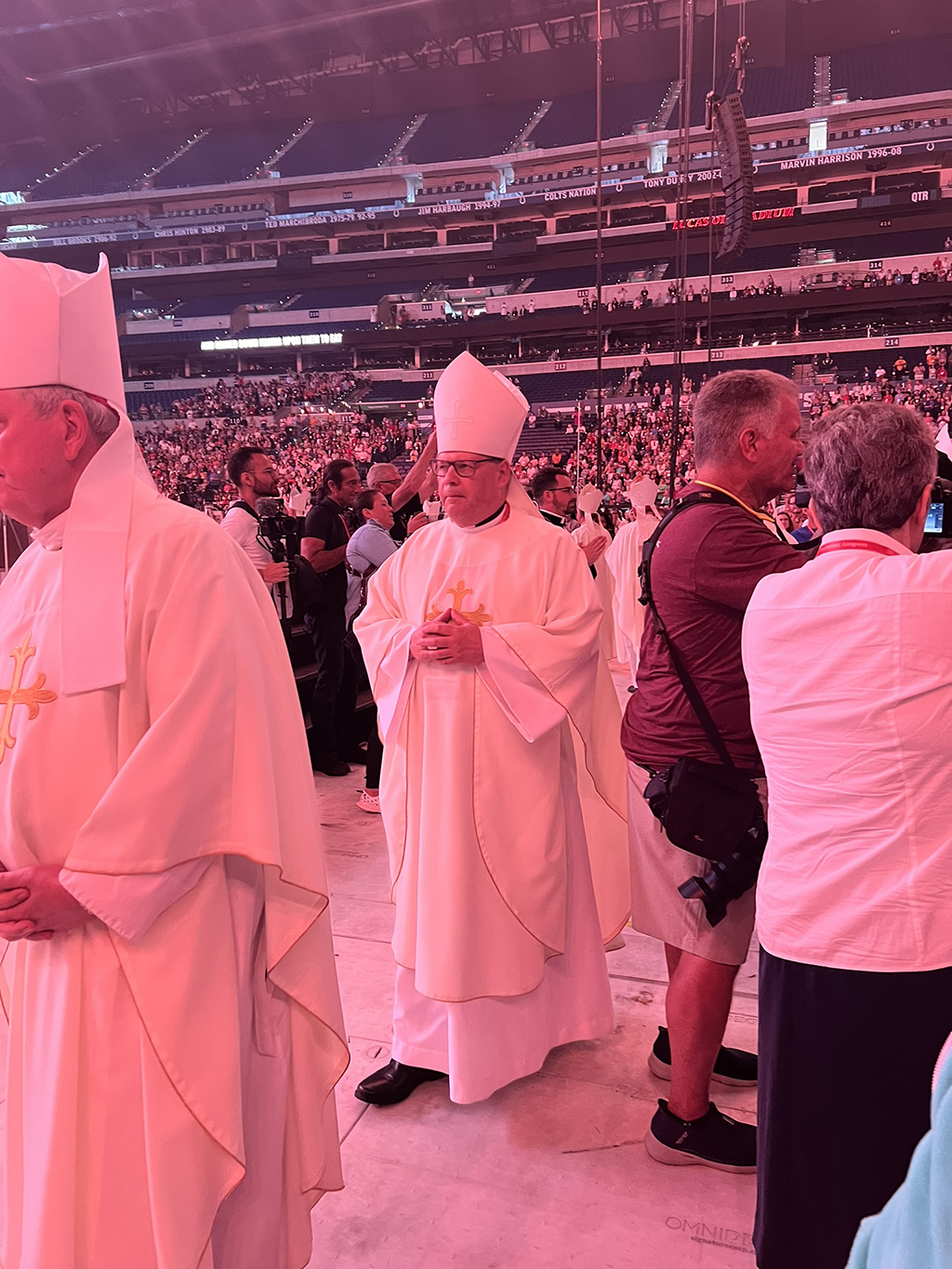
Bishop Douglas J. Lucia in procession to enter Mass at the Congress. Photo courtesy of Allison Bracht (St. Elizabeth Ann Seton, Baldwinsville).
The convention center was also a place where the spontaneity of joy could be seen and felt. Young people marched through chanting their love for Jesus, while further on, a group of Catholic women, dressed in traditional apparel from Cameroon, sang and danced their love for Jesus and Mary to the delight of people who gathered around them.
Congress-goers had the opportunity to attend off-site events such as The Catholic Project’s panel discussion July 19 that explored the challenges of navigating the dating landscape as Catholics.
Tens of thousands of congress-goers at the revivals — and the liturgies as well — eagerly joined their voices in singing the beautiful hymns and chants, both traditional and contemporary, in English, Spanish, Latin and other languages. The congress saw the musicianship of Dave and Lauren Moore, Sarah Kroger and Matt Maher, as well as the talents of the men’s ensemble Floriani and the Indianapolis Symphony Orchestra.
The nightly revival sessions created a sensory experience of awe around the Eucharistic Lord, as tens of thousands prayed in silent contemplation before the Eucharist on the altar — illuminated in the dark stadium by spotlights. Adoring Jesus in the stadium, concluding with Benediction, was the pinnacle movement of each evening.
Keynote speakers and testimonies helped keep people’s eyes fixed on Jesus’ personal love for them and his desire to be close to them.
“Knowledge can make us great, but only love can make a saint,” said Father Mike Schmitz, the Diocese of Duluth, Minnesota, priest known for chart-topping podcasts “The Bible in a Year” and “The Catechism in a Year.”
Jonathan Roumie, the actor famous for his portrayal of Jesus in the hit miniseries “The Chosen,” told the audience at the final revival night July 20 after reading Jesus’ Bread of Life discourse from John 6, “The Eucharist for me is healing. The Eucharist for me is peace, the Eucharist for me is my grounding. The Eucharist for me is his heart within me.”
Congress organizers also made intentional efforts to be inclusive of families and those with disabilities, particularly those with sensory disorders, so they could also experience the congress and participate fully in the experience.
More than 1,200 religious sisters and brothers, 1,170 priests, 630 deacons, 610 seminarians and 200 bishops participated in the congress, according to congress organizers. At a press conference July 19, Philadelphia Archbishop Nelson J. Pérez said he had never seen anything like the congress, as a non-papal event, in his 35 years of priesthood.
The highlight came July 20 as tens of thousands of Catholics followed behind the truck-pulled, flower-rimmed float carrying the Blessed Sacrament accompanied by Bishop Cozzens and Indianapolis Archbishop Charles C. Thompson. They walked 10 blocks from the convention center through downtown Indianapolis to the Indiana War Memorial Plaza for what Bishop Cozzens said “might be the largest Eucharistic procession in the country in decades.”
At the sending-forth Mass July 21, Pope Francis’ special envoy to the congress, Cardinal Luis Antonio Tagle, delivered a homily with warmth, joy and humor that made participants both laugh and feel inspired as he told them, “A Eucharistic people is a missionary and evangelizing people.”
“We should not keep Jesus to ourselves,” he said, exhorting them not to use their time in church to escape others, but to “share Jesus’ tender love” with “the weary, the hungry and suffering … the lost, confused and weak.”
Peter Jesserer Smith is national news editor for OSV News. Staff from OSV News, The Criterion and Simone Orendain contributed to this report.