St. Mary’s of the Lake Celebrates 175 years in Skaneateles
_A930868
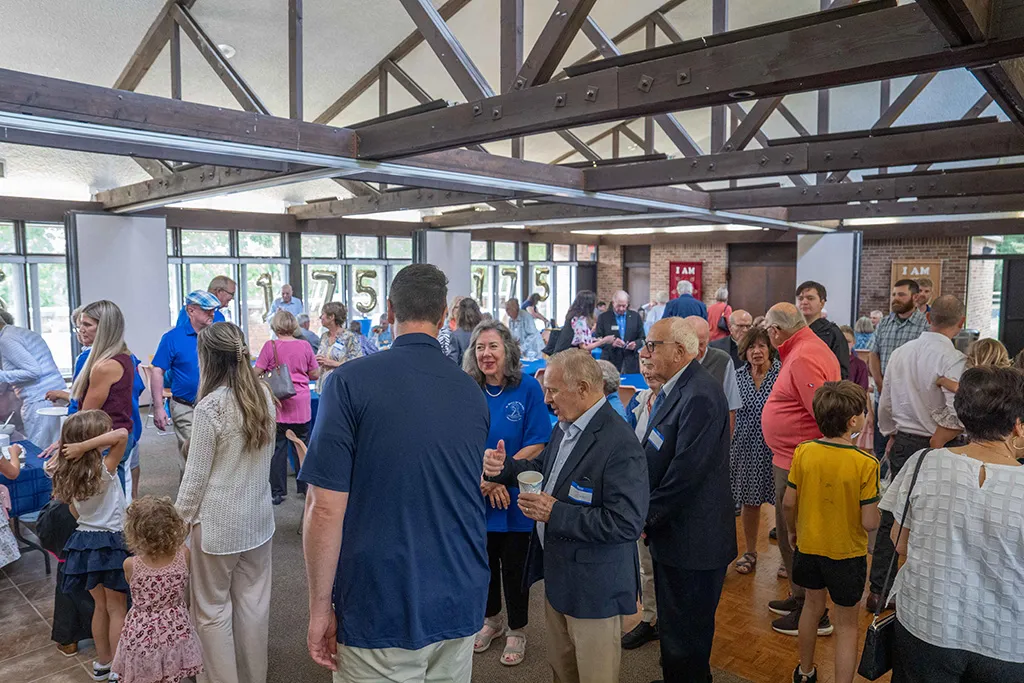
Many gather for a reception following Mass to celebrate the parish’s 175th anniversary. Photo | Chuck Wainwright
By Mary Anne Winfield
Sunday, Sept. 13, 2026, marked the 175th anniversary of the founding of St. Mary’s of the Lake in Skaneateles. More than 200 parishioners, neighbors, and guests joined in Mass and a reception at the church and parish center. Bishop Douglas J. Lucia presided over morning Mass.
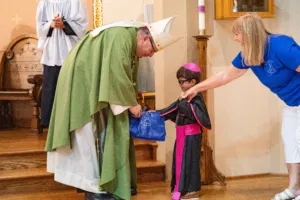
Nico, dressed in a bishop’s choir robes, presents Bishop Lucia with several items bearing an emblem of the parish. Photo | Chuck Wainwright
Three-year-old Nico appeared dressed as a “little bishop.” He presented Bishop Lucia with “spirit wear,” including a shirt, hat, and tumbler with an emblem displaying an image of the Virgin Mary, the church’s name, and 175 years.
Before Sunday’s celebration, St. Mary’s participated in the Skaneateles Fireman’s Labor Day Parade with a float depicting their garden shrine in the grotto. They earned the “Unity Spirit” award for their entry. The New York State Assembly also issued a proclamation recognizing the faith, fellowship, resilience, and service of St. Mary’s of the Lake for its “enduring commitment to the spiritual lives of families throughout Skaneateles and surrounding communities. “
Editor’s note: The following is an article by Mary Anne Winfield that originally appeared in the Eagle News Press-Observer in August, 2026. Winfield, a parishioner at St. Mary’s of the Lake, previously wrote a column for The Catholic Sun in the 1970s, titled “In Exodus.”
The origins of the brick church on the corner of Austin and Jordan Streets are found in faded archives from early church records, the Syracuse diocese, and the Skaneateles Historical Society Museum. They tell the history of St. Mary’s of the Lake, founded 175 years ago.
The original parish included Camillus, Marcellus, Jordan, Baldwinsville, and Skaneateles. Various priests were assigned to minister to the people before a church was built. In 1848, the first Catholic Mass was said in the home of Patrick McCormick in the first block of Fennell Street.
James McLaughlin, an early resident, is the great-great-grandfather of Barb Hunt, a parishioner today at St. Mary’s. His account came from a news story in The Catholic Sun:
“Father William McCallion came to my house in Mandana and told me he intended to collect money enough to build a church in Skaneateles. My brother John and I rowed Father among the farmers who had Irish boys and girls working for them. We rowed Father across Skaneateles Lake in a small boat in November 1853, to enable the priest to hold a station in the home of Patrick Wall, who lived north of Borodino. Well, when we were crossing the lake, a very severe storm came on, and the wind blew so hard that the three of us came near to losing our lives.” – John McLaughlin for The Catholic Sun, 1904.
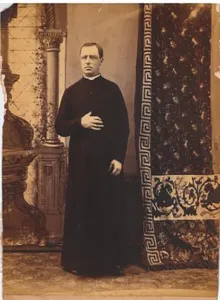
Pastor Reverend Francis Purcell. Submitted by Mary Anne Winfield
By 1855, land was purchased on the corner of Austin and Jordan, funds were raised and combined with labor, and a wooden church was built for $2500. The first resident pastor was Reverend Francis Purcell.
To accommodate the large number of Catholics in Skaneateles Falls, he arranged for construction of a new frame church. St. Bridget’s was dedicated in Skaneateles Falls in 1874. Land purchase was recorded in the following warranty:
“Beginning at the corner of John Kenans land and on the east bounds of the Skaneateles Rail Road, then 10 degrees, 40 feet south, three chains and 57 links along said Kenans south line at a stake.” – Warranty Deed, 1873
For $1000, Father Purcell also purchased seven acres, north of the village, and established St. Mary’s Cemetery. The cemetery was dedicated in 1869. Father Purcell served St. Mary’s and the vicinity for 40 years, with a penchant for fostering abstinence.
“Father Purcell was a strong advocate of total abstinence from intoxicating liquors and formed the Total Abstinence and Benevolent Societies, St. Mary’s of the Lake T. A. and B. and St. Bridget’s T.A. and B. These societies exerted a wholesome influence in Skaneateles and Skaneateles Falls until the present day.” – Syracuse Diocese Archives
Masses and liturgies were not held for long in the first church. Disaster struck St. Mary’s in 1866, and a defective flue in the chimney caused a fire.
“About half-past five o’clock this (Wednesday) morning, the Catholic Church (St. Mary’s) in this village was discovered to be on fire. The alarm was promptly given, and our firemen were speedily on the ground but all efforts to save the church were useless, as there was not enough water to supply the engine. The building burned […] and in an hour’s time, was in total ruins. The loss we estimate at from $6,000 to $8,000. The church, we believe, was insured for $2,000.
“The fire is a terrible blow to our Catholic citizens, who built the church from their hard earned contributions and labor. Very little of value was saved. The church contained a number of scriptural engravings, among them two Madonnas of rare grace and beauty. All these are lost. The wind at the time was fortunately in the west, but had it been in any other direction, we should have a still greater calamity to Chronicle.”- Skaneateles Democrat, May 24, 1866
A new church was built on the site soon after. In 1867, the brick church was dedicated on the same site at Austin and Jordan Streets. This structure stood for 59 years and then suffered the fate of its predecessor. On February 10, 1926, it burned to the ground.
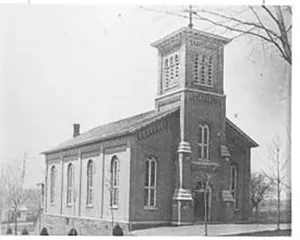
The second church building, which stood from 1853 to 1866. Submitted by Mary Anne Winfield
Fire (sans brimstone) seemed to be the misfortune of the buildings. However, once again, the parish collected the insurance on the old building, sold the old rectory, and gathered funds for a new church. Construction began on what now is the present church and rectory in 1926.
During this phase, an offer from the owner of the local movie theater allowed liturgies to continue. Mass was celebrated in the Huxford Theater, later known as the Colonial, and now residential condos on Genesee Street.
Work on the new church began without delay. The new church was framed with steel, and stained-glass windows were set by Franz Mayer Company of Munich, Germany. The 23 stained-glass windows depict famous scenes from the life of Jesus. The rose window casts myriad lights of multiple shades of color.
I was 21 years old and a member of the Carpenter’s Union in Auburn when the Bradley Construction Company of Binghamton won a contract to build the new church and new home for the priest. The roof was built of cypress, with one inch of cork panels under the shingles which, supported with steel trusses, made the wall straight.
Over the altar are Gothic windows made of keen stone. The steeple is steel, covered with wood and shingles, built during February. The wind was strong off the lake! The Rose Window was quite a job to construct. All the stones had to be put in place with the joints sealed with mortar. There was a small hole in the top through which gallons of grout had to be poured so as to join the stones. – Albert Colman, letter from Syracuse Diocese archives
The present church and rectory were dedicated in 1927. At one time, the church had a single old bell inside next to the choir that rang by pulling a rope. The bell was silenced, on complaints of being too loud, for 25 years. In 1964, an electrified Quadra bell unit was installed and now rings as a call to worship, just before Mass begins.
The Grotto of St. Mary’s of the Lake, outside the church, welcomes residents and visitors to stop in a quiet space. Dedicated in 1955, the origins of this Shrine of the Blessed Virgin began in a small town in Poland at the outbreak of World War II. As the Germans marched into Poland, a Carmelite priest named Father Marianus became a prisoner at Dachau. Once liberated, he was assigned to a monastery in Auburn. A stonemason, he sought to build a shrine in gratitude to Mary. In 1957, with help from parishioners, he directed the building of the grotto.
High school boys from St. Mary’s gathered the fieldstone from surrounding areas. Among them was a young man who became known as Father Peter Major, who spent years as a missionary in Borneo and Africa. While helping the Sudanese, he was captured and held prisoner. Mistreated, he was threatened with death and then released. He returned to Africa to study Arabic in Cairo. He believed that communication could help Christians and Moslems understand each other. Father Major remains a parishioner of St. Mary’s today.
St. Mary’s remains a welcome presence in the community… for worship and for generations of families celebrating marriages, new births, faith formation for the young, comfort for the sick, and end-of-life tributes. The parish’s generosity extends to many others in need through a sandwich ministry, human development collections, support for the Ecumenical Food Pantry, and collaboration with a twin parish, St. Anthony of Padua, on the city’s south side.