Pastoral planning: Finding new strength through change
USE MAIN Theology Uncorked
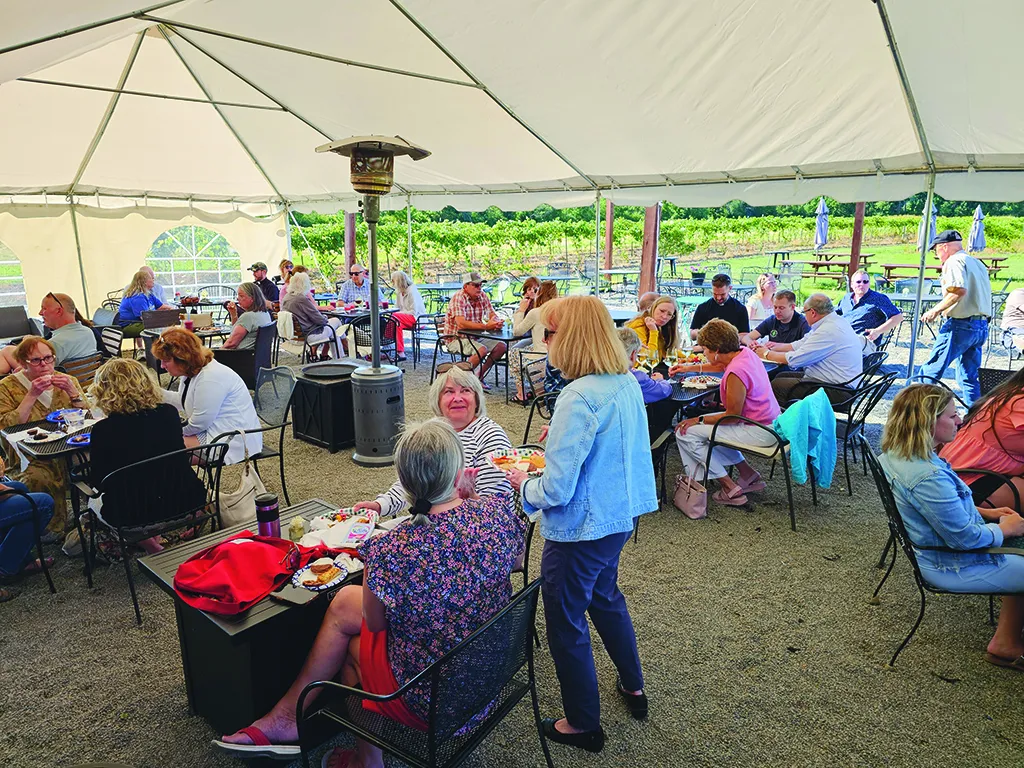
Theology Uncorked is an annual event that brings Divine Mercy and Sacred Heart parishioners together at a local winery, Grace Tyler Estate Winery, in Constantia. Father Seibt began this event in 2021, and for the first couple of years, it was an opportunity to ask Father Seibt whatever questions about the faith were weighing on parishioners' hearts. When he became pastor of Sacred Heart, the event began to take on specific themes and he began to invite other speakers, such as Father John Brusa, Father James Buttner, and Deacon Douglas Villanella. Each talk is is followed up with questions and answers.
Sharing a pastor, resources, and a common mission, two Central New York parishes discover the blessings of coming together in faith
Change isn’t easy, especially when it comes to pastoral planning. While many of the faithful accept it, and some even embrace it, for others it can still fuel concern and fear of the unknown. Many priests once served as pastors of a single parish with one church. Today, they may find themselves juggling multiple churches, or worship sites, within a single parish.
The seven-county diocese currently has 65 active priests, 75 active deacons, and 15 external priests serving 103 parishes, which encompass 129 worship sites.
For instance, Spirit of Hope Parish in Oneida has four churches, or worship sites, across Oneida and Madison counties. Sacred Heart Parish in Rome, New York, comprises four worship sites. Holy Spirit Parish, which spans Oneida and Madison counties, also has four worship sites. And one of the diocese’s newest parishes, Prince of Peace in Endicott (Broome County), has four worship sites.
Each of these parishes has one pastor.
Pastoral planning is a long-term, strategic process designed to strengthen faith communities facing challenges such as a shortage of priests, declining membership, or significant financial constraints. These plans can and do work when the message is clear, faith remains the focus, and the past, though significant and evocative, gives way to forward thinking — mission over maintenance.
‘Two Parishes, One Family’
Father Christopher Seibt is pastor of Divine Mercy Parish in Central Square and Sacred Heart Parish in Cicero, located eight miles apart and affectionately known as Two Parishes, One Family. The parishes are not formally merged; rather, they share a pastor, resources, and a commitment to living the Christian life.
The story of how these two parishes arrived at this arrangement began about seven years ago. In 2019, Father Seibt was assigned to serve as pastor of Divine Mercy in Central Square and the Mission of St. Bernadette in Constantia with its “oratory” of St. Mary’s in Cleveland. Among his early responsibilities was helping parishioners navigate difficult decisions about the future of their worship sites.
First came the relegation (closure) and alienation (sale) of St. Mary’s in 2020, which Saint Bernadette parishioner Ellen Holst said raised many questions among parishioners concerned that the Northshore/Route 49 corridor would be left without a parish. Next came the merger of the Mission of St. Bernadette with Divine Mercy; the two had been linked in 2015. “The period leading up to the merger was marked by significant negativity and a decline in parishioner numbers,” Holst said.
To prepare for the merger and relegation of St. Bernadette, Father Seibt held several town hall meetings to explain the parish’s circumstances to parishioners. He presented financial comparisons from previous years, along with information about the number of active parishioners attending Mass, contributing financially, and volunteering; the number of sacraments celebrated; and the repairs needed to maintain the St. Bernadette building. He encouraged open dialogue and welcomed difficult questions, recognizing that parishioners needed both an honest understanding of the challenges and a voice in moving forward.
“These meetings helped parishioners understand the deficits and the challenges the parish would face if it remained open,” Holst said. “Most, though not all, expressed support for a planned closure rather than waiting for circumstances to force the decision.”
In July 2023, Divine Mercy and St. Bernadette made the final transition to an official merger, and the St. Bernadette worship site closed. The vast majority (90%) of parishioners from St. Bernadette came to Divine Mercy and started getting involved. One month later, Bishop Douglas J. Lucia appointed Father Seibt pastor of Sacred Heart Church in Cicero in response to the diocesan priest shortage.
“Like the great leaders in the Church (St. Gregory the Great, Fulton J. Sheen, etc.), you look ahead at what is coming, address it and move forward,” said Father Seibt. “When the changes that need to be made are evident, you don’t belabor them so as to exhaust everyone in the process. Most importantly, you take the focus off the things that don’t matter and place it on the Lord. You strive to follow Him and be faithful. Everything else then falls in its proper place when Christ and the mission of His Church are at the center, and everything you do stems from there.”
Adapting to change
Paul Macarelli, a parishioner of Divine Mercy and the Mission of St. Bernadette, highlighted the importance of flexibility and perseverance. He said the rapidly shifting restrictions during the COVID-19 pandemic strengthened parishioners’ ability to adapt to change.
“Not having Mass, then limited Mass, and not being able to partake in the [Blood of Christ] for the longest time, I think only strengthened both parishes and gave us the endurance needed for the changes that would ultimately bind us in faith, hope, and community,” he said.
When the Mission of St. Bernadette merged with Divine Mercy, Macarelli viewed the experience as both a litmus test and a smaller practice run for what would ultimately become the sharing of resources between Sacred Heart and Divine Mercy.
“It was really the Divine Mercy–St. Bernadette merger that helped to bring Sacred Heart and Divine Mercy into the fold of ‘Two Parishes, One Family,’ which was very exciting,” he said. “The coming together has made our faith stronger and [it] started to empower our parishioners of both parishes to volunteer more and have a new sense of ‘mission.’”
“We had a town hall meeting right away to present the reality of our situation and discuss ways to move forward. We prepared for our new reality by focusing on mission from the very beginning,” Father Seibt said.
For instance, the parishes immediately revised their daily Mass schedules, establishing one daily Mass between the two locations so they could better accommodate funerals at either parish. A few months later, they established a new Sunday Mass schedule. They also worked to streamline and combine processes and programs and began using a shared events calendar.
“The number one benefit, without question, is shared resources,” said Michael Smith, a parishioner of Sacred Heart for 18 years. “We’re able to do more with staff and programming [now] than the parishes could do separately.
“I think challenges are few,” he continued, crediting Father Seibt’s structured approach from the very beginning. “Over-communicating was key.” Father Seibt provided well-written letters published in the weekly bulletin, along with Mass announcements, parish reports, and timelines. “In addition, seeing clergy, specifically the deacons, crossing over between the two parishes early on was a big benefit to the messaging.”
As an active volunteer at Sacred Heart, Michele Koehler said she had a good sense of how parishioners felt about the upcoming changes. Sharing resources — and, more specifically, a pastor — was foremost on people’s minds.
“There was an initial air of concern and doubt,” Koehler said. “People wondered if it was even possible, but after meeting Father Seibt, people were excited and optimistic because he had a presence that just put us at peace. He was present and upfront about the upcoming changes. He shared realistic concerns, but soon put teams into place to work toward solutions.”
The fruits of faith
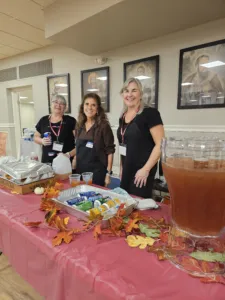
Sacred Heart parishioners Jill Lee (left), Brenda Wheeler (middle), and Sandy Barbato (right), serve at senior luncheons and at any event involving food (which most do!). Here, they are volunteering at a recent Fall Festival.
Little by little, Koehler said, things began to fall into place, and “great things started happening.”
“Hospitality ministry turned into organized liturgical ministry with annual training. … Ideas of how to move forward became a very clear process with a strategic planning committee; questions were answered with town hall meetings,” she said. “The whole time it was evident that what we were moving toward was something very special. It was as if our trust in the Lord was front and center, and blessings were apparent throughout the entire process.
“[Father Seibt] leads us with such a strong faith in the Lord, and it was underscored in all of the decisions that were made and discussed throughout the process of coming together as two parishes,” she added.
Macarelli described the initial days after the announcement that the two parishes would be sharing resources and a pastor as marked by “excited trepidation.”
“Change is never easy, especially in a place where tradition and consistency are what we are known for as Catholics,” he said.
Father Seibt was upfront about the difficult realities facing both parishes. He spoke candidly about the shortage of priests, limited resources, and the increasing costs of maintaining both churches.
“Ultimately, it came down to soul-searching and what is most important to us,” Macarelli said. “I think everyone independently realized that the Eucharist and the celebration of the Eucharist were the most important part of what we were trying to accomplish in having our places of worship endure.
“I find these times exciting at Sacred Heart and Divine Mercy because early on it was a new concept to merge or combine resources, and we got to do that and to see the fruit that was produced from that,” he continued. “To see us come together and support each other in various events and liturgical settings is a great testament to the core of our faith. It is no longer us and them or them and us; it is just us, unified in the Body of Christ.”
When more changes come
Speaking directly to parishioners who may be dealing with changes in their parish, Macarelli emphasized that, although it may feel like the end of the world, everything will be OK. A cradle Catholic, he said he has experienced the hardship of watching his two Catholic schools and home parish in the Catskills close, as well as, more recently, the multiple changes in the Diocese of Syracuse.
“Although it seems like all is lost, your faith and hope will sustain you,” he said. “Don’t let the discouragement of one door closing cause you to miss the next one opening.”
He then shared a story about a beloved priest at a parish he once attended on Long Island. As the priest prepared to leave for his next assignment, many parishioners asked where he was going. During his final homily, the priest explained why he wouldn’t reveal his destination.
“Because we follow the faith and not the man,” Macarelli said, recalling the priest’s response. “That always stuck with me and became my personal philosophy: It is not the building or the priest, but our faith that should and will always sustain us.”