Renewal through ‘Immersion in Living Water’
IMG_1464
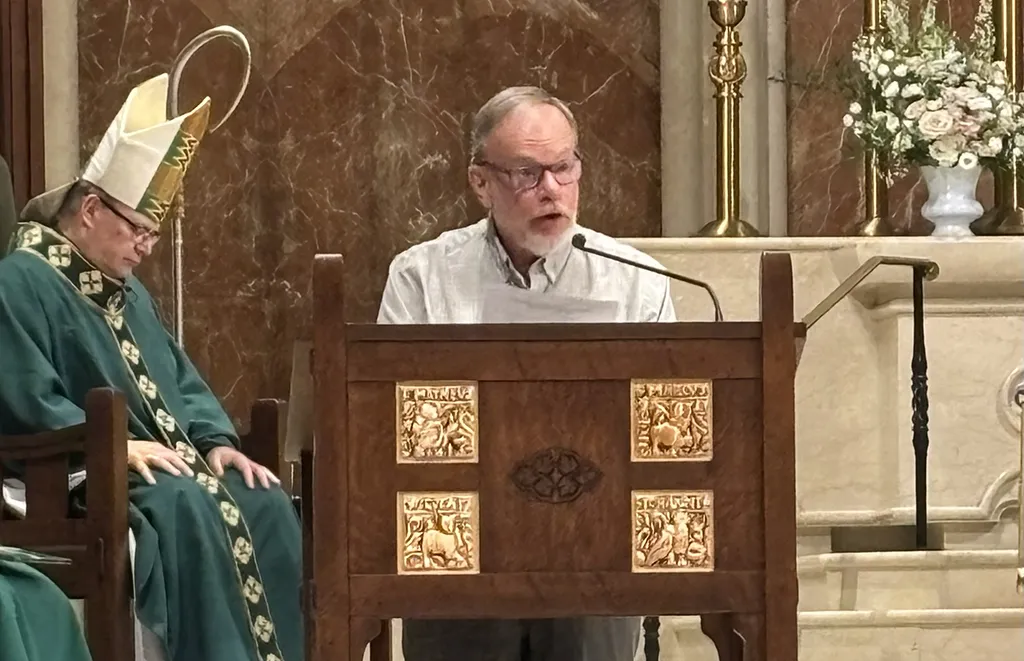
At the end of Mass, David Babcock speaks to those gathered at the Cathedral of the Immaculate Conception on Sept. 1 about the start of the Season of Creation 2026.
Season of Creation 2026 invites us to deeper care for our common home
Each year, Catholics celebrate the Season of Creation from Sept. 1, the World Day of Prayer for the care of creation, to Oct. 4, the Feast of St. Francis of Assisi. During this time, we are called to remember that all of creation — the soil, water, air, creatures, and people — are God’s handiwork, our common home entrusted to our care.
To begin this season, Bishop Douglas J. Lucia celebrated a special noon Mass at the Cathedral of the Immaculate Conception in Syracuse on Sept. 1. At the beginning of his homily, he quoted from Pope Leo XIV’s message in honor of the day. As Pope Leo XIV wrote, and as Bishop Lucia said, “Our Lord Jesus Christ came so that we might have life and have it in abundance. This gift of life lies at the very heart of our mission as disciples and of our shared calling to build a civilization of love. As we observe this … day of prayer … we are once again invited to contemplate the gift of life and to cherish the earth that sustains it, for they are tangible ways of offering praise to our Creator.”
This year’s Season of Creation theme, chosen by an international interfaith coalition, is “Immersion in Living Water,” inspired by Ezekiel 47:1-12. David Babcock, leader of the Diocesan Care for Our Common Home Task Force, said the theme reminds us of the importance of good quality water, which is essential for all life forms to live and thrive.
“Water nourishes, heals, and refreshes everything it touches. The importance of renewal is the central theme for Season of Creation 2026. We too often take good quality, life-giving water for granted. With renewal and reflecting on water’s constant refreshment, we can experience a conversion of our relationship with God’s Earth, our home, and everything upon it and in it.”
Below is an excerpt of The Catholic Sun’s Q&A with Babcock about this year’s Season of Creation, which includes input from several members of the Diocesan Care for Our Common Home Task Force.
TCS: The image in Ezekiel is of water flowing from the Temple, growing deeper and bringing life wherever it goes. What does that image mean to us spiritually, particularly in terms of our relationship with God and creation?
DB: As water flows downstream, it gathers more water from larger areas of drainage and gets deeper, nourishing more life as it flows. God’s grace continues to flow and offer sustenance to all forms of life. Let us thank God for this continuing flow of grace that is offered to each of us. Let us pray that we are aware of this grace as we continue through our lives. And let us commit to protecting all forms of life that come from God and are so essential for the Earth and for us as Earth inhabitants to thrive.
TCS: How does this year’s theme connect with the Catholic understanding of creation as a gift from God and our responsibility as stewards of that gift?
Care for creation (our common home) is one of the seven principal themes of Catholic Social Teaching brought to us in the past 130+ years by various popes. Creation is a common good that all of us together are called to protect and nurture.
Catholic theology consistently teaches that creation is a gift, freely given, and that it reveals God’s presence. God’s creation is a network of relationships, not just a collection of resources. Responsibility is given to all of us equally to care for creation, not dominate it.
The river in Ezekiel’s vision comes from God, not human effort. It heals and nourishes. Creation is ordered toward life, healing, and communion.
To be immersed in living water is to embrace our identity as stewards: Stewards protect what God has entrusted to them. Stewards also recognize that the cry of the earth and the cry of the poor are the same. Stewards see creation as part of God’s ongoing self-communication, not simply as a backdrop for human life. Ecological care is a spiritual focus and lifestyle rooted in gratitude, humility, and conversion.
TCS: What are some practical things individuals can do — not just during the Season of Creation, but throughout the year — to better care for our common home?
DB: We know from decades of scientific evidence that fossil fuels are forcing air and water temperatures all around God’s Earth to rise to an extent that we see clearly its effects: heavier floods, hotter and drier summers, more and longer droughts, and many more wildfires. Weaning our society off the use of fossil fuels is a very important task to complete over the next few decades. We can use less energy. We can also use renewable forms of energy and encourage our governments to prepare for higher future uses of electricity generated from renewable sources such as the sun, wind, water, and geothermal sources below ground. For those of us with personal financial investments, we can also focus those investments on entities that promote renewable sources and green lifestyles.
In addition, we see that many of God’s creatures are being killed as humans expand their influence over God’s Earth. Those creatures that can survive are forced under stress into smaller living areas called habitats. We can work with others in groups and communities to prioritize conserving and revitalizing natural areas. Those of us who have access to private property can implement actions that increase the abundance of many types of plants and animals that are meant to thrive, such as through pollinator gardens and allowing lawn spaces to diversify with many forms of plant life.
TCS: Because this year’s theme centers on water, are there specific ways people can become more mindful of water — its use, conservation and protection — in their everyday lives?
DB: We are blessed in Upstate NY with abundant quantities of water, and the quality of our waters is also generally very good except when and where our human activities significantly degrade water quality. We can use lower quantities of water in our everyday lives to help preserve the quality of our water resources. We can also speak out when we see or hear that water quality is or may be adversely affected by human activities and come together with others to defend our bodies of water, both surface waters and groundwaters.
TCS: If you could challenge every person in the Diocese of Syracuse to do one thing during this year’s Season of Creation — one action that could continue beyond Oct. 4 — what would it be?
DB: Connect frequently with God’s natural world in person, if possible, or through media opportunities such as National Geographic and nature series. We feel God’s presence, and we become more aware of the beauty and balances of God’s creation the more we experience them.
If you’d like to learn more about the Season of Creation and what you can do to help be a good steward of God’s gift of creation, contact the Diocesan Care for Our Common Home Task Force at [email protected] or call/text 315-263-9023.
Editor Tami S. Scott also contributed to this story.