‘To the glory of God’
USE L1990882
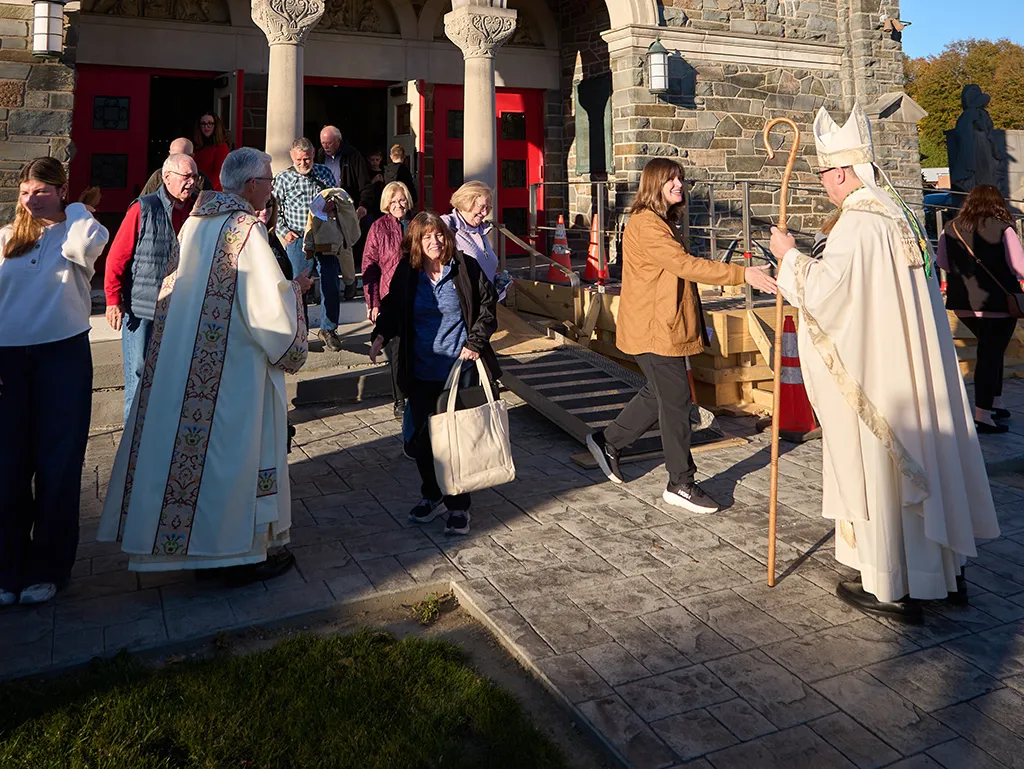
Bishop Lucia greets parishioners at St. Bartholomew’s after Mass. Photo | Chuck Wainwright
St. Bartholomew’s in Norwich celebrates its centennial
Known affectionately as Norwich’s “Little Cathedral,” St. Bartholomew’s Church recently celebrated its centennial with Bishop Douglas J. Lucia presiding over the Oct. 24 vigil Mass, and Father Dan Caughey, pastor, concelebrating. Immediately following Mass, parishioners and community members gathered for the 73rd annual Spaghetti Dinner, where volunteers served more than 400 dinners. On Sunday morning, churchgoers continued the special anniversary with fellowship, plates of donuts, and hot coffee.
It began in 1919, when a small group of Italian immigrants in Norwich petitioned the Diocese of Syracuse to form their own parish. Later that same year, the parish of St. Bartholomew was dedicated. Masses took place in a small chapel on the corner of Birdsall and Clinton streets.
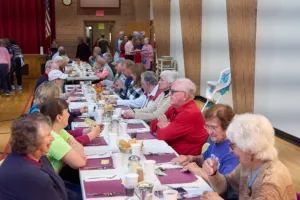
St. Bartholomew’s parishioners gather after the vigil Mass on Oct. 24 for the 73rd annual Spaghetti Dinner. Photo | Chuck Wainwright
By 1926, that small group had grown to more than 200 families — over 1,000 people. The chapel could no longer meet the parishioners’ needs. That’s when construction began on the current church. Located on Silver and Main streets, it more than doubled the chapel’s capacity.
“The laying and blessing of the cornerstone on Oct. 17, 1926, brought approximately 2,000 people together in a remarkable expression of faith and community,” said Anna McLaughlin, co-church historian for St. Bartholomew’s. The cornerstone is engraved with “A. M. D. G. 1926” (Ad Majorem Dei Gloriam), Latin for “To the glory of God.” Monsignor Daniel Doody, vicar general of the Syracuse Diocese, led the ceremony.
“These families faced many hardships as they established new lives in America,” McLaughlin said, “but their faith, determination, hard work, and generosity gave them the foundation on which St. Bartholomew’s stands today. They raised funds, contributed their labor, and made sacrifices to build a beautiful church that would serve generations to come.”
Before Saturday’s Mass, Norwich Mayor Robert Jeffrey and New York State Assemblyman Joe Angelino each presented St. Bartholomew’s with special proclamations, recognizing the church’s longstanding presence and contributions to the local community.
Weekend guests also had opportunities to explore the church’s history room and view several displays that were prepared to honor its 100th anniversary. “Our hope was [that] the display offered visitors a deeper appreciation for the church’s architectural features and the spiritual meaning, symbolism, and craftsmanship reflected throughout the church building,” McLaughlin said.
Looking to the future, McLaughlin said, “We hope to carry forward the same spirit of faith, generosity, and service that sustained our founding families. … Buildings and traditions are important, but it is the faith of the people who gather here and the good they do for others that give them life. Our goal is to preserve this sacred place while continuing to nurture our parish community, welcome others, and pass on our Catholic faith to future generations.”
Architectural highlights
- Romanesque style construction
- Built of local blue stone from a quarry just outside the city of Norwich
- Altar is plain Botticino marble with the Baldachin, supported by four columns of Breccia marble
- Imported from Italy, the two statues on each side of the sanctuary are of the Blessed Virgin Mary and St. Joseph
- 15th-century stained-glass windows each contain a medallion representing the 15 mysteries of the Rosary made by George W. Sotter of Holicong, Penn.
- Marble furnishings, statues, and Stations of the Cross were from the Nardini Art Associates of Boston
- Above each door is a stone lunette, the first representing the birth of Christ, the second is Christ comforting the afflicted, and the third is the burial of Christ
- The red tile roof is what the Italians from the Island of Lipari were accustomed to
Source: Anthony Testani, co-church historian for St. Bartholomew’s Church, Norwich