A place to call home

Screenshot 2024-11-26 at 11.24.20 AM
Emma, a native of Burundi, is a former unaccompanied refugee minor. Here, she poses at the naturalization ceremony where she became a U.S. citizen.
Toomey Residential seeks foster families for unaccompanied refugee minors
Seventeen. Fourteen. Fifteen.
These are the ages of child refugees who seek a place to call home when their native homes are no longer safe. Political persecution and war are often the reasons they flee their countries. Unless they have siblings, they arrive alone, unaccompanied on foreign soil.

Amy O’Riley poses with six former unaccompanied refugee minors she fostered at different times. They gathered together at a local lake for a Toomey event. The boys are from Honduras, Guatemala and Eritrea.
Syracuse-based Toomey Residential, a 501(c)(3) nonprofit independent agency that’s affiliated with Catholic Charities, Diocese of Syracuse, actively pursues foster families to help raise these children and prepare them for successful futures in the United States. Its Unaccompanied Refugee Minors program, or URM, currently supports almost 40 teens and young adults (who age out at 21). Some are sibling groups.
“We take youth from a variety of countries. A lot of African youth from Congo, from Eritrea. We have Afghani kids coming over. We have Central American kids from Guatemala, El Salvador,” said Tiffany Teeter, the outgoing executive director at the time of the interview. “We get our referrals from the United States Conference of Catholic Bishops (USCCB),” which follows a full process to determine if it’s in the children’s best interest to resettle.
Toomey’s URM program has also hosted youth from Burma, China, India, Somalia, Ethiopia, Congo, Kenya, Sudan, Honduras, Mexico, the Central African Republic and Tanzania.
Caseworkers, Teeter explained, are critical in the lives of young people transitioning from the familiar to the unknown. “They see the caseworker as one of the most important people in their lives,” she said.
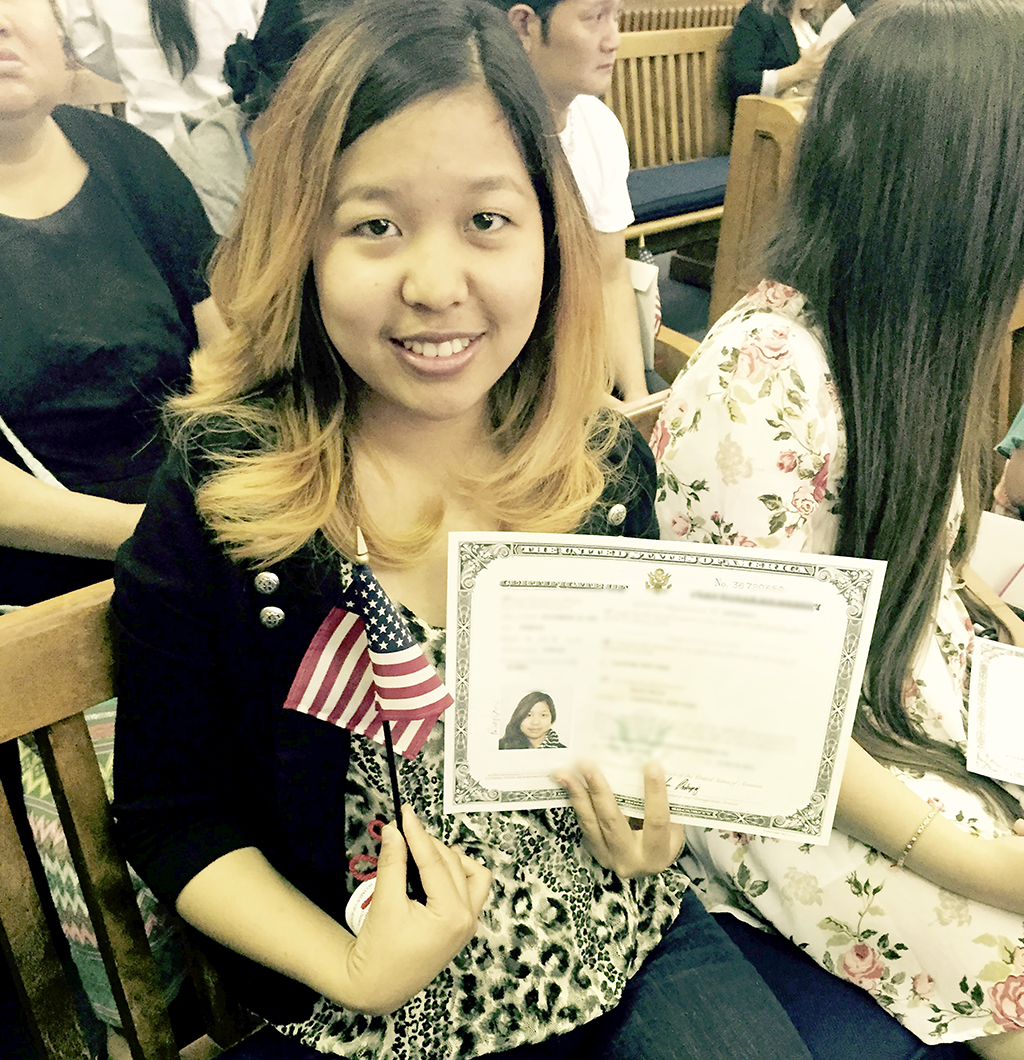
Rosy, a former URM and native of Myanmar, smiles at her naturalization ceremony.
Angel Fikes knows that firsthand. With 15 years of experience, she’s one of Toomey’s senior caseworkers. “I actually meet the youth at the airport, so I’m their first point of contact,” she said. Fikes not only introduces them to their foster parents but often takes on a comparable role. She attends school events, sports games and even represents them at teacher conferences. “I help the youth in our program accomplish their goals,” she said, which generally include adjusting to life in the United States, building independent living skills, acquiring an education and ensuring their basic needs are met.
But caseworkers can’t do their job — or rather their vocation, as turnover is low — without families stepping in to foster. “Our foster parents are the reason we can do this and help the refugee community, and that is very rewarding,” Fikes said, adding, “The fact that these kids have just thrived is a reward in itself.”
There is a strong need for foster parents, Teeter confirmed. The program is seeking open-minded, flexible people who can preserve these children’s native cultures while simultaneously helping them acclimate to life in America. “These kids need loving parents and support,” she said.
Onondaga County resident Amy O’Riley is currently a foster parent for two girls from Guatemala, ages 16 and 18. “We have welcomed many children into our home, with the longest being about five years,” she said. “We have done some respite care, but mostly long term.”
Some may question why O’Riley or other foster families would accept the challenges of welcoming children with language barriers, cultural differences and no family nearby. O’Riley clearly explains her reasons: “The most rewarding parts are being able to help other youth who just need a better chance at life, having bonus family members, and watching my two [biological] kids interact with the others and combine cultures in my home—it is amazing!

Emma, now a citizen, votes for the first time.
“I would say give it a try and be open-minded and ready to give a home to children as if they were your own,” she said when asked what she would tell a prospective candidate. “They need as much love and support as possible coming so far from home.
Catholic Charities CEO Michael Melara, also a Toomey board member, says the URM program is a source of pride for both organizations.
“When you consider the plight of adult refugees and all that is required of them to leave their country of origin and start a new life in the United States, it is an overwhelming prospect,” he said. “Imagine being a child or a teenager, physically disconnected from their family, and journeying to the United States to live out their childhood years in a foster home. That is unimaginable and we are so thankful to the dedicated foster parents at Toomey who embrace these children and create new homes for them.”
Interested in learning more about becoming a foster parent for the URM program? Email Foster Care Manager Courtney Blom at [email protected], call 315-424-1845 or visit www.toomeyresidential.com.