Bishop Lucia tells DPC the Synod ‘is all about listening’
DPC 12-2-23
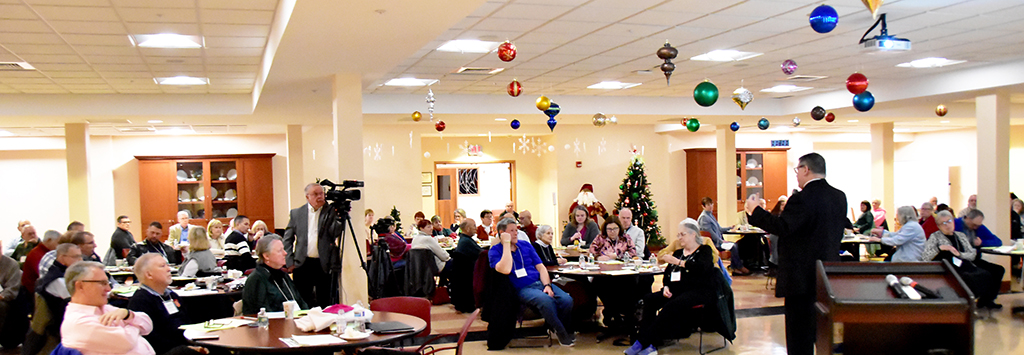
Bishop Douglas J. Lucia addresses the Diocesan Pastoral Council on Dec. 2 at Holy Cross Church in DeWitt. (Sun photos | Tom Maguire)
By Tom Maguire
Associate editor
In the Catholic Church, cultural adaptations, such as the garb a priest wears or the length of a Mass in a foreign country, are permissible, but “what we can’t adapt is doctrine,” Bishop Douglas J. Lucia told the Diocesan Pastoral Council on Dec. 2 at Holy Cross Church in DeWitt.
Years ago during the African Synod in Rome, the bishop said that being the good Westerner that he is, he was startled to see women in native dress swaying and the drums playing in the opening procession of Mass. And in Japan, he said, instead of sitting in pews, people will kneel on the floor and some gatherings have a low altar so that the priest can adopt the same posture as the people.
Bishop Lucia also noted that Western culture is very patriarchal, but in Africa many tribal systems are matriarchal. And he said that in Africa, the catechist is one of the chief persons in parish life, even running parishes and performing baptisms, officiating at burials and witnessing marriages. “The difference is,” he said, “in Africa, they have very few permanent deacons.”
Many cultures came together for the October 2023 16th Ordinary General Assembly of the Synod of Bishops First Session in Vatican City. “The Synod is all about listening to one another,” Bishop Lucia said. “Listening to one another. And that’s what they really tried to do in Rome.” He said that in calling the Synod, Pope Francis “is really looking for a conversion of the Church. And the conversion doesn’t mean a change of doctrine. The conversion is really the Church becoming even more Church, becoming more of what Jesus wants us to be.”
The Synod, the bishop said, is about “Where do we go from here? How do we live out our faith better as Church? … And part of that is seriously getting to know one another, and getting to see the other person who might have a different opinion, not as the enemy, but how do we work together to really work at being Church.”
The trap
Impediments to working together are listed in a U.S. Conference of Catholic Bishops video recorded by Catholic News Service. In the video Dominican Father Timothy Radcliffe, the Synod’s spiritual advisor, says: “What impedes communion is that we get trapped in small desires, little satisfactions, such as beating our opponents, having status, grand titles. According to … tradition, when Thomas Aquinas is asked by his sister, Theodora, how to become a saint, he replied …, ‘Want it.’ Constantly Jesus asks people who come to him, What do you want? What can I do for you? The Lord wants to give us the fullness of love. Do we want it?”
The Synod featured roundtables with 10 people at each table — cardinals, bishops, priests, women, men, religious — and they called one another by their first names. Bishop Lucia noted that Pope Francis, instead of being called “Your Holiness,” prefers to be called “Francis.” And one attendee of the Synod, commenting in a webinar viewed by the DPC, figured that about half of the roundtables were facilitated by a woman.
Women’s role in the Church is a very important topic, Bishop Lucia said, and women’s participation is also discussed in the Synod’s Synthesis Report:
“We have had a very positive experience of the reciprocity between women and men during this Assembly. Together we echo the call made in the previous phases of the synodal process, that the Church adopt a more decisive commitment to understand and accompany women from a pastoral and sacramental point of view. Women desire to share their spiritual experience of journeying towards holiness in the various stages of life. … Women cry out for justice in societies still marked by sexual violence, economic inequality and the tendency to treat them as objects. Women are scarred by trafficking, forced migration and war. Pastoral accompaniment and vigorous advocacy for women should go hand in hand. …
“Women make up most of those in our pews and are often the first missionaries of the faith in the family. Consecrated women, both in contemplative and apostolic life, are a fundamental and distinctive gift, sign and witness in our midst. The long history of women missionaries, saints, theologians and mystics is also a powerful source of nourishment and inspiration for women and men today.”
Under the heading of “Proposals,” the Synthesis Report says, “Deeper study will shed light on the question of the access of women to the diaconate.”
‘Hidden gems’
Addressing the concerns of women is cited as a highlight of the Synod by Jesuit Father Thomas Reese in his commentary “15 hidden gems in the synod on synodality report” in the National Catholic Register online.
Reviewing Father Reese’s “gems” for the DPC was Sister Katie Eiffe, diocesan Director of Synodal Planning. Father Reese notes that the Synthesis Report says the Synod put a new stress on lay involvement; did not forget the poor; recommended reforming priestly formation; called for a regular review of how bishops, priests and deacons carry out their ministry; raised the possibility of offering Communion to non-Catholics, or what it called “Eucharistic hospitality”; took aim at what it means to be a deacon in the Church; stated that reform of the Roman Curia must continue; and acknowledged disagreements and uncertainties.
Regarding disagreements, Sister Katie noted that that the Diocese of Syracuse had conducted 42 listening sessions in preparation for the Synod. “You heard directly opposing opinions expressed at the listening sessions, which was fine,” she said, because she had encouraged people to speak “freely, boldly and courageously. And boy, did we.” Sister Katie asked the DPC if there are other issues the members would like to include in discussions over the next year leading up to the Second Session of the Synod.
Regarding the theological questions raised at the Synod, Bishop Lucia said the U.S. bishops will be meeting to discuss them at the end of February.
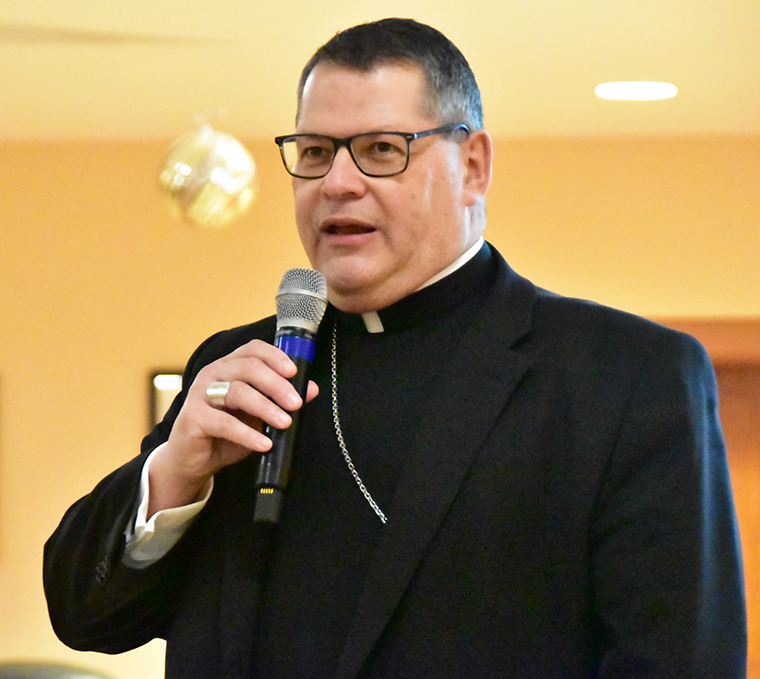
Bishop Douglas J. Lucia addresses the Diocesan Pastoral Council on Dec. 2 at Holy Cross Church in DeWitt. (Sun photos | Tom Maguire)
Also at the DPC meeting:
• Bishop Lucia said the meetings of the U.S. Conference of Catholic Bishops are transitioning to a more synodal style — roundtables and business conducted face to face at the fall meeting of the conference. The idea, he said, is to ask, “What can we do together?”
• The bishop said a new evaluation process for priests will be introduced next year. In general, priests serve two terms of six years at a parish. But they will now be evaluated every three years. He said it will help the priests consider what they can do better and what they need to know.
• Bishop Lucia said he is looking at the requirements for deacon formation. He noted that deacons are supposed to be pastoral leaders in the Church.
• The bishop said he has changed a lot in 35 years of priesthood. “I was very rigid,” he said. “‘No: Church says this, this is the way it is.’” But as he began to deal with people, he said, he realized that “you deal with a person where they’re at, and that’s what Jesus did.” And vestments do not define a priest, he said; “it really has to be, who we are among God’s people.”
• Sister Katie also noted that the New York State Eucharistic Congress was held in October, and a National Eucharistic Congress will be held in July in Indianapolis (eucharisticcongress.org).
• Past DPC Chairperson David Roman said current DPC officers are all eligible for reelection. And he invited any potential Steering Committee members to contact him. Elections are in May.