Catholic Charities director Mike Melara speaks to DPC audience on mission, paused refugee program
IMG_6353
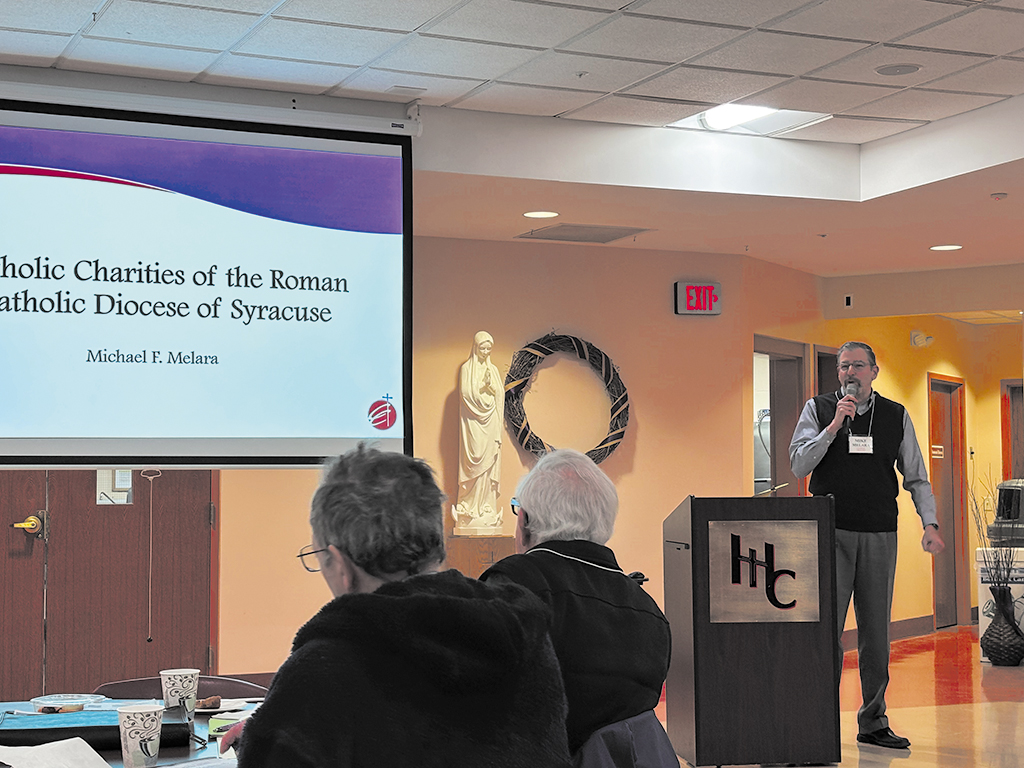
Catholic Charities of the Roman Catholic Diocese of Syracuse Director Mike Melara presents mission, programs, employees and more at last month’s DPC meeting held at Holy Cross Parish in DeWitt.
Mike Melara gave a compelling presentation about Catholic Charities at last month’s Diocesan Pastoral Council (DPC) meeting, moving at least one person to tears. The diocesan director of the nonprofit recalled stories and lessons of humility and gratitude, from volunteering at a homeless shelter to greeting refugees at the airport.
“Raphael gets off the plane in a wheelchair,” Melara said, speaking about a refugee from the Central African Republic. “He’s got six bullets lodged in his spine from being in conflicts [in his native country]. [His] two daughters; they were absolutely exhausted. They’ve been traveling for four days straight to get to Syracuse.”
Melara and his team warmly welcomed the family to their new home in the United States — their first apartment in Syracuse — and made sure they were fed an appropriate ethnic meal. The following days would begin the process of resettlement.
Melara devoted time to explain why Catholic Charities exists, and said it’s straight from Scripture — to serve those who are poor. “And when we think about being poor, poor in every possible way, you can be poor in resources, poor in opportunities, poor in spirit,” he said.
This guiding principle equates to Catholic Charities serving about 100,000 people per year across the diocese, ranging in age from infants to senior citizens. “We work with those members of our community who are most vulnerable and in greatest need,” Melara said, “regardless of their religious beliefs or background.
“We take a human development approach when we work with people,” he added. “We want to work with the whole person, the whole family, the whole neighborhood, the whole community. We do not pay attention to working with people around their diagnoses. What we pay attention to is their first name. We want to come to know them, understand their story, see their inherent strengths as a human being, and be part of their journey.”
Welcoming the stranger: Understanding the path to becoming a refugee
Three months after Melara greeted Raphael and his daughters at the airport, he said he saw the family at the Catholic Charities refugee program site in Syracuse. It was around Christmastime, and Melara noticed Raphael wasn’t wearing socks. “We don’t have a lot of money,” Melara said about the organization, “but people donate socks to us like crazy.” He brought him a pair of wool socks, but Raphael struggled with putting them on. “I find myself on my knees taking his shoes off to put on this pair of socks. First thing I see — his feet are immaculate. They’re like shined leather. They’re beautiful. And I have this thought … could Raphael’s mother ever imagine when he was a baby — and I think all parents do this, you kiss your baby’s feet — that he would end up in a place called Syracuse, New York, where this guy, this strange man, is putting socks on his feet? Right in that moment, I was t ransformed.”
Catholic Charities has been resettling refugees for more than 50 years, starting at the end of the Vietnam War. In January, federal funding for its Refugee Resettlement Program was paused, resulting in the cancellation of 90 refugee households on the threshold of starting a new life in the US. Some were reunification cases, Melara said, with one that included a child. The child was living in a refugee camp, undergoing chemotherapy, and expecting to reunite with her mother in Syracuse. “All of those travel plans were canceled. They will not come to the United States,” he said.
The funding cut affected the organization’s internal stability, too, leading to the layoff of 11 employees and the furlough of 40 others.
Melara emphasized the need for people to understand the difference between refugees, undocumented, migrants and immigrants and their unique paths to the United States. “Those three terms in the media, in our social-political context, get used interchangeably, and they are vastly different,” he said. “I want to make sure our Catholic community understands the difference, particularly when it comes to refugees, because in the case of a refugee, once they make it to a refugee camp, they start the process of actually becoming designated as a refugee. It’s a legal distinction.”
Melara went on to say that these people, who are persecuted in their native country for either their religious or political beliefs — typically by their government — are rigorously vetted by the State Department, Homeland Security and the UN. “I will tell you that refugees are more vetted than anybody in this room before they are given the legal status of a refugee.” And once given that legal status, they then have permanent legal residence. “They are allowed to be here, just like everybody in this room. That’s the path for a refugee.”
Undocumented migrants enter the US without a government inspection, and immigrants have an altogether different legal path than refugees.
When Raphael and his two daughters arrived in Syracuse, they had to completely rebuild their lives. Now, Malera said Raphael is thriving: “He’s out of a wheelchair. He’s a medical translator. His daughters are in high school and will likely graduate top of their class.
“That’s a refugee story. That’s baked into the 1,000 refugees that we serve every year at Catholic Charities.”
Other DPC news
Following Melara, the listeners of each vicariate broke into groups to discuss what their parishes are doing for the poor, the disadvantaged and “the stranger.”
• DPC Vice Chairperson Chris Gorman spoke about revisions in the Constitution, including term lengths and exceptions. Additionally, officer elections are coming up, and new officers will begin their three-year term in the fall.
• Bishop Douglas J. Lucia and Vicar for Clergy Father John Manno discussed the implementation of the Disciple Maker Index (DMI) to assess parish life and leadership skills. Parishioners are encouraged to take the survey, which is available through Easter.
• The meeting concluded with a Q&A session addressing various parish concerns and updates
The DPC will meet next on Saturday, May 31.
Community needs
Child poverty rate in Syracuse: 48.3%
Overall poverty rate in Syracuse: 31.6%
Homelessness increased by 27% from 2023
Family homelessness has increased by 192% since 2019
CCOC is currently serving 124 adults and 222 children who are homeless and another 600+ homeless men a year
Agency vitals
Total budget: $72.4 million
Total number of staff: 1,188 over seven counties
Total number of people served: 100,000
Funding breakdown:
Federal: 23%
State/Local: 30%
Hope Appeal: 0.8%
The differences between Immigrants, refugees and migrants
Immigrants
Immigrants choose to come to the United States for some reason, such as having a relative here, for a better life, or for more opportunities to go to school, and then stay in the United States. An immigrant makes a conscious decision to leave his or her home and move to a foreign country with the intention of settling there. Immigrants often go through a lengthy vetting process to immigrate to a new country. Many become lawful permanent residents and eventually citizens. Most importantly, immigrants are free to return to their homeland whenever they choose.
Refugees
A refugee is someone who has been forced to flee his or her homeland because of war, violence, or persecution, or based on race, religion, nationality, membership in a particular social group, or political opinion. A refugee is unable to return home and must apply to come to the United States from a country outside of their homeland.
The United Nations High Commission on Refugees (UNHCR) confers refugee status to people or groups who meet the above definition. Once refugee status is confirmed, individuals can apply for resettlement in the United States or another country. The application process takes several years to complete, and refugees being considered for the United States must undergo a very rigorous vetting process conducted by United States Department of State and Homeland Security. If approved, refugees arrive in the United States legally and are granted legal residency by the United States government. Their resettlement is facilitated by a resettlement agency, such as the United States Conference of Catholic Bishops, which works with local Catholic Charities offices. Refugees have the opportunity to apply for a Permanent Resident Card one year after arrival and to become United States Citizens five years after arrival.
Migrants
A migrant is someone who is moving from place to place (within his or her country or across borders), usually for economic reasons such as seasonal work or better employment opportunities.
Individuals crossing into the United States at the southern border are typically termed migrants, but this is not always correct. Many of those crossing the United States border from Central American countries, such as Guatemala, El Salvador, and Honduras, are in fact asylum seekers, not migrants. They are often fleeing gang violence and drug cartels, and they have a well-founded fear of persecution if they were to return home. They intend to apply for asylum once they have been permitted to enter.
Asylum seekers are also crossing the borders from Ukraine, Syria, Afghanistan, and other countries in crisis. These individuals will file for asylum in the United States as well.
It is legal under United States law to ask for asylum at a border crossing or port of entry. However, in recent years, the United States has restricted asylum seekers at the southern border and currently the United States-Mexico border is closed to asylum seekers.
Undocumented
Undocumented typically means that someone crossed the border, either from Canada or the southern border, and they were not actually eligible (or permitted) to come into the United States or were not inspected by an immigration official at the border. They may have crossed the border on foot, or come in a car that was not inspected by an immigration official. Many of these individuals will apply for asylum.