
CC’s 7th director reflects on serving soldiers and neediest
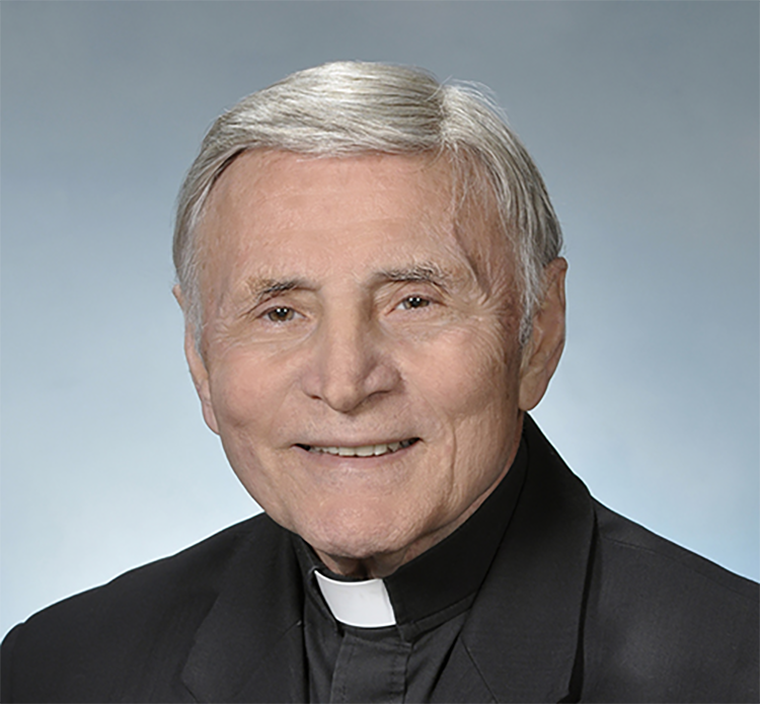
Msgr_Bill-color
Editor’s note: This article concludes the Sun’s series honoring the 100th year of Catholic Charities in the Diocese of Syracuse.
By Tom Maguire
Associate editor
His principles were in place but his marching was off.
In his early service as a military chaplain, Msgr. Ronald C. Bill figured he knew how to march. “‘Not good enough,’” a Marine major said. The ensuing 3 a.m. regimen lasted maybe a couple of months.
“So by the time I went to bed I had to get up again,” the monsignor recalled. Now 92 and a retired brigadier general, he salutes that Marine: “He made me a tougher guy.”
Tough but approachable and dedicated. He served in the Army for 23 years, much of it in the National Guard. He was named an Honorary Prelate to Pope Paul VI in 1973, and he served as the seventh diocesan director of Catholic Charities from October 1979 until Father Robert B. Stephenson succeeded him in February 1988.
“He’s remarkable,” Jack Balinsky, a former Syracuse Area Director of Catholic Charities, said of Msgr. Bill. Balinsky, of Victor, N.Y., noted that Msgr. Bill had been the Executive Director of the Binghamton office of CC for a long time before becoming diocesan director.
Housing for seniors
“And he was really Mr. Catholic Charities of Binghamton and did very well with that program,” Balinsky said. He said Msgr. Bill had helped create the SEPP (Serving the Elderly through Project Planning) housing program for senior citizens.
And because he was coming from one of the outlying agencies, Balinsky said, the monsignor was very much attuned to keeping going the decentralized community- and agency-based program that Msgr. Charles J. Fahey (see “In memoriam” on page 5), the sixth diocesan director of CC, had created.
“I jumped right in and kept getting the grants” to build housing for the elderly, Msgr. Bill said. Every year his office would put in at least two proposals and it usually got at least one grant. “It was a lot of fun, a lot of work, but it was worth it,” he said.
“Being charitable and kind and understanding — you had to do those things as a chaplain in the Army,” he said. “You had to do that in Catholic Charities. All the programs that we did were for the neediest people, for the people who really needed help at that time.” During the Cuban Missile Crisis, CC brought in a plane with children from Cuba. The parents “sent them here to save them from communism, I guess,” he said.
Under Msgr. Bill’s leadership, CC also addressed mental-health services in the diocese. A July 1980 article in the Catholic Sun says:
“Msgr. Bill has been coordinating policy for ‘hands-on’ issues like deinstitutionalization of mental patients, obtaining greater public assistance payments for the needy, consolidating each region’s jail ministry program in the diocese into a central unit, and strengthening the rural ministry apostolate.”
The Army life
Also, he liked being a chaplain in the Army, where he learned a lot and it felt “like being in college all the time.” He served in the Binghamton area, then the Rochester area, then Buffalo. He also served in big forts in the U.S. One day the regular Army had been called up for battle, so he celebrated four or five Masses outside in tents at Fort Bragg in North Carolina. For years, he had to inform families of the death of a loved one from the Vietnam War. “That was tough, knocking on the door,” he said.
He retired as a priest July 1, 2001. He said Bishop James M. Moynihan told him, “‘I’ll let you retire if you fill in when I need you.’” So from 2001 to 2020, he filled in at seven parishes, “which was a lot different from all my other experiences,” he said. “But it was wonderful, you know, meeting a lot of people, being able to, again, help where that was needed.”
He lives at the Immaculate Conception Church rectory in Fayetteville. Up until about two years ago, as a carryover from his Army days, he ran six miles every day, and sometimes farther than that. “Didn’t get exhausted,” he said.
And today he feels just like he did 30, 40 years ago. “Work every day,” he said.