Father Hage to DPC: You too can make vocations happen
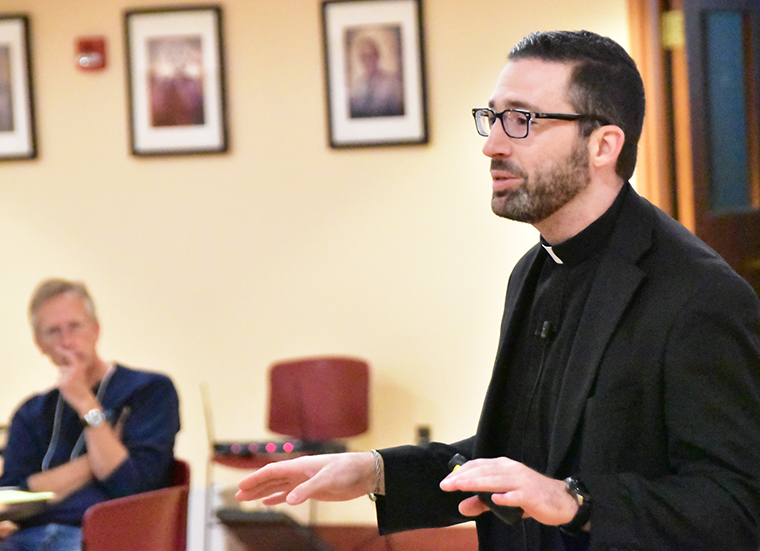
Father Hage at DPC
Father Jason Hage, director of the diocesan Office of Vocation Promotion, talks to the Diocesan Pastoral Council on Sept. 23 at Holy Cross Church in DeWitt. Father Hage urges parishes to have at least one designated person to accompany young people in their discernment of a vocation. (Sun photo | Tom Maguire)
By Tom Maguire
Associate editor
Vocation promotion can add to the power of a Catholic education, Father Jason Hage believes.
Father Hage cited statistics showing that 43% of the priests ordained this year attended a Catholic elementary school, 34% a Catholic high school and 35% a Catholic college. And before entering the seminary, 52% of the ordinands participated in a parish youth group.
“So investing in our Catholic schools is probably needed now more than ever,” Father Hage, director of the diocesan Office of Vocation Promotion, told the Diocesan Pastoral Council on Sept. 23 at Holy Cross Church in DeWitt.
His statistics come from the Center for Applied Research in the Apostolate at Georgetown University, which reports to the Secretariat of Clergy, Consecrated Life & Vocations of the U.S. Conference of Catholic Bishops.
The Ordination Class of 2023 had an average age of 16 when they first considered a vocation to the priesthood; 73% of them participated in Eucharistic Adoration; 72% of them had been altar servers; 51% had been lectors; 63% were encouraged to consider the priesthood by a parish priest and 44% by a parishioner; and 49% had participated in a come-and-see vocation weekend.
To Father Hage, the statistics show the need for school personnel to promote vocations by intentionally accompanying fifth graders, sixth graders and high school juniors on their journey of faith. He said every Diocese of Syracuse Catholic school teacher and administrator has received multiple trainings on how to identify a candidate for the priestly or religious life and how to accommodate that person through the stages of discernment.
Build up that altar server ministry
And Father Hage wonders: What are parishes doing to build up the altar-service ministry? Father Hage himself never was as an altar server until he was in the seminary. But he was a lector in his home parish in his senior year of high school. “It took them seven months to get me on the schedule,” he said. “Seven months. I was like, did they just forget about me?” But when he finally became a lector, he “fell in love with the Word of God,” he said, and he started to “visualize myself preaching from the pulpit.”
So Father Hage urged the DPC to look at the importance of liturgical ministries in men’s and women’s life of discernment. How can a parish foster vocations? “Get young people in. And when they present themselves act on it right away.”
The laity, he said, have a “co-responsibility over the future of our Church,” especially in calling for future vocations. He said the DPC should ask: Are we supporting the youth and young- adult ministry in our parish? Are we talking to parents about the beauty of a vocation? What are we doing in parishes and vicariates to help? It could be a monthly meeting of young adults or a holy hour once a month.
Father Hage thinks vocations can arise if young people go to Mass, have a daily prayer life and live a life of virtue. All those foundations have to be set before they can start discerning with him in his office.
“Thank you so much for all you do,” Bishop Douglas J. Lucia told Father Hage, who is also the pastor of several parishes.
The DPC also received an update on Chapter 11 bankruptcy stemming from sexual abuse cases. It was announced on July 27, 2023, that the diocese and the Official Committee of Unsecured Creditors in the Chapter 11 reorganization have reached an agreement on the contribution to be made by the diocese, its parishes and other Catholic entities to the Victims’ Trust Fund. The contribution totals $100 million.
‘Absolutely no leverage’
Typically in a negotiation there is give and take, and each party at the table has some strength, said diocesan CFO Stephen Breen. But it became very clear very early on in Chapter 11, he said, that the diocese had “absolutely no leverage.” But even though $100M is a staggering number, he said, “we can do that, then we can move on.”
Under the agreement to establish the Victims’ Trust, the Catholic Family contribution consists of the Diocese of Syracuse, which will contribute $50M. Collectively, parishes will contribute $45M. The remaining $5M will come from other diocesan entities. As for how much insurance carriers will pay toward settlement of claims, insurance companies have yet to reach an agreement with the Creditors Committee. The diocese has already paid $11M in attorneys’ fees for both the diocese and the Creditors Committee.
The diocese says the agreement on the $100M will have no impact on HOPE Appeal funds. HOPE Appeal contributions can only be used for the ministries supported by the HOPE Appeal. HOPE Appeal contributions are considered donor restricted funds. Only unrestricted funds may be used to form the Victims’ Trust.
The DPC also heard from Beth Hoey, the executive director of the Foundation of the Roman Catholic Diocese of Syracuse, who thanked attendees for their personal support of the HOPE Appeal. Over $988,000, 24% of the overall goal, has been raised through the generosity of over 3,600 parishioners throughout the diocese. “We will continue to support every parish in their individual work for the HOPE Appeal,” she said.
A few of the ministries supported by the HOPE Appeal are Elderly Services, for those 62 and up, including transportation to medical appointments; the Deaf Ministry, which offers signing at Masses; Formation for Ministry, which offers people an opportunity to go deeper in their faith; and the Newman Centers at colleges.
Also addressing the DPC was Sister Katie Eiffe, CSJ, director of synodal planning for the diocese, who reported that the Eucharistic Revival is in full swing. She noted that on Oct. 20-22, the dioceses of New York State are coming together at the Shrine of Our Lady of Martyrs in Auriesville, N.Y., for a statewide Eucharistic Congress.
‘A sign of hope’
Sister Katie also spoke about the Synod, which she called “a sign of hope for our Church.” The process started in the fall of 2021, and 42 listening sessions were held through the fall and winter in the middle of the pandemic. Next, in 2022, came synodal conversation groups in the vicariates. And Sister Katie’s office participated in preparing summary reports for the Diocese of Syracuse, for New York State and for the national report. The next stage was the continental stage of the Synod, in which a group from the diocese participated in virtual assemblies involving the United States and Canada.
Sister Katie noted that on Oct. 4, the 16th General Assembly of the World Synod of Bishops was to begin in Rome. She supplied the DPC with sheets that discuss the working document for the 16th General Assembly. Sample statements: “A synodal Church is a Church willing and able to handle tensions without being crushed by them”; “A synodal Church is a restless Church because she is aware that she is vulnerable and incomplete.”
The sheets also pose questions such as “What can be done so that a synodal Church is also an ‘all ministerial’ missionary Church?” and “How can the ordained ministry, in its relationship with baptismal ministries, be enhanced in a missionary perspective?”