
Seeing life through a different lens
IMG_2093
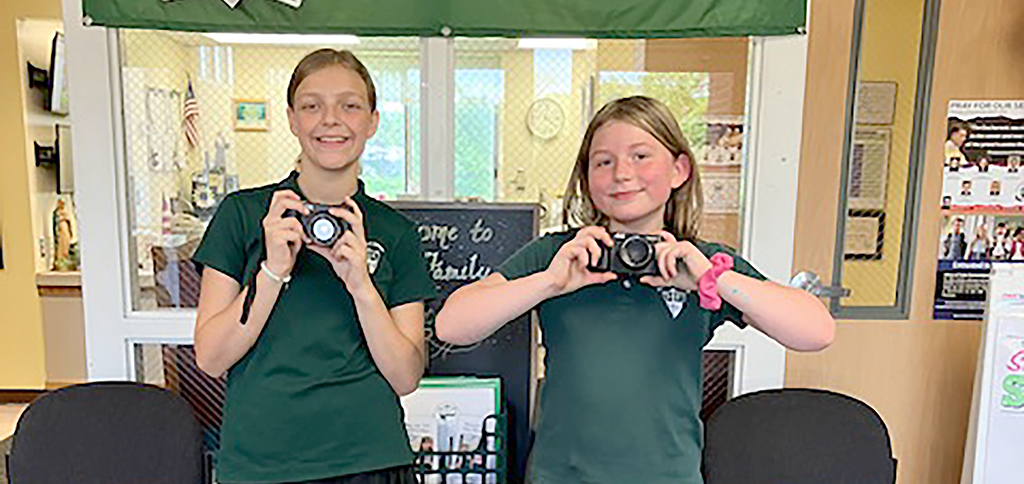
Holy Family School sixth-graders CeCe (left) and Abigail pose with their digital cameras obtained through a grant to use for a CSEL photography project.
Holy Family School sixth-graders recognize God’s presence through photos
By Tami S. Scott
Associate editor
Imagine life with no internet. For most of us, that’s pretty easy to do.
Now imagine never knowing life without it. Gen Z and later fall into this category. The internet is so vast and widespread now that it can be carried in a pocket or worn on your wrist. And social media? There’s virtually no escaping that either – unless you really try.
Principal Daryl Hall of Holy Family School in Fairmount is mindful of modern-day technology and its cons for the younger generations, like anxiety, depression and isolation to name a few. That’s why when she saw an opportunity to help combat the crises, she applied for and was awarded a $4,000 grant.
Over the past few months, sixth graders have been working on a photography project that supports Catholic Social-Emotional Learning (CSEL). This evidence-based approach helps students develop skills like healthy identities, emotional management, goal achievement and responsible decision-making. It also fosters social connections, empathy, relationship skills, and conflict resolution, all strengthened by the Catholic faith and gospel values, particularly the commandments to love God and our neighbor.
“In today’s world with so much technology, the computer, everything – kids are always doing this …” Hall said as she looked down at an imaginary mobile phone in her hands. “No one’s talking to each other anymore. No one’s able to solve problems anymore. It’s all about being on their [phones], getting instant gratification rather than being able to sit down and have fun with a friend.”
To be clear, the cameras that the students are using are not those that are built into cell phones. They are digital cameras purchased with the grant money. The kids have learned to make camera adjustments, use manual focus – and how to take good care of borrowed property.
“This project has made me feel responsible because, like, letting us have these cameras – we’re responsible for them,” said CeCe, one of 15 sixth graders working on this assignment. “If it breaks, I’m gonna obviously feel really bad because it’s our job to keep them safe.”
A different perspective
This same photography project that’s homing in on becoming trustworthy individuals also aims to focus the boys’ and girls’ attention on the world around them, to take abstract concepts like compassion and empathy and capture them on camera, and to recognize God’s presence around us.
“So, a couple of days ago, I took a picture of the sky,” said Abigail, also a sixth-grade student. “The whole entire sky was red so I took a picture of it and I thought that was really beautiful to me and I felt like that was kind of like a gift to see that.”
Hall and Abigail spoke together about her photos, with Abigail expressing how they made her feel comfortable and relaxed when looking at them. These types of discussions between teacher and student are meant to help build the framework for students to talk with their contemporaries. For example, “I took this picture because …”
“That’s part of the grant – how do you help them to get to communicate more with one another? That’s one of the goals,” Hall said. “While we see them eating [and talking at] lunch, that’s different from discussing a more serious topic. How do you get them to be talking about more serious things? Things that are important in your life and your education.”
At the time of our interview, the students had just recently met in the cafeteria to share their photos with their classmates. CeCe took about 50 photos; Abigail, 60. The next step was to narrow down their choices to just one.
“Everyone will come together to seriously look at the photos that have been taken by the students, and say, ‘Well, what do you think about this picture? What did you like about the picture? What didn’t you like?’” Hall said. “They’re going to want other people’s opinions, so this is a good opportunity for them to talk to one another.”
Hall again emphasized the need to talk comfortably about the bigger things in life and to recognize and accept the individuality of each person. “They have no problem talking to each other,” she said, laughing. “I mean, they really don’t, but on serious things; on things that are meaningful and will help them develop and grow into nice, wonderful young men and women – they’re doing that.”
Once they decide on their photo to showcase, they will print it, frame it and write a story about how it touched their heart and connected to God’s presence. The project culminates with a school exhibit this month.
“God’s world is beautiful and you should enjoy everything that he gave us,” CeCe said, adding, “There are so many pictures that you could take that mean so much to you … or to other people … and not to you. There’s just so many different meanings.”